Transfer On Death Deed For Real Estate
Description



Get your form ready online
Our built-in tools help you complete, sign, share, and store your documents in one place.
Make edits, fill in missing information, and update formatting in US Legal Forms—just like you would in MS Word.
Download a copy, print it, send it by email, or mail it via USPS—whatever works best for your next step.
Sign and collect signatures with our SignNow integration. Send to multiple recipients, set reminders, and more. Go Premium to unlock E-Sign.
If this form requires notarization, complete it online through a secure video call—no need to meet a notary in person or wait for an appointment.
We protect your documents and personal data by following strict security and privacy standards.

Make edits, fill in missing information, and update formatting in US Legal Forms—just like you would in MS Word.

Download a copy, print it, send it by email, or mail it via USPS—whatever works best for your next step.

Sign and collect signatures with our SignNow integration. Send to multiple recipients, set reminders, and more. Go Premium to unlock E-Sign.

If this form requires notarization, complete it online through a secure video call—no need to meet a notary in person or wait for an appointment.

We protect your documents and personal data by following strict security and privacy standards.
Looking for another form?




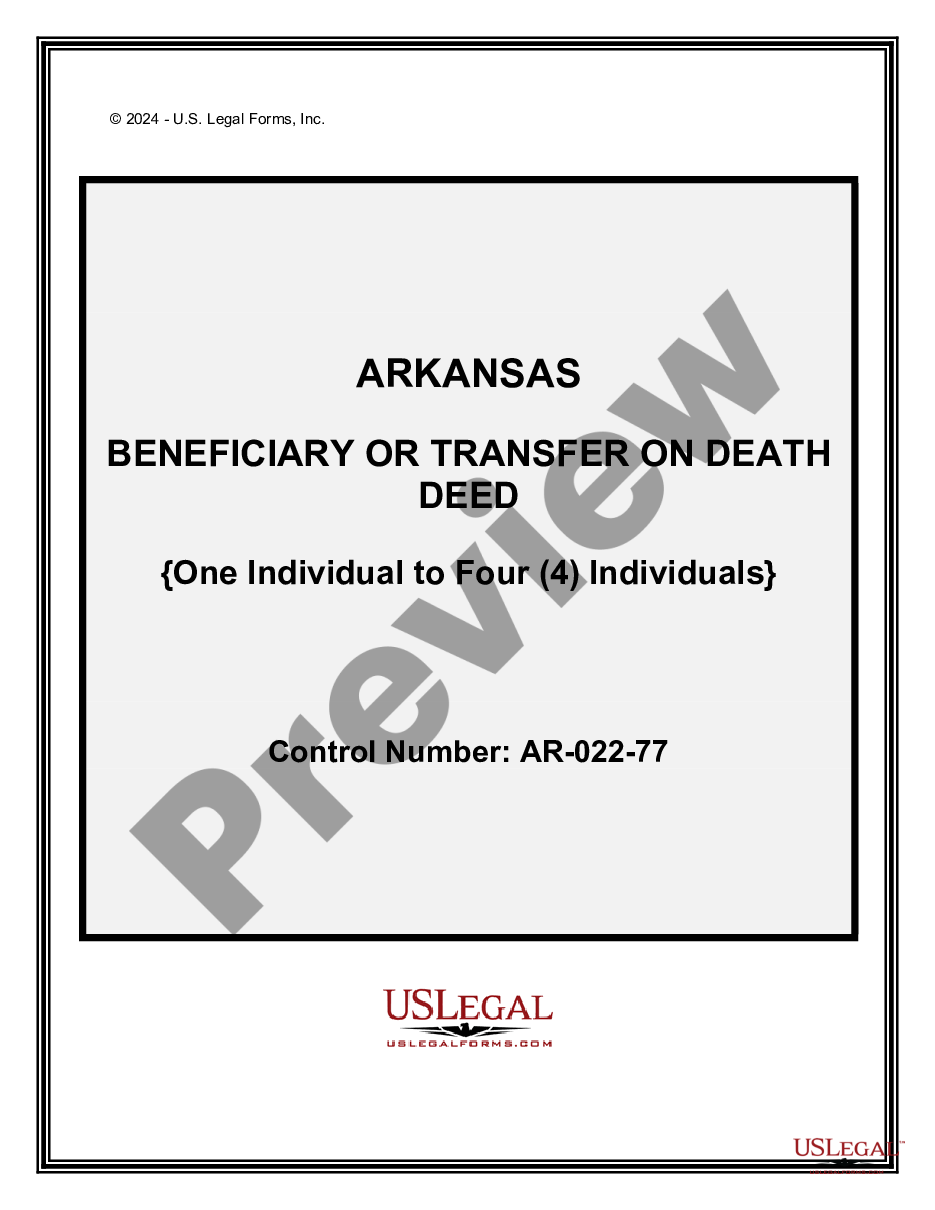
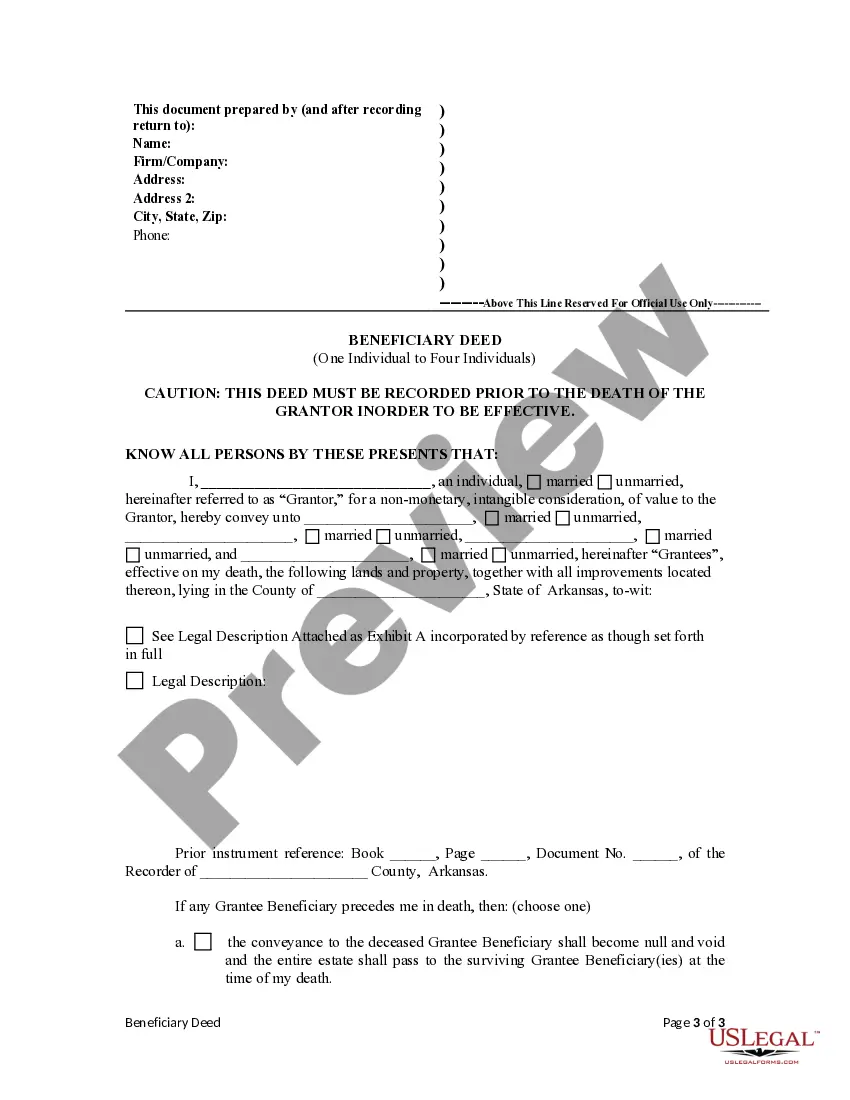
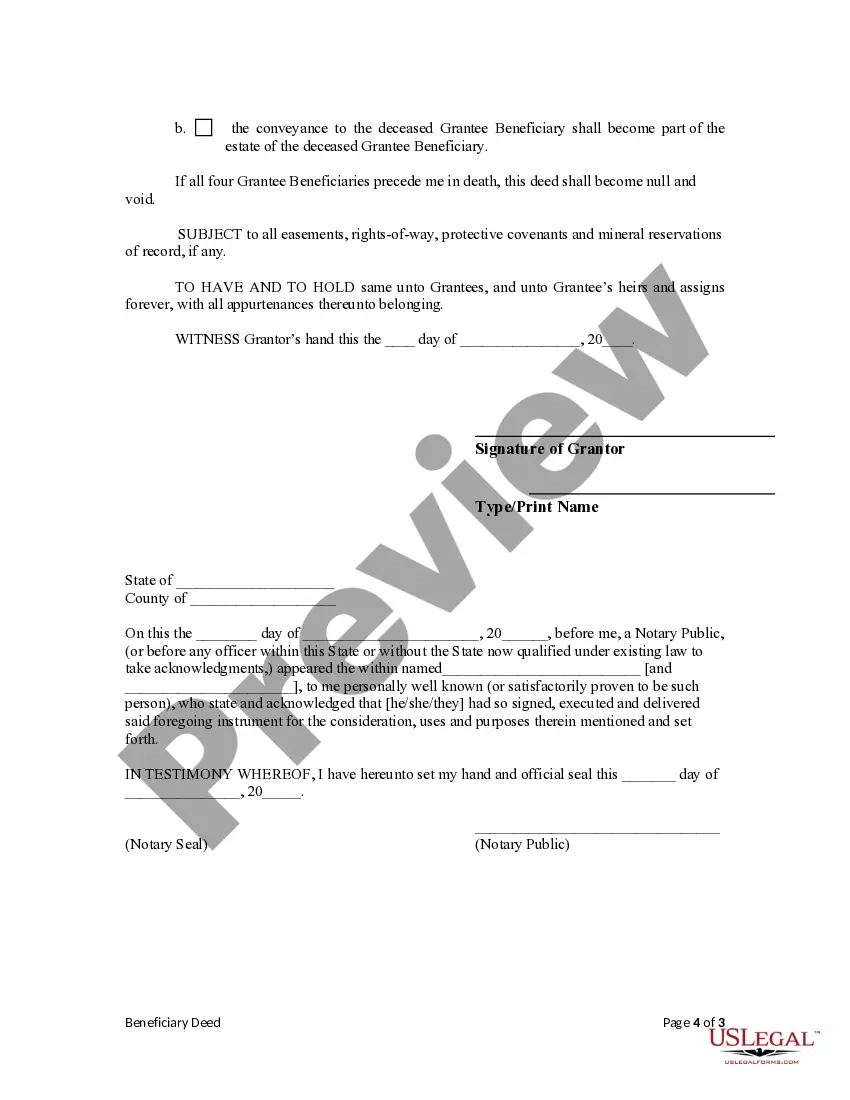
How to fill out Arkansas Transfer On Death Deed Or TOD - Beneficiary Deed For One Individual To Four Individuals?
- Log in to your US Legal Forms account if you're a returning user, ensuring that your subscription is active. If not, renew it based on your payment plan.
- For new users, start by browsing the extensive online library and using the Preview mode to find the correct transfer on death deed that meets your requirements.
- Utilize the Search feature if necessary to narrow down your options until you locate the right document.
- Once you've identified the appropriate template, click 'Buy Now' to select your desired subscription plan and create an account for access.
- Complete your purchase by entering your payment details using either a credit card or your PayPal account.
- Finally, download your completed form from your account and save it to your device for easy access in the 'My Forms' menu.
Finally, utilizing US Legal Forms simplifies the process of creating legal documents, ensuring you have a well-prepared transfer on death deed. With an extensive library and expert support, you can feel confident about your legal documentation.
Start your journey today by visiting US Legal Forms and find the right document to achieve your estate planning goals!
Form popularity
FAQ
In Texas, the rules for a transfer on death deed for real estate are straightforward. The deed must be signed by you and acknowledged by a notary public, and it must be properly recorded in the county clerk's office where the property is located. Texas law also requires that you specifically name the beneficiaries and clearly identify the property to ensure that your intentions are legally recognized.
You may not necessarily need a lawyer to create a transfer on death deed for real estate, but consulting one is often advisable. A lawyer can ensure that the deed complies with state laws and addresses your specific needs. This professional guidance helps avoid potential legal issues that could arise after your death.
While a transfer on death deed for real estate simplifies the transfer process, it has some potential drawbacks. For instance, if the property has debts or liens, those obligations may still affect the beneficiary after your death. Additionally, if you decide to sell the property while you are still alive, you need to revoke the deed properly to avoid complications.
Creating a transfer on death deed for real estate involves filling out a specific form that states your intent to transfer real property to a designated beneficiary upon your death. It's important to clearly describe the property in question, including its address and any specific legal descriptions. You must sign the deed in front of a notary public and ensure it is recorded in the county where the property is located to make it legally enforceable.
The best way to leave property upon death often depends on your specific situation. Using a transfer on death deed for real estate is an effective method that allows you to pass property directly to your beneficiaries without probate. Other options, like wills or trusts, might also be suitable depending on your estate’s complexity. Evaluating these options with a knowledgeable professional can lead to the best solution.
While you can create a transfer on death deed for real estate without a lawyer, consulting one is highly advisable. A legal expert can ensure that the deed complies with state laws and properly addresses your intentions. This can help avoid legal issues or complications down the road. Using uslegalforms can also provide you with the necessary templates and guidance if you choose to go it alone.
The disadvantages of a transfer on death deed for real estate include limited flexibility once established. For instance, if you want to sell or mortgage the property, you must legally revoke the deed first. Additionally, since the deed does not avoid claims by creditors, this means that the property could be subject to debt obligations. Understanding these aspects is essential for making informed decisions.
Yes, New Jersey allows the use of transfer on death deeds for real estate since 2012. This facilitates the automatic transfer of property to designated beneficiaries at death, avoiding the lengthy probate process. If you're in New Jersey and considering this option, it can simplify your estate planning. Utilizing a transfer on death deed for real estate can be a wise choice for efficient asset management.
Many states across the U.S. allow transfer on death deeds for real estate. Popular states such as California, Florida, and Texas have adopted this option for estate planning. However, each state has specific rules regarding how these deeds must be executed. You should check your state's regulations to ensure compliance and maximize the benefits of a transfer on death deed for real estate.
While a transfer on death deed for real estate has benefits, it also has downsides. One disadvantage is that it does not provide protection from creditors, meaning that outstanding debts could affect the asset transferred. Additionally, if you change your mind or need to sell the property, you must revoke the deed to avoid complications. Always weigh these factors carefully.