Transfer Death Deed Beneficiary With Mortgage
Description


Get your form ready online
Our built-in tools help you complete, sign, share, and store your documents in one place.
Make edits, fill in missing information, and update formatting in US Legal Forms—just like you would in MS Word.
Download a copy, print it, send it by email, or mail it via USPS—whatever works best for your next step.
Sign and collect signatures with our SignNow integration. Send to multiple recipients, set reminders, and more. Go Premium to unlock E-Sign.
If this form requires notarization, complete it online through a secure video call—no need to meet a notary in person or wait for an appointment.
We protect your documents and personal data by following strict security and privacy standards.

Make edits, fill in missing information, and update formatting in US Legal Forms—just like you would in MS Word.

Download a copy, print it, send it by email, or mail it via USPS—whatever works best for your next step.

Sign and collect signatures with our SignNow integration. Send to multiple recipients, set reminders, and more. Go Premium to unlock E-Sign.

If this form requires notarization, complete it online through a secure video call—no need to meet a notary in person or wait for an appointment.

We protect your documents and personal data by following strict security and privacy standards.
Looking for another form?







How to fill out Arkansas Transfer On Death Deed Or TOD - Beneficiary Deed For One Individual To Four Individuals?
- Log in to your US Legal Forms account if you’re a returning user. Ensure your subscription is active; if it’s expired, renew it based on your payment plan.
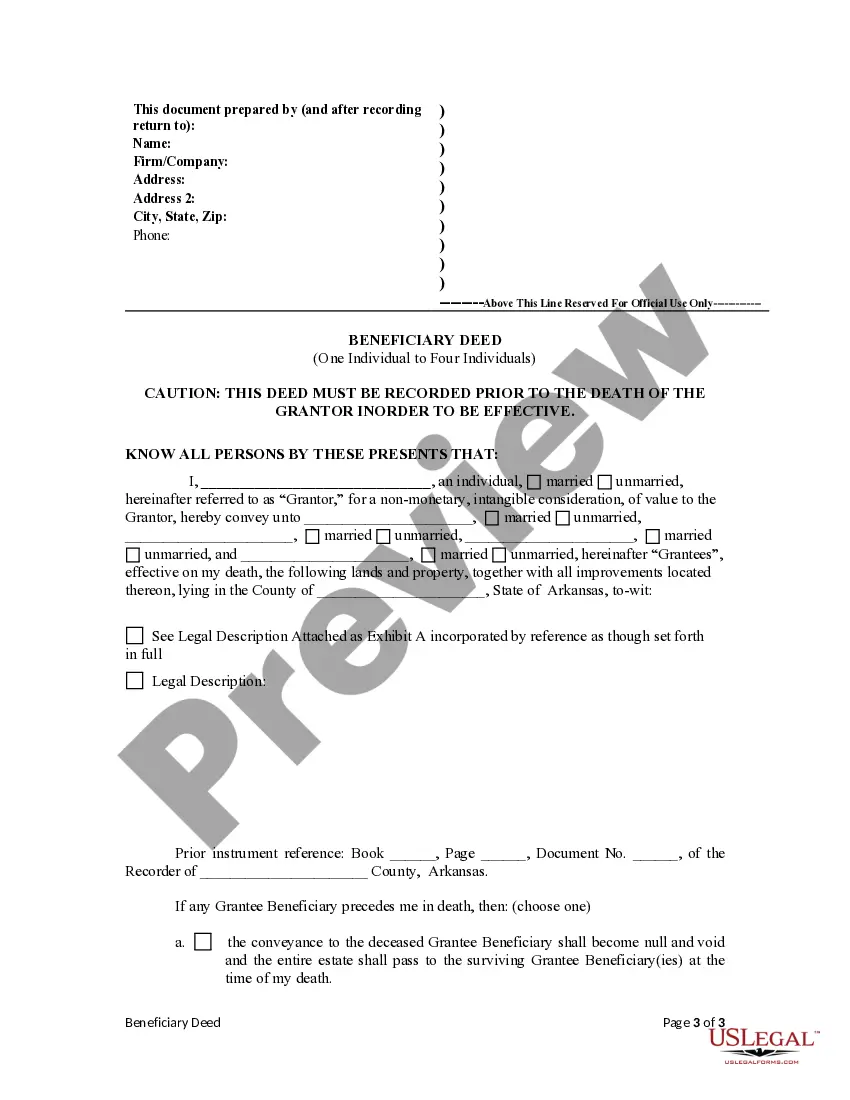
- For first-time users, start by checking the preview and form description to ensure you select the right template that complies with your local laws.
- Use the search feature to find any alternative forms you may need. If you discover inconsistencies, look for the appropriate form based on your requirements.
- Purchase the document by clicking the Buy Now button and selecting your preferred subscription plan. Remember to create an account for complete access to the resources.
- Provide necessary payment details through credit card or PayPal and confirm your subscription.
- Once your payment is processed, download the form and save it to your device. You can also access it anytime through the My Forms menu in your profile.
Following these straightforward steps ensures that your transfer is handled correctly and legally, simplifying a potentially complex process.
Don’t hesitate to explore the benefits of US Legal Forms today; get started on your legal document needs with ease!
Form popularity
FAQ
One disadvantage of a transfer on death (TOD) deed is that it may not eliminate the need for a probate process if other claims exist against the estate. Another concern is that creditors may still pursue the property to settle debts, which could complicate the transfer. While it offers a streamlined transfer upon death, understanding how it interacts with existing mortgages is important for effective planning. You may want to consult uslegalforms as a resource to navigate these complexities.
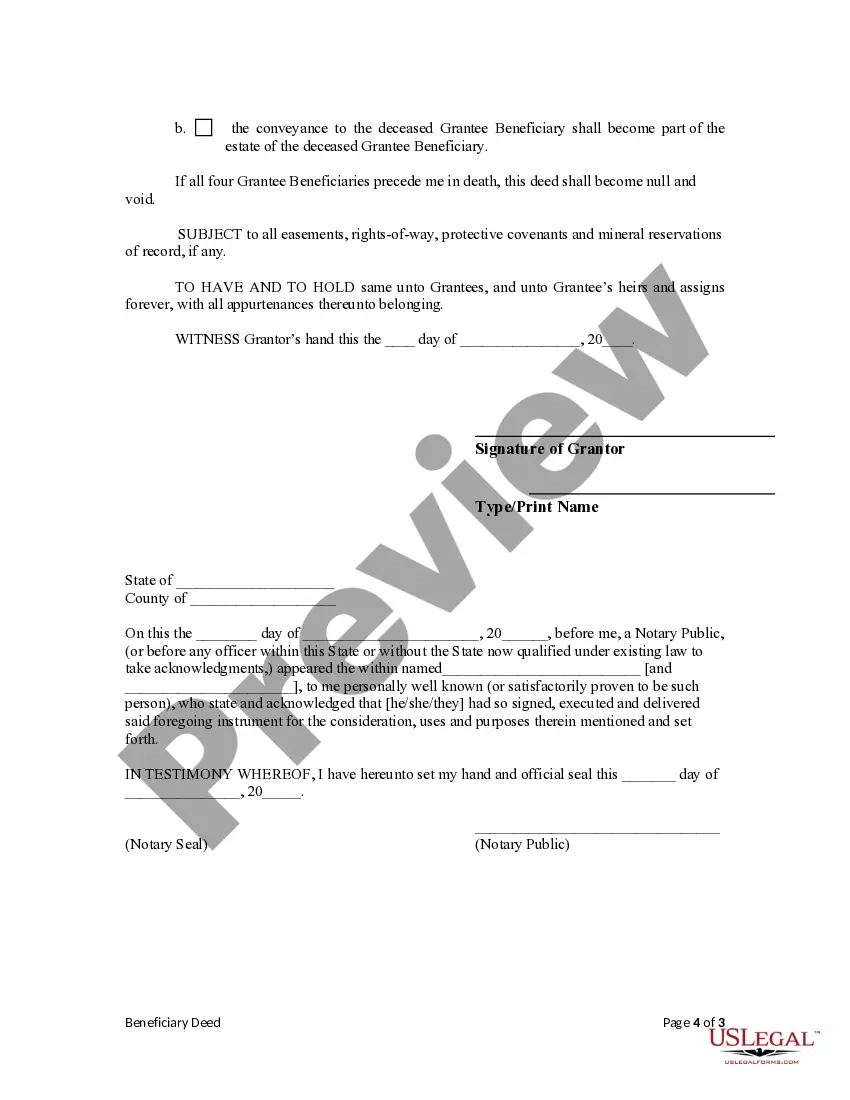
To write a beneficiary deed, start by including the legal description of the property along with the names and details of the beneficiaries. Ensure that you specify that the transfer occurs upon your death. After drafting, you must sign the deed before a notary and record it with your county’s office. This process allows you to effectively transfer the death deed beneficiary with mortgage considerations in mind.
When a property has a transfer on death deed (TOD), the mortgage remains attached to the property. The new owner, who is the beneficiary, will need to manage the mortgage payments. It is crucial to communicate with the lender to ensure they understand the new ownership status and receive the necessary payments.
When one person dies, the mortgage does not automatically disappear. Instead, the surviving party may need to continue making payments. If the deceased had a transfer death deed beneficiary with mortgage in place, the property can be transferred more smoothly, but the mortgage obligations must still be addressed.
Yes, a mortgage can be transferred to another person after death. Typically, the mortgage will remain in the name of the deceased unless the lender allows the transfer to the beneficiary. Using a transfer death deed beneficiary with mortgage can facilitate this process, ensuring that the beneficiary can take over the mortgage obligations.
While a transfer on death deed provides benefits, it also has disadvantages. For instance, it does not remove the obligation of the deceased's mortgage. Moreover, if the beneficiary does not assume the mortgage, they may face difficulties in handling the property, which could lead to foreclosure if payments are missed.
To transfer ownership of a house with a mortgage after death, you may use a transfer death deed. This legal document allows the property to pass directly to a beneficiary without going through probate. It is essential to notify the mortgage company about this transfer to understand their requirements regarding payments and the mortgage terms.
Typically, you cannot directly put a beneficiary on a mortgage. Mortgages are legal agreements between the lender and borrower. However, you can use a transfer death deed beneficiary with mortgage to ensure that the property automatically transfers to your chosen beneficiary upon your death, which can simplify the process.
A Transfer on Death deed can be more efficient than a will because it avoids the probate process, but it has its limitations. Unlike a will, a TOD deed specifically applies to real estate and does not address other assets. If you have a mortgage, ensure that your beneficiary is prepared to handle such obligations because the TOD deed does not erase debts. Consider using US Legal Forms to compare options and find the best solution for your estate planning needs.
One downside of a Transfer on Death deed is that it does not provide protection against creditors. If you have a mortgage, your beneficiary will need to continue payments to avoid foreclosure. Additionally, the property cannot be transferred to multiple beneficiaries unless carefully outlined in the deed, which can create complications. Platforms like US Legal Forms can help clarify these points to ensure a smooth transition.