Sample Letter for Motion to Join Additional Defendants
What is this form?
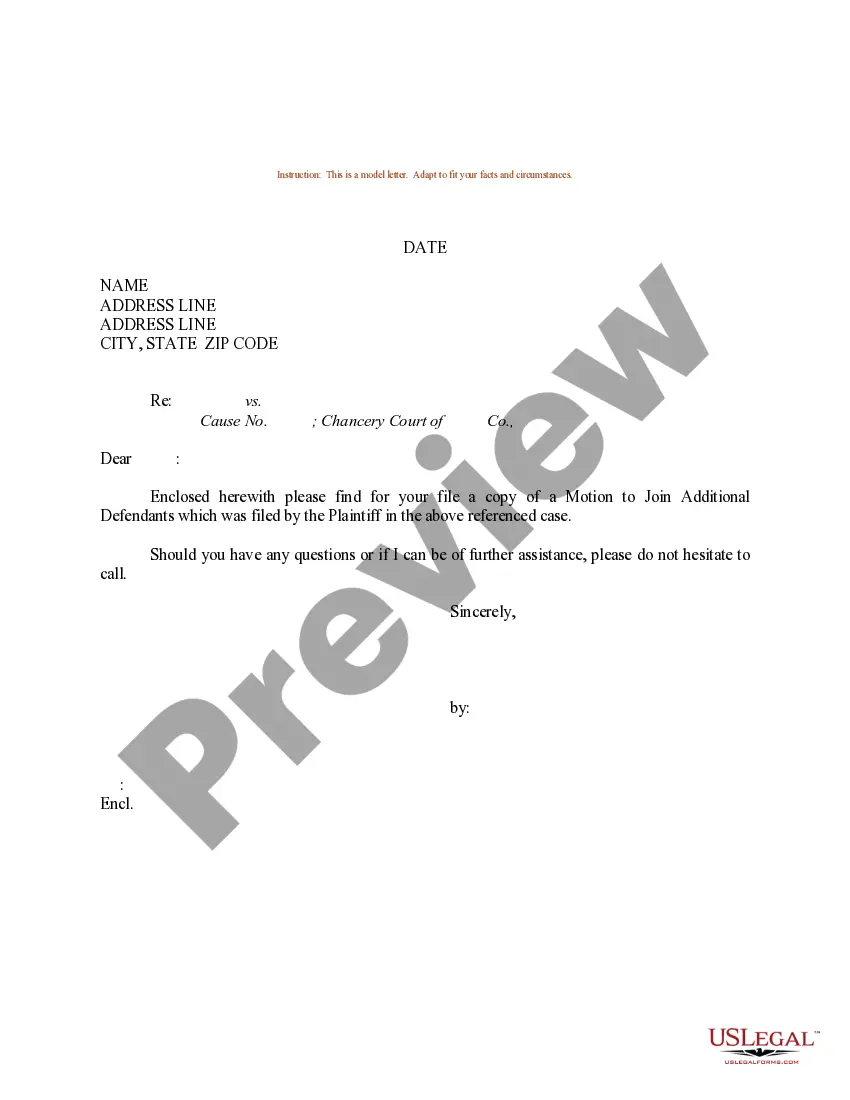
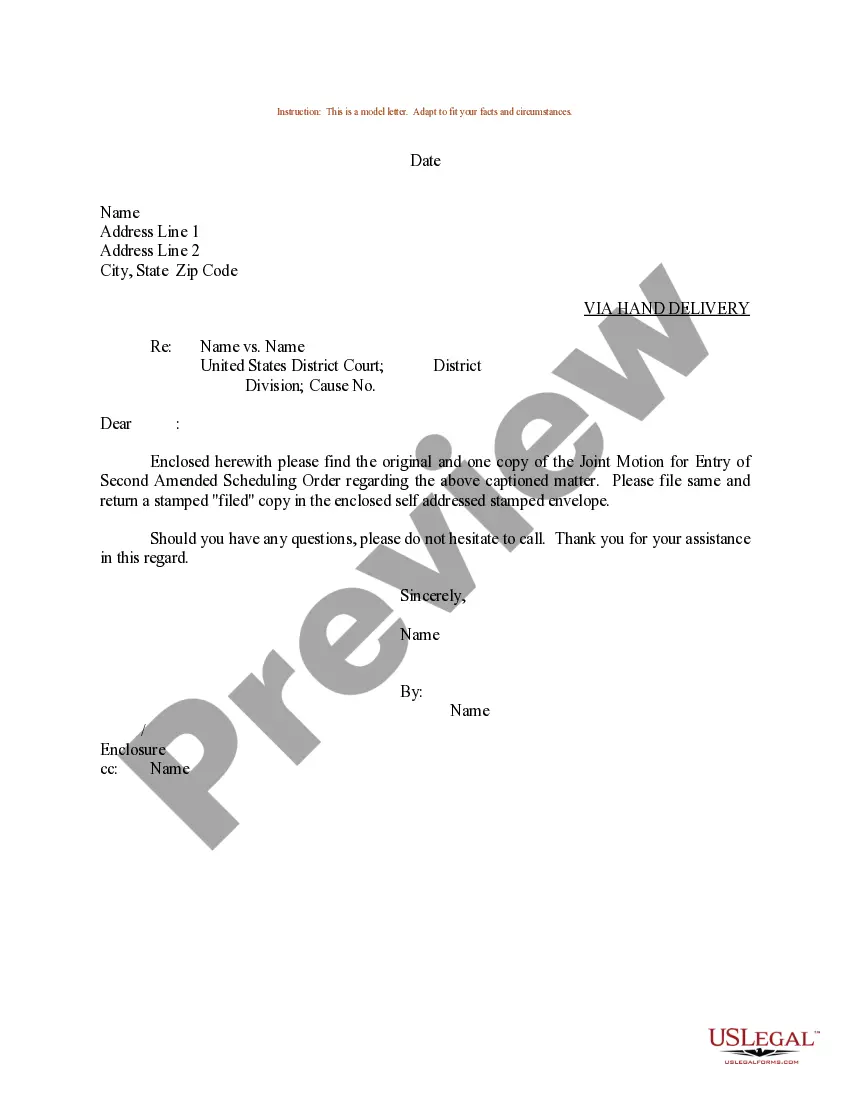
The Sample Letter for Motion to Join Additional Defendants is a legal document that assists a party in a lawsuit to officially request the court to add other defendants to an existing case. This form serves as a template, outlining the necessary components of such a request and ensuring compliance with procedural requirements, distinguishing it from other motions that may pertain to different aspects of a case.
Key components of this form
- Date: Specifies when the letter is drafted.
- Sender's information: Includes the name and address of the party initiating the motion.
- Enclosures: Notes any additional documents submitted with the letter.

Situations where this form applies
This form is typically used when a party in a legal dispute realizes that additional defendants should be included in the case to ensure all relevant parties are present for a fair resolution. Situations may include discovering new evidence that implicates others or changes in the legal dynamics that warrant the addition of more defendants.
Who needs this form
This form is intended for:
- Individuals or entities currently involved in a lawsuit.
- Parties seeking to ensure all responsible individuals or organizations are held accountable.
- Attorneys representing clients who want to add parties to litigation.
How to complete this form
- Start by entering the date at the beginning of the letter.
- Provide your name and address in the appropriate sections.
- Clearly state your request to join additional defendants, referencing the case involved.
- Include any necessary enclosures that support your motion.
- Review for completeness and accuracy before submission.
Is notarization required?
This form does not typically require notarization unless specified by local law. Always check your jurisdiction's requirements to ensure compliance.
Get your form ready online
Our built-in tools help you complete, sign, share, and store your documents in one place.
Make edits, fill in missing information, and update formatting in US Legal Forms—just like you would in MS Word.
Download a copy, print it, send it by email, or mail it via USPS—whatever works best for your next step.
Sign and collect signatures with our SignNow integration. Send to multiple recipients, set reminders, and more. Go Premium to unlock E-Sign.
If this form requires notarization, complete it online through a secure video call—no need to meet a notary in person or wait for an appointment.
We protect your documents and personal data by following strict security and privacy standards.

Make edits, fill in missing information, and update formatting in US Legal Forms—just like you would in MS Word.

Download a copy, print it, send it by email, or mail it via USPS—whatever works best for your next step.

Sign and collect signatures with our SignNow integration. Send to multiple recipients, set reminders, and more. Go Premium to unlock E-Sign.

If this form requires notarization, complete it online through a secure video call—no need to meet a notary in person or wait for an appointment.

We protect your documents and personal data by following strict security and privacy standards.
Avoid these common issues
- Failing to include all necessary parties in the motion.
- Not following the correct format for the letter.
- Forgetting to sign or date the letter before submission.
Benefits of using this form online
- Instant access to a professionally drafted template.
- Easy to edit and customize to fit individual needs.
- Reliable format that adheres to legal standards.
Looking for another form?



Form popularity
FAQ
All persons can be joined in one suit as defendant where: a. Any right to relief in respect of, or arising out of, the same act or transaction or series of acts or transactions is alleged to exist against such persons, whether jointly, severally or in the alternative; and b.
Fill out the forms. You have to fill out at least 2 forms, maybe more, to file your opposition. File the forms. Turn in your completed forms by mail or efiling. Serve the other party. Get ready for the hearing. Prepare an order.
(a) All persons may be joined in one action as defendants if there is asserted against them: (1) Any right to relief jointly, severally, or in the alternative, in respect of or arising out of the same transaction, occurrence, or series of transactions or occurrences and if any question of law or fact common to all
A Motion for Joinder is a request made to the court by which a party is asking that a person or entity be brought before the Family Law Court and made to comply with its orders.
The plaintiff has several options for doing so. One potential way to add a new defendant is to amend the Complaint to include a new defendant and then serve the new defendant with a summons and the amended Complaint.
Joinder. Joinder is a process by which parties and claims are added to an ongoing lawsuit. The typical litigation scenario begins with a plaintiff who enters into a lawsuit by suing a defendant. The plaintiff has a claim against the defendant for which he or she seeks some type of relief.
3d 1061, 1067 (9th Cir. 2000). Fraudulent joinder exists "if the plaintiff fails to state a cause of action against a resident defendant, and the failure is obvious according to the settled rules of the state." McCabe v.
In law, a joinder is the joining of two or more legal issues together. Procedurally, a joinder allows multiple issues to be heard in one hearing or trial and is done when the issues or parties involved overlap sufficiently to make the process more efficient or more fair.