Texas Response to Petition to Adjudicate Parentage
What is this form?
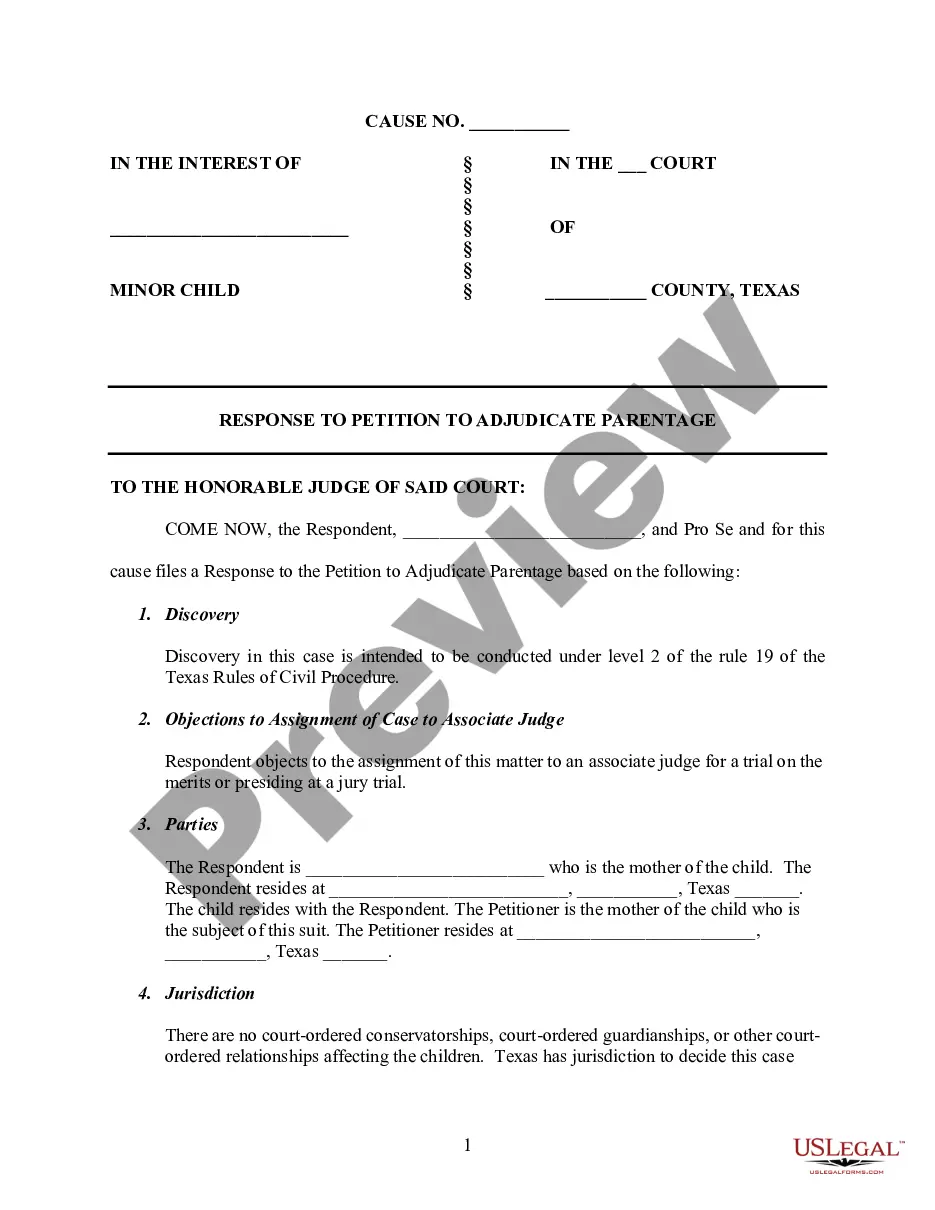
The Response to Petition to Adjudicate Parentage is a legal document filed by a respondent in response to a petition concerning the establishment of a parent-child relationship. This form is specifically designed to facilitate the legal process of determining paternity, addressing custody, child support, and visitation rights in family law cases. It differs from other legal forms as it directly pertains to the acknowledgment or dispute of parentage based on paternity testing results.
What’s included in this form
- Discovery: Indicates the intended level of discovery in the case.
- Objections: Allows the respondent to object to the assignment of the case to an associate judge.
- Jurisdiction: Affirms that Texas has jurisdiction over the matter concerning the child.
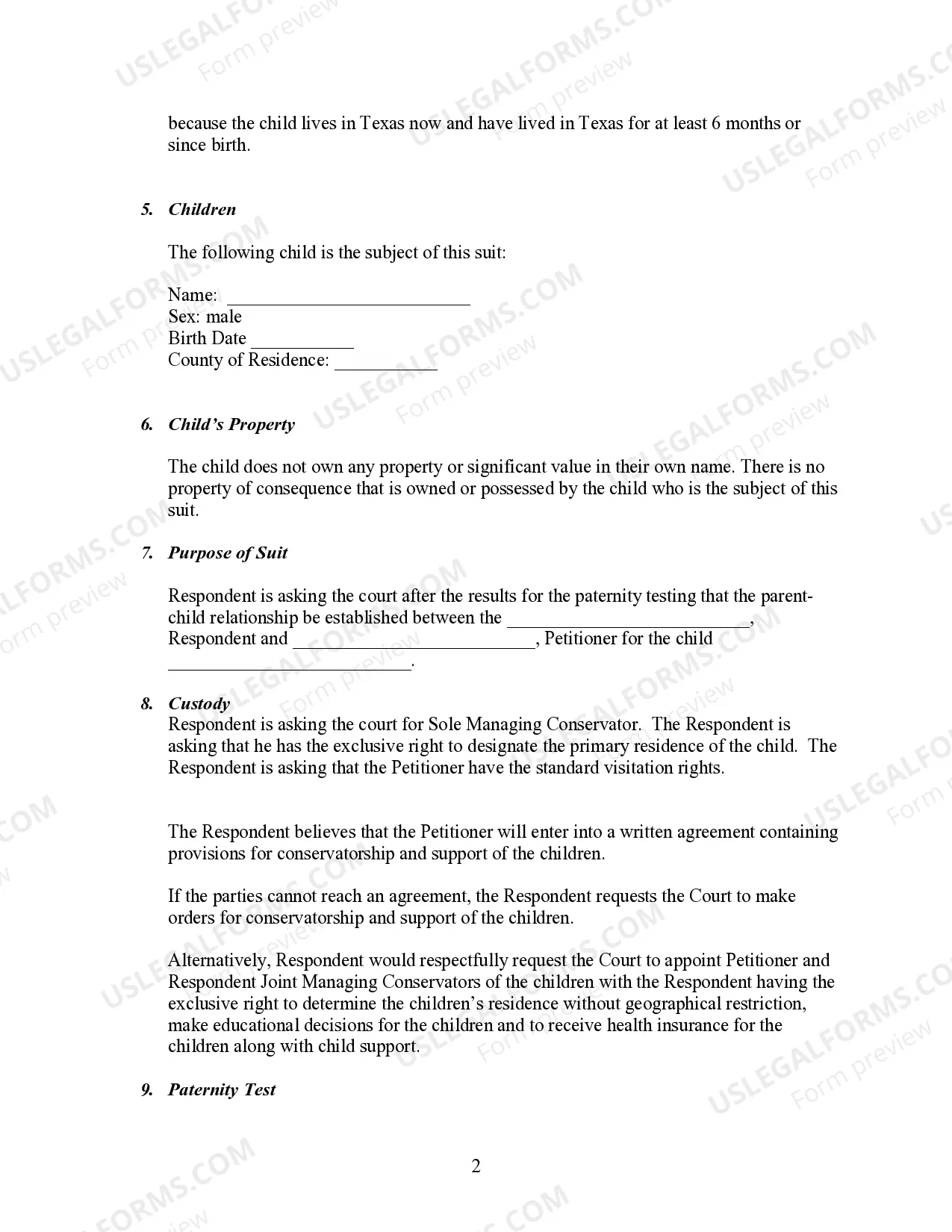
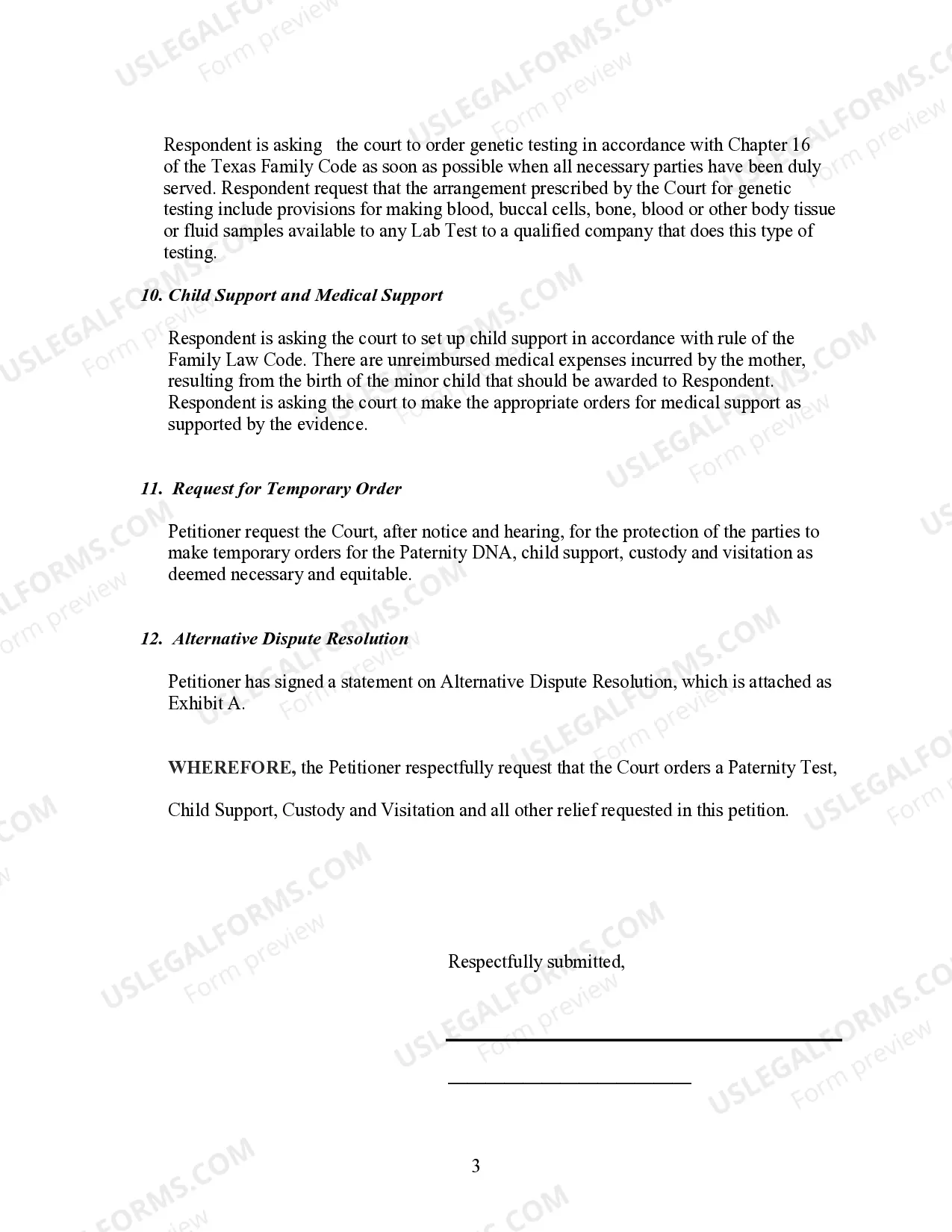
- Paternity testing request: Requests the court to order genetic testing to establish parentage.
- Custody arrangements: Specifies the desired custody and visitation rights for both parties.
- Child support demands: Requests the court to establish terms for child support and medical support.
When this form is needed
This form should be used when a respondent is challenging or responding to a petition regarding the adjudication of parentage. It is appropriate in cases involving potential disputes over paternity, custody, and child support, particularly after the results of paternity testing become available. Using this form helps ensure that the respondentâs rights and wishes are presented to the court effectively.
Who should use this form
- Individuals who have been named as respondents in a petition to adjudicate parentage.
- Parents or guardians who seek to establish legal recognition of their parental rights.
- Any party involved in a legal dispute regarding the custody or support of a child.
- Individuals looking to obtain a formal ruling on paternity and associated rights.
How to complete this form
- Identify the parties involved: Clearly state the names and addresses of both the respondent and the petitioner.
- Complete the section on jurisdiction: Confirm that Texas has jurisdiction based on the child's residency.
- Detail the request for paternity testing: Specify your request for genetic testing in accordance with Texas law.
- Outline custody preferences: State your desired custody arrangement and visitation rights.
- Enter your request for child support: Clearly articulate the expectation for child and medical support orders.
- Sign the document and include a certificate of service: Ensure all necessary parties are notified of the filing.
Notarization requirements for this form
This form does not typically require notarization unless specified by local law. However, having it notarized may provide additional authenticity and may be beneficial in court proceedings.
Get your form ready online
Our built-in tools help you complete, sign, share, and store your documents in one place.
Make edits, fill in missing information, and update formatting in US Legal Forms—just like you would in MS Word.
Download a copy, print it, send it by email, or mail it via USPS—whatever works best for your next step.
Sign and collect signatures with our SignNow integration. Send to multiple recipients, set reminders, and more. Go Premium to unlock E-Sign.
If this form requires notarization, complete it online through a secure video call—no need to meet a notary in person or wait for an appointment.
We protect your documents and personal data by following strict security and privacy standards.

Make edits, fill in missing information, and update formatting in US Legal Forms—just like you would in MS Word.

Download a copy, print it, send it by email, or mail it via USPS—whatever works best for your next step.

Sign and collect signatures with our SignNow integration. Send to multiple recipients, set reminders, and more. Go Premium to unlock E-Sign.

If this form requires notarization, complete it online through a secure video call—no need to meet a notary in person or wait for an appointment.

We protect your documents and personal data by following strict security and privacy standards.
Typical mistakes to avoid
- Failing to accurately complete personal information of all parties involved.
- Not addressing all necessary components such as jurisdiction and custody preferences.
- Omitting the request for paternity testing, which is central to the case.
- Neglecting to sign the document or provide proper certification of service.
Why use this form online
- Convenience: Access and complete the form from anywhere at any time.
- Editability: Make changes easily as needed without the hassle of reprinting.
- Guidance: Receive step-by-step information to ensure accurate completion.
- Reliability: Use forms drafted by licensed attorneys, ensuring legal compliance.
Looking for another form?
Form popularity
FAQ
A paternity test is simple - the parents and child(ren) have their cheeks swabbed either in court, at a local clinic, or at a local Child Support office. DNA tests can determine the biological father with 99% accuracy.
An Acknowledgment of Paternity (AOP) is a legal form signed by a man and the child's mother that states (under penalty of perjury) that the man is the child's genetic father. An AOP is usually used when the parents aren't married but agree on the identity of the child's father.
Establishing Paternity Within A Limited Timeframe This time limit is four years after the birth of that child, as specified on their birth certificate. However, there are exceptions to this period of four years.
What Is the Process for Filing for Adjudicate Parentage in Texas? The first step in filing an adjudication of parentage action is to file a completed "Petition to Adjudicate Parentage" with the appropriate court. There is a limited period during which an individual can pursue an Adjudicated Parentage action.
In Texas, signing a birth certificate will not establish paternity. In fact, a purported legal father of a child who is not married to the mother will not be able to even sign the birth certificate until he signs a voluntary acknowledgment of paternity (AOP).
If there is a disagreement in terms of paternity, the court may order DNA testing. If the paternity test is court-ordered, neither the mother nor the presumed father can refuse to test.
In Texas, to rebut the presumption of paternity a person must plead that there was either no sexual intercourse during the time of conception or that there was infidelity at the time of conception.