Finding Fact Sample With Standard Deviation
Description
Get your form ready online
Our built-in tools help you complete, sign, share, and store your documents in one place.
Make edits, fill in missing information, and update formatting in US Legal Forms—just like you would in MS Word.
Download a copy, print it, send it by email, or mail it via USPS—whatever works best for your next step.
Sign and collect signatures with our SignNow integration. Send to multiple recipients, set reminders, and more. Go Premium to unlock E-Sign.
If this form requires notarization, complete it online through a secure video call—no need to meet a notary in person or wait for an appointment.
We protect your documents and personal data by following strict security and privacy standards.

Make edits, fill in missing information, and update formatting in US Legal Forms—just like you would in MS Word.

Download a copy, print it, send it by email, or mail it via USPS—whatever works best for your next step.

Sign and collect signatures with our SignNow integration. Send to multiple recipients, set reminders, and more. Go Premium to unlock E-Sign.

If this form requires notarization, complete it online through a secure video call—no need to meet a notary in person or wait for an appointment.

We protect your documents and personal data by following strict security and privacy standards.
Looking for another form?




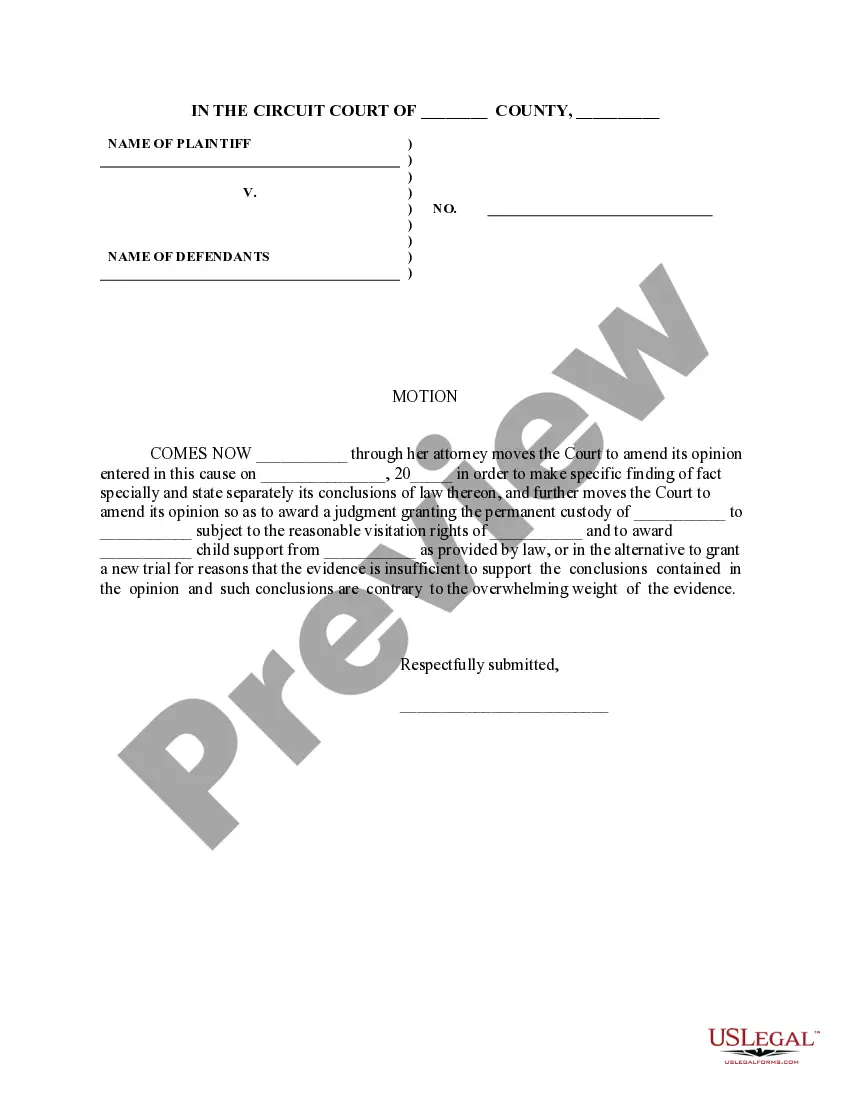
How to fill out Motion To Make Specific Findings Of Fact And State Conclusions Of Law - Domestic Relations?
Creating legal documents from the ground up can occasionally feel overwhelming.
Certain situations may require extensive research and significant financial investment.
If you’re looking for a simpler and more cost-effective method of producing Finding Fact Sample With Standard Deviation or other types of forms without unnecessary complications, US Legal Forms is continually available to assist you.
Our online collection of over 85,000 current legal documents encompasses nearly every aspect of your financial, legal, and personal affairs.
Examine the document preview and descriptions to ensure it’s the correct form you require. Confirm that the template you choose meets your state and county regulations. Select the appropriate subscription plan to purchase the Finding Fact Sample With Standard Deviation. Download the document, then complete, sign, and print it. US Legal Forms has an excellent reputation and over 25 years of experience. Join us today and make the process of filling out forms easy and efficient!
- With just a few clicks, you can swiftly obtain state- and county-specific templates meticulously prepared by our legal professionals.
- Utilize our service whenever you need trustworthy and dependable assistance to find and download the Finding Fact Sample With Standard Deviation quickly.
- If you're familiar with our site and have already set up an account, simply Log In, choose the template, and download it or re-download it anytime later from the My documents section.
- Don't have an account? No problem. Registering takes no time at all, allowing you to explore the catalog.
- However, before proceeding to download Finding Fact Sample With Standard Deviation, consider these suggestions.
Form popularity
FAQ
To understand finding fact sample with standard deviation, start with a set of data points. Calculate the mean of your data, then subtract the mean from each data point and square the result. Next, find the average of these squared differences and take the square root of that average. Using platforms like US Legal Forms can help simplify this process, providing you with resources and examples to effectively demonstrate how to calculate the sample standard deviation.
Standard deviation allows you to determine how much variation exists in a data set. It provides valuable insights into whether your data points are close to the mean or if they're widespread. With standard deviation, you can also assess risks, performance metrics, and overall data reliability. Understanding these aspects through finding fact sample with standard deviation can guide your decision-making process effectively.
To calculate the sample standard deviation, first find the mean of your data points. Then, subtract the mean from each data point, square the result, and sum these squared differences. Next, divide this total by the number of data points minus one to get the variance, and finally, take the square root of that result. This process is key in finding a fact sample with standard deviation, helping you understand how spread out your data is.
To get the sample standard deviation, begin by collecting your data and calculating the mean. Then, determine each data point's deviation from that mean, square those deviations, and sum them up. Divide this total by the number of data points minus one, and take the square root to find your sample standard deviation. This method is crucial in finding fact sample with standard deviation and provides valuable data insights.
For the series 1, 2, 3, 4, 5, 6, 7, firstly calculate the mean, which is 4. Next, find the squared differences from the mean and calculate their average to determine the variance. Finally, the standard deviation, which is about 2, is obtained by taking the square root of the variance. Mastering this calculation assists you in finding fact sample with standard deviation.
To calculate the standard deviation of the dataset 16, 24, 18, 17, 12, 17, 25, 15, 19, 20, 27, 24, start with finding the mean, which is 19. Next, compute each value’s deviation from the mean, square those deviations, and find their average. The last step is to take the square root of the resulting variance, yielding a standard deviation of about 4.1. This process is essential for finding fact sample with standard deviation.
For the data set 5, 5, 9, 9, 9, 10, 5, 10, 10, calculate the mean first, which is 8. Now, determine the variance by finding the squared differences from the mean and averaging them. The standard deviation is the square root of that variance, which is approximately 1.5. Understanding how to calculate this allows you to achieve better insights while finding fact sample with standard deviation.
To get a standard deviation sample, start by collecting your data points. After obtaining the data, compute the mean by summing all values and dividing by the number of data points. Then, find the variance by calculating the difference between each data point and the mean, squaring those differences, and averaging them. Finally, take the square root of the variance to obtain the standard deviation sample, which helps you understand the data distribution while finding fact sample with standard deviation.
Choose STDEV.S when your data represents a sample from a larger set, as it compensates for potential sample error. Use STDEV.P if you intend to calculate the standard deviation for your complete data set. This distinction is important in ensuring accurate results when finding fact sample with standard deviation. For more tailored analytical tools, consider exploring the uslegalforms platform.
Use STDEV.S when you are dealing with a sample and want to estimate the standard deviation for a larger population. This method accounts for sample variability. On the other hand, STDEV.P is appropriate when calculating standard deviation for an entire population. Knowing when to use each function helps enhance your analysis while finding fact sample with standard deviation.