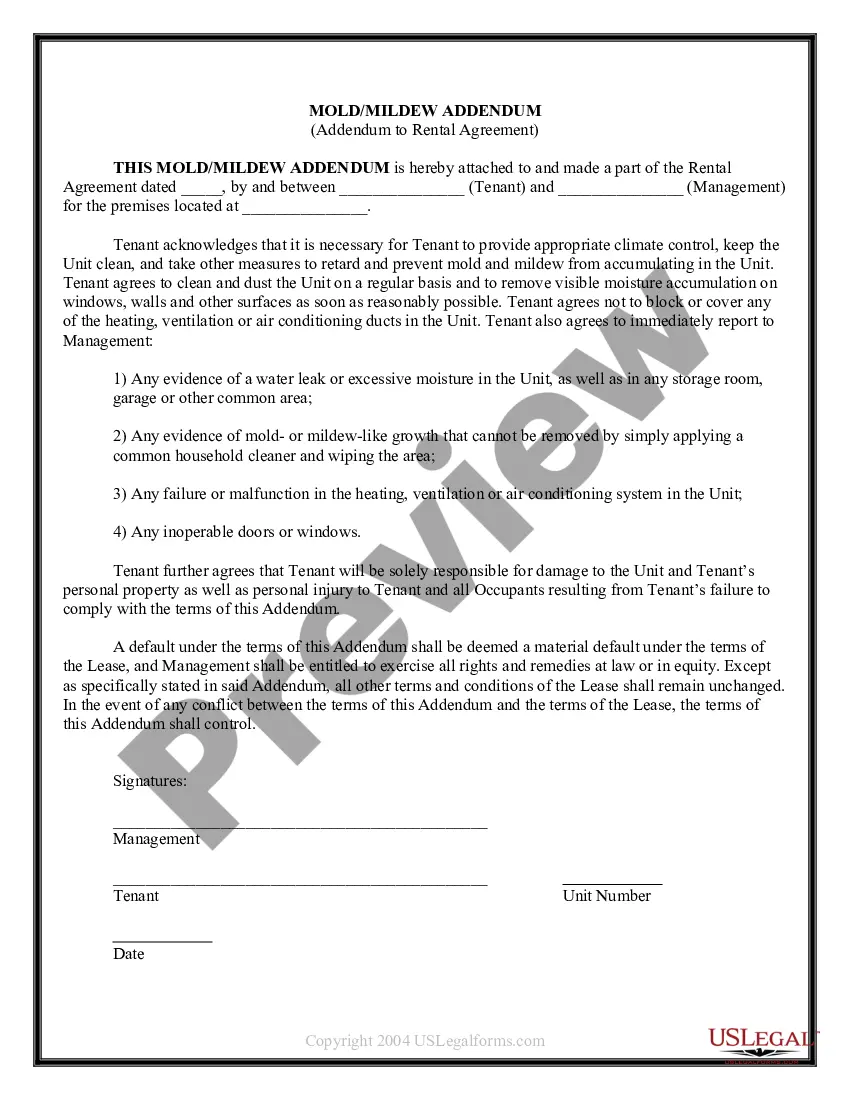
Lease Mold With Bleach
Description
Get your form ready online
Our built-in tools help you complete, sign, share, and store your documents in one place.
Make edits, fill in missing information, and update formatting in US Legal Forms—just like you would in MS Word.
Download a copy, print it, send it by email, or mail it via USPS—whatever works best for your next step.
Sign and collect signatures with our SignNow integration. Send to multiple recipients, set reminders, and more. Go Premium to unlock E-Sign.
If this form requires notarization, complete it online through a secure video call—no need to meet a notary in person or wait for an appointment.
We protect your documents and personal data by following strict security and privacy standards.

Make edits, fill in missing information, and update formatting in US Legal Forms—just like you would in MS Word.

Download a copy, print it, send it by email, or mail it via USPS—whatever works best for your next step.

Sign and collect signatures with our SignNow integration. Send to multiple recipients, set reminders, and more. Go Premium to unlock E-Sign.

If this form requires notarization, complete it online through a secure video call—no need to meet a notary in person or wait for an appointment.

We protect your documents and personal data by following strict security and privacy standards.
Looking for another form?



How to fill out Addendum To Apartment Lease Regarding Mold?
Finding a go-to place to take the most recent and appropriate legal templates is half the struggle of handling bureaucracy. Finding the right legal documents requirements accuracy and attention to detail, which is the reason it is crucial to take samples of Lease Mold With Bleach only from trustworthy sources, like US Legal Forms. A wrong template will waste your time and delay the situation you are in. With US Legal Forms, you have little to worry about. You can access and view all the information regarding the document’s use and relevance for your circumstances and in your state or county.
Take the listed steps to complete your Lease Mold With Bleach:
- Make use of the catalog navigation or search field to locate your template.
- View the form’s description to ascertain if it suits the requirements of your state and county.
- View the form preview, if available, to ensure the form is the one you are looking for.
- Get back to the search and find the proper template if the Lease Mold With Bleach does not match your requirements.
- When you are positive about the form’s relevance, download it.
- When you are a registered customer, click Log in to authenticate and gain access to your selected forms in My Forms.
- If you do not have an account yet, click Buy now to get the template.
- Pick the pricing plan that fits your needs.
- Proceed to the registration to complete your purchase.
- Complete your purchase by selecting a transaction method (credit card or PayPal).
- Pick the document format for downloading Lease Mold With Bleach.
- When you have the form on your gadget, you may alter it using the editor or print it and complete it manually.
Eliminate the inconvenience that comes with your legal documentation. Discover the comprehensive US Legal Forms collection where you can find legal templates, examine their relevance to your circumstances, and download them on the spot.
Form popularity
FAQ
Mix no more than one cup of bleach in one gallon of water. Wash the item with the bleach and water. If the surface of the item is rough, scrub the surface with a stiff brush. Rinse the item with clean water.
Hear this out loud PauseBiocides are substances that can destroy living organisms. The use of a chemical or biocide that kills organisms such as mold (chlorine bleach, for example) is not recommended as a routine practice during mold cleanup.
You can use bleach to remove traces of mold on tub and tile surfaces, which are hard and impermeable. However, bleach can't kill mold on porous surfaces, such as those made of wood.
Bleach Can Worsen Mold Infestation Since bleach doesn't kill the roots underneath porous surfaces, it will only cause the mold to grow deeper and stronger as a reaction to the bleach. Also, bleach contains around 90% water.
While it may seem tempting to use bleach to remove mold, it's not the most effective solution. Bleach might make mold disappear temporarily, but it doesn't address the root of the problem. Mold can return when treated with bleach.