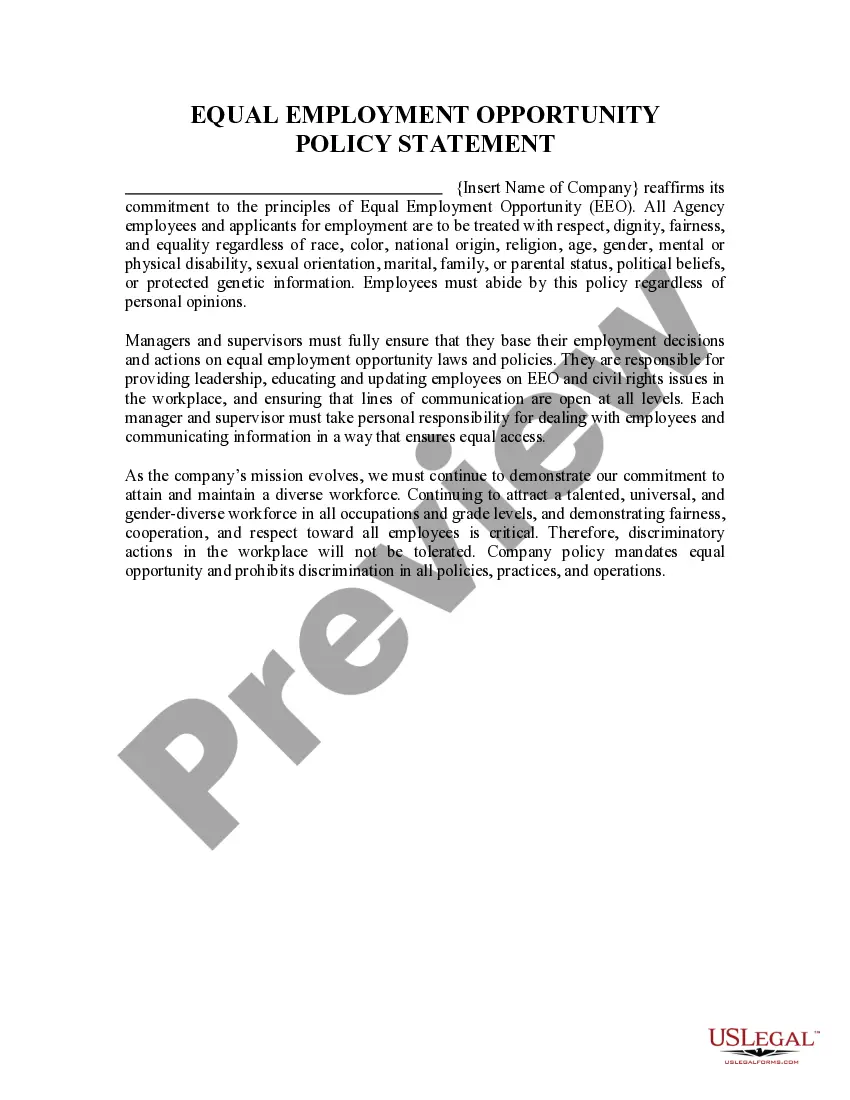
Equal Opportunities Policy For Schools
Description
Get your form ready online
Our built-in tools help you complete, sign, share, and store your documents in one place.
Make edits, fill in missing information, and update formatting in US Legal Forms—just like you would in MS Word.
Download a copy, print it, send it by email, or mail it via USPS—whatever works best for your next step.
Sign and collect signatures with our SignNow integration. Send to multiple recipients, set reminders, and more. Go Premium to unlock E-Sign.
If this form requires notarization, complete it online through a secure video call—no need to meet a notary in person or wait for an appointment.
We protect your documents and personal data by following strict security and privacy standards.

Make edits, fill in missing information, and update formatting in US Legal Forms—just like you would in MS Word.

Download a copy, print it, send it by email, or mail it via USPS—whatever works best for your next step.

Sign and collect signatures with our SignNow integration. Send to multiple recipients, set reminders, and more. Go Premium to unlock E-Sign.

If this form requires notarization, complete it online through a secure video call—no need to meet a notary in person or wait for an appointment.

We protect your documents and personal data by following strict security and privacy standards.
Looking for another form?

How to fill out Equal Employment Opportunity Policy Statement?
It’s clear that you cannot transform into a legal specialist instantly, nor can you acquire the ability to swiftly draft an Equal Opportunities Policy For Schools without requiring a unique expertise.
Assembling legal documents is a lengthy endeavor that demands particular training and expertise. So why not entrust the development of the Equal Opportunities Policy For Schools to the experts.
With US Legal Forms, which boasts one of the most comprehensive libraries of legal templates, you can discover everything from court documents to templates for internal corporate correspondence.
You can access your forms from the My documents tab at any time. If you are an existing customer, you can simply Log In, and find and download the template from the same tab.
Regardless of the purpose of your forms—whether financial, legal, or personal—our platform has you covered. Experience US Legal Forms today!
- Identify the document you require by using the search bar at the top of the page.
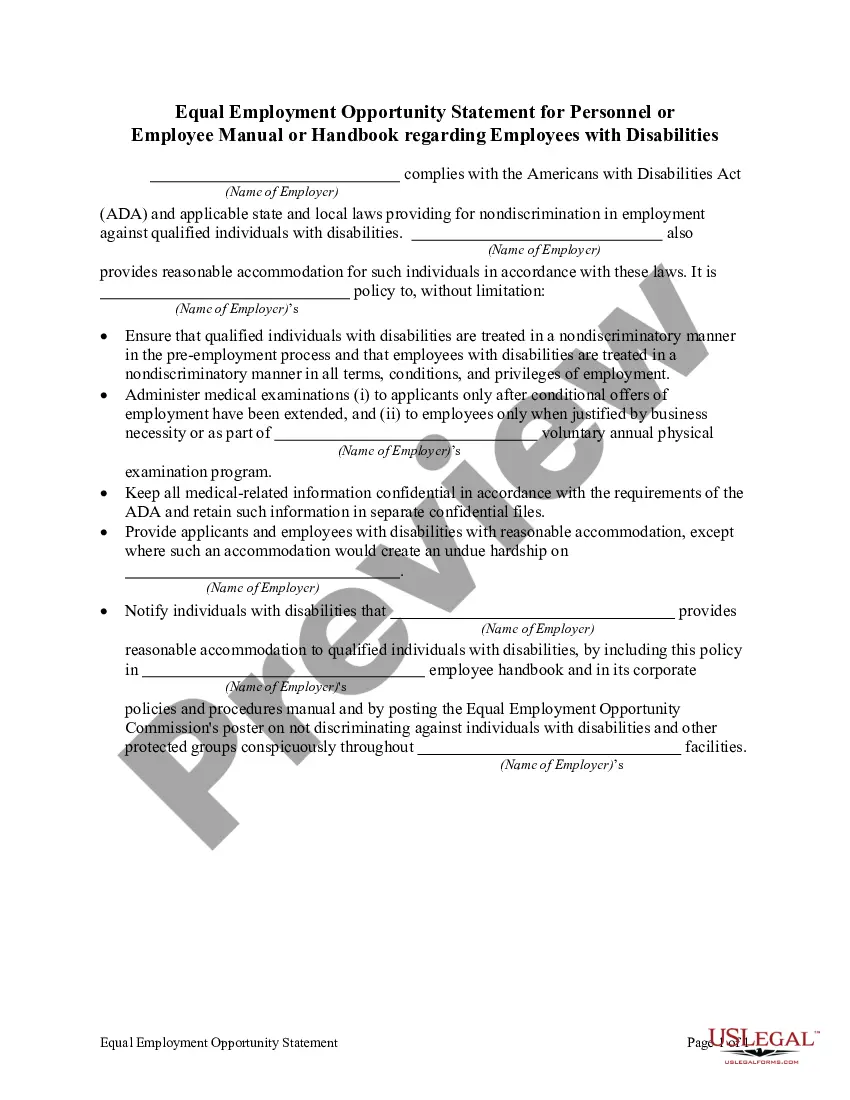
- View it (if this option is available) and review the supporting description to determine if the Equal Opportunities Policy For Schools is what you’re looking for.
- Re-initiate your search if you need a different template.
- Create a complimentary account and choose a subscription plan to acquire the template.
- Select Buy now. After the payment is completed, you will receive the Equal Opportunities Policy For Schools, fill it out, print it, and send or mail it to the intended people or organizations.
Form popularity
FAQ
In order to modify an existing parenting plan, the parent that wants to modify the parenting plan is under the burden to prove that there has been a substantial and permanent change in circumstances. If the other parent challenges the change in circumstances, it will be up to you and your attorney to prove the change.
A child support order can be reviewed for a change in support: After three years at the request of either parent. Or if there has been a substantial change in circumstance that has been maintained for at least six months.
For an Idaho birth, a person believed to be the father of a child may acknowledge he is the father by signing a voluntary acknowledgment of paternity in front of a notary. The court may then order child support without further proceedings.
Under Idaho law, a parent who shares custody of a child is typically not permitted to relocate with them to another state, or even within the state, if the move is more than around 50 miles away.
There shall be a rebuttable presumption that a minimum amount of support is at least $50.00 per month per child.
Based in child custody laws governing in the state of Idaho, there is no age limit for a child to decide which parent he or she wants to live with. The court usually considers the child's wishes provided that the child is mature enough to make sound reasoning and independent preferences in parenting schedule.
The father and mother of a legitimate unmarried minor child are equally entitled to its custody, services and earnings. If either the father or mother be dead or be unable or refuse to take the custody or has abandoned his or her family, the other is entitled to the child's custody, services and earnings.
When circumstances have changed, the court allows you to file to have the existing orders changed, to modify custody and/or modify child support. You must be able to clearly demonstrate that there has been a material and substantial change in circumstances, involving yourself, the other parent, or the minor child.