Injuries Compensation Withdrawal
Description
Get your form ready online
Our built-in tools help you complete, sign, share, and store your documents in one place.
Make edits, fill in missing information, and update formatting in US Legal Forms—just like you would in MS Word.
Download a copy, print it, send it by email, or mail it via USPS—whatever works best for your next step.
Sign and collect signatures with our SignNow integration. Send to multiple recipients, set reminders, and more. Go Premium to unlock E-Sign.
If this form requires notarization, complete it online through a secure video call—no need to meet a notary in person or wait for an appointment.
We protect your documents and personal data by following strict security and privacy standards.

Make edits, fill in missing information, and update formatting in US Legal Forms—just like you would in MS Word.

Download a copy, print it, send it by email, or mail it via USPS—whatever works best for your next step.

Sign and collect signatures with our SignNow integration. Send to multiple recipients, set reminders, and more. Go Premium to unlock E-Sign.

If this form requires notarization, complete it online through a secure video call—no need to meet a notary in person or wait for an appointment.

We protect your documents and personal data by following strict security and privacy standards.
Looking for another form?

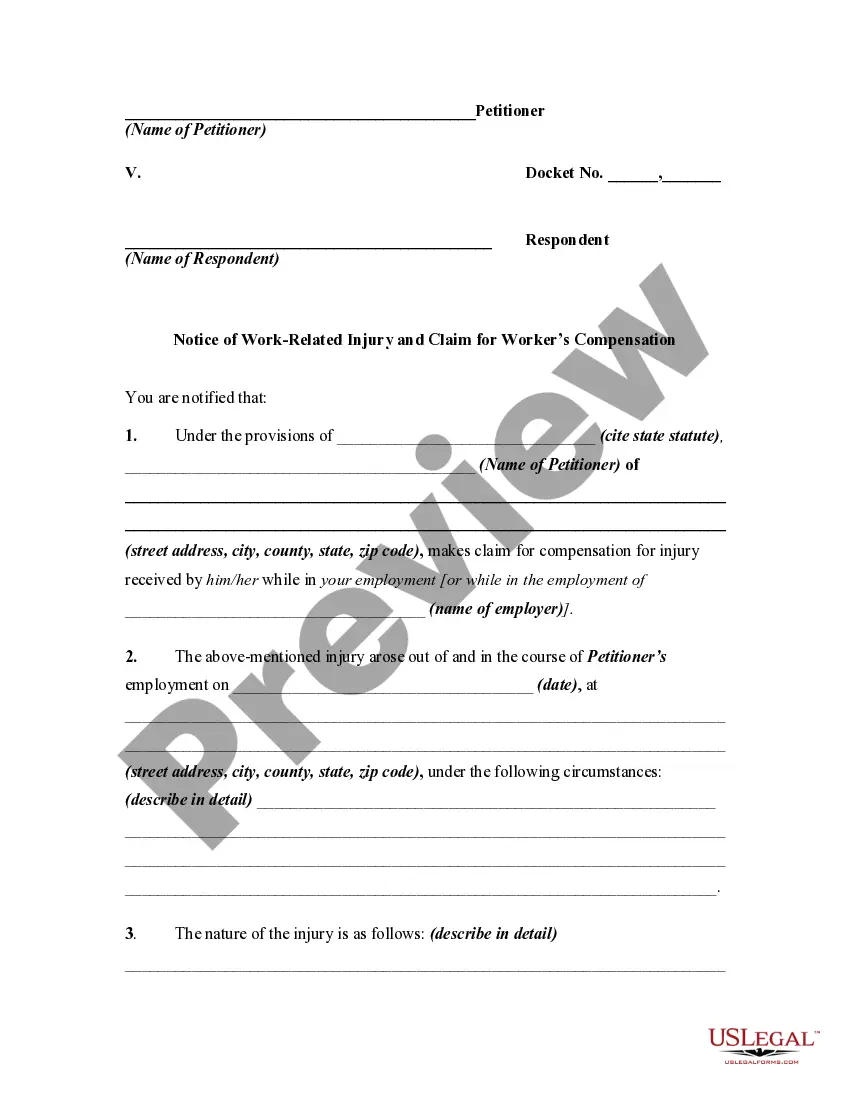
How to fill out Notification Of Workers' Compensation Injury - Illness?
Whether for commercial reasons or personal matters, everyone must handle legal issues at some time during their lives.
Filling out legal paperwork requires meticulous care, starting from choosing the appropriate form example.
With an extensive US Legal Forms catalog available, you never have to waste time searching for the correct template online. Take advantage of the library's straightforward navigation to find the right template for any situation.
- Locate the template you require by using the search feature or by browsing through the catalog.
- Examine the description of the form to confirm it is applicable to your situation, region, and county.
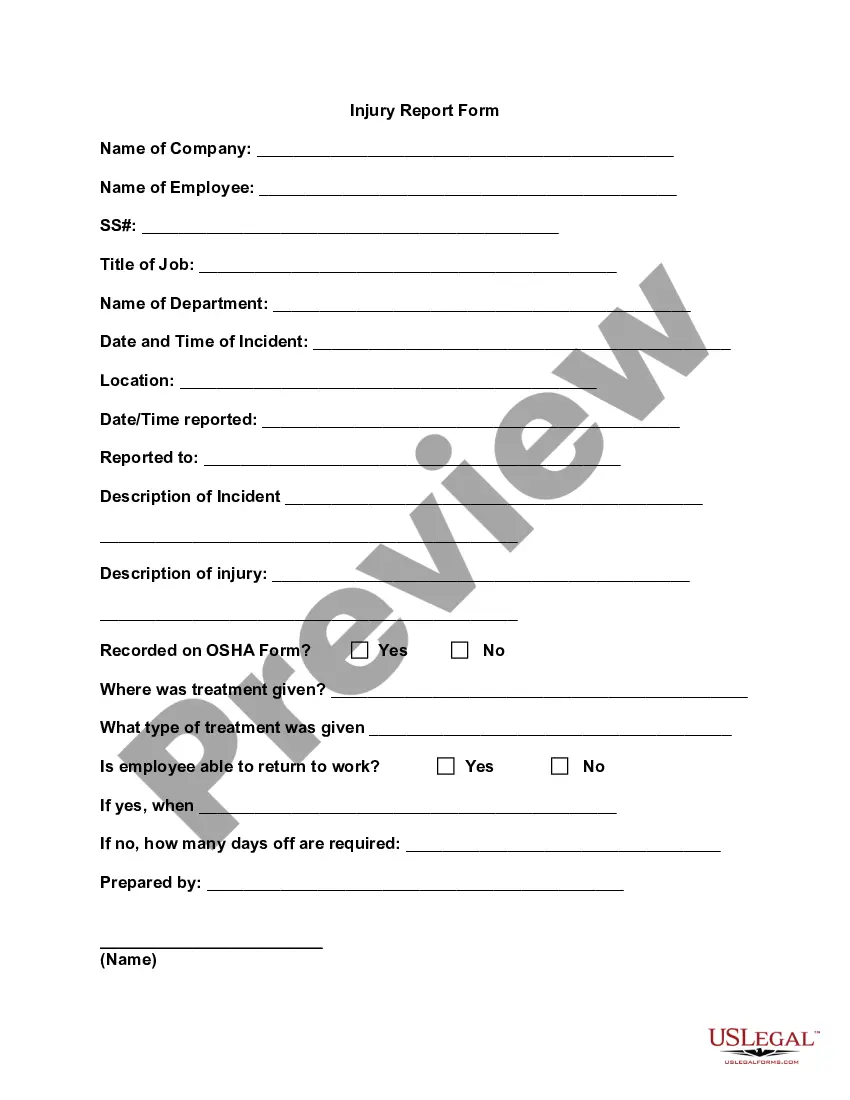
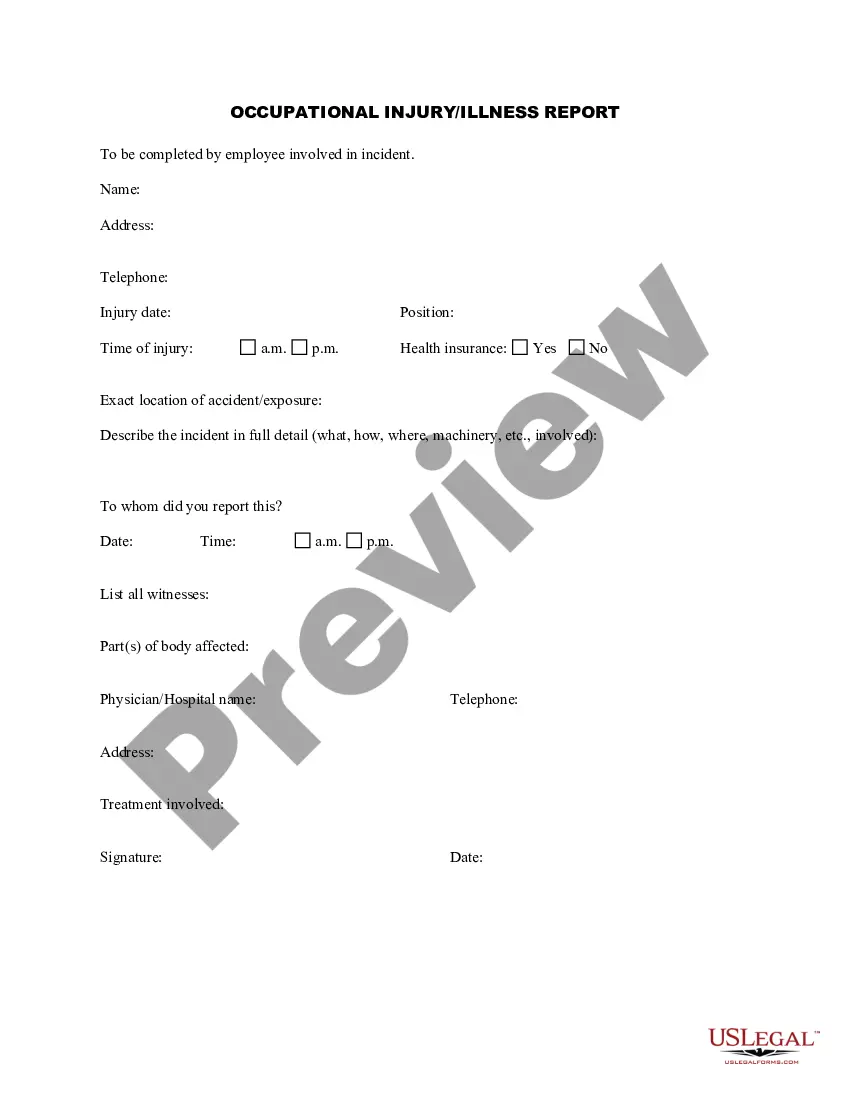
- Select the preview of the form to review it.
- If it is the incorrect document, return to the search option to find the correct Injuries Compensation Withdrawal sample.
- Obtain the file if it meets your specifications.
- If you already possess a US Legal Forms account, simply click Log in to access previously stored documents in My documents.
- In case you do not have an account at this time, you can secure the form by clicking Buy now.
- Choose the correct pricing plan.
- Complete the account registration form.
- Select your payment method: you can opt for a credit card or PayPal account.
- Choose the document format you desire and download the Injuries Compensation Withdrawal.
- Once downloaded, you can either fill out the form using editing software or print it and fill it out by hand.
Form popularity
FAQ
The USPTO's Patent Pro Bono Program In 2011, the USPTO launched the Patent Pro Bono Program. The Patent Pro Bono Program allows inventors who meet certain qualifications to receive free legal assistance in preparing and filing a patent application. This program is currently accessible to inventors in all 50 states.
Method 1: Write and file your own patent application (the cheapest way) - total cost about $1,000 for most inventors to get an issued patent (USPTO government fees only). A provisional type application is only about $150 to file but this only stays pending for 12 months and is only a 'placeholder' type application.
The Patent Pro Bono Program is a nationwide network of independently operated regional programs that matches volunteer patent attorneys and agents with financially under-resourced inventors and small businesses to provide free legal assistance in securing patent protection.
Along with the written application, you must submit a description of the invention, a drawing, an oath testifying you are the original creator of your invention, and an application fee (which varies depending on the type of patent).
360 Legal Forms can take care of all of your personal, business, and real estate needs. Enjoy 24/7 access to our full library of forms created by lawyers. to sign too. Sign online and allow other parties to do the same.
A patent attorney will usually charge between $8,000 and $10,000 for a patent application, but the cost can be higher. In most cases, you should budget between $15,000 and $20,000 to complete the patenting process for your invention. Previous: Why should you file a patent application? Next: Is your invention valuable?
Utility patent application: may be filed by anyone who invents or discovers any new and useful process, machine, manufacture, or composition of matter, or any new and useful improvement thereof.
A trademark license is a document that proves the registration of the trademark. A patent is a set a rights granted to the inventor of an invention. Proof of patent is a document that proves a patent is granted for the invention. A copyright is legal rights granted to the creator of an original work.