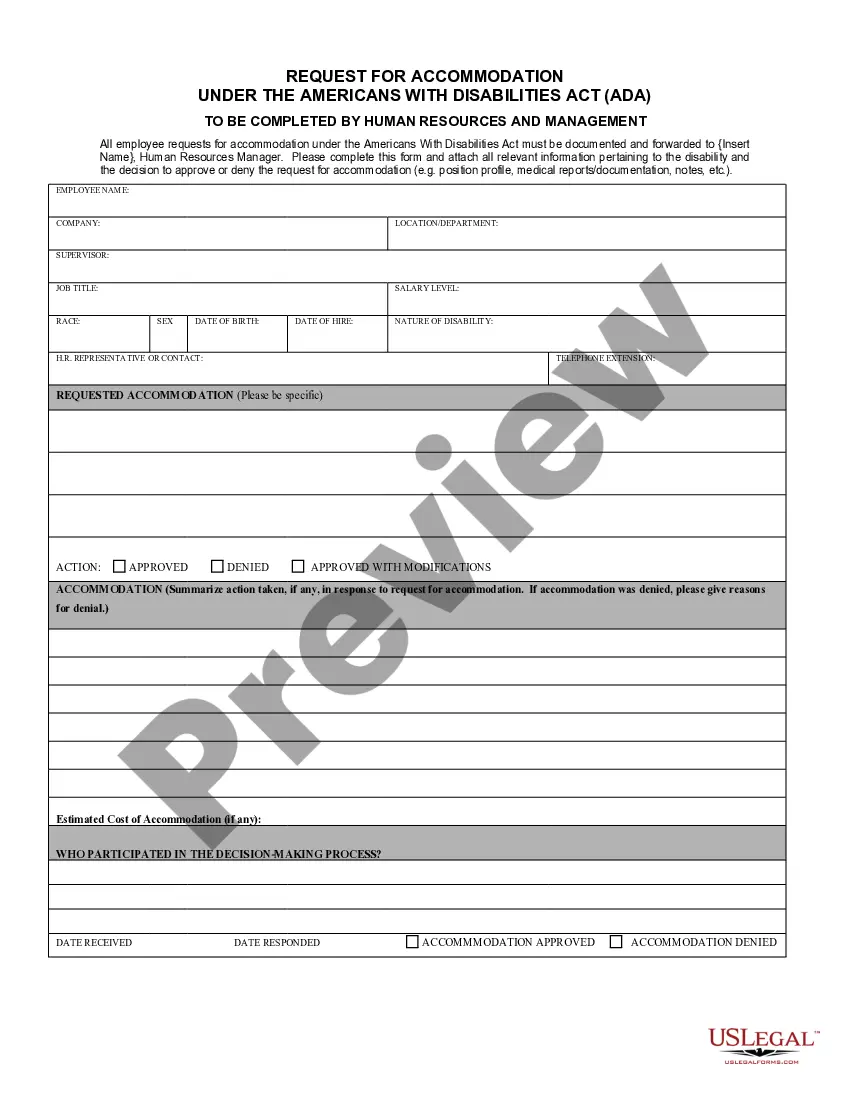
Accommodation Act Under Forrest
Description
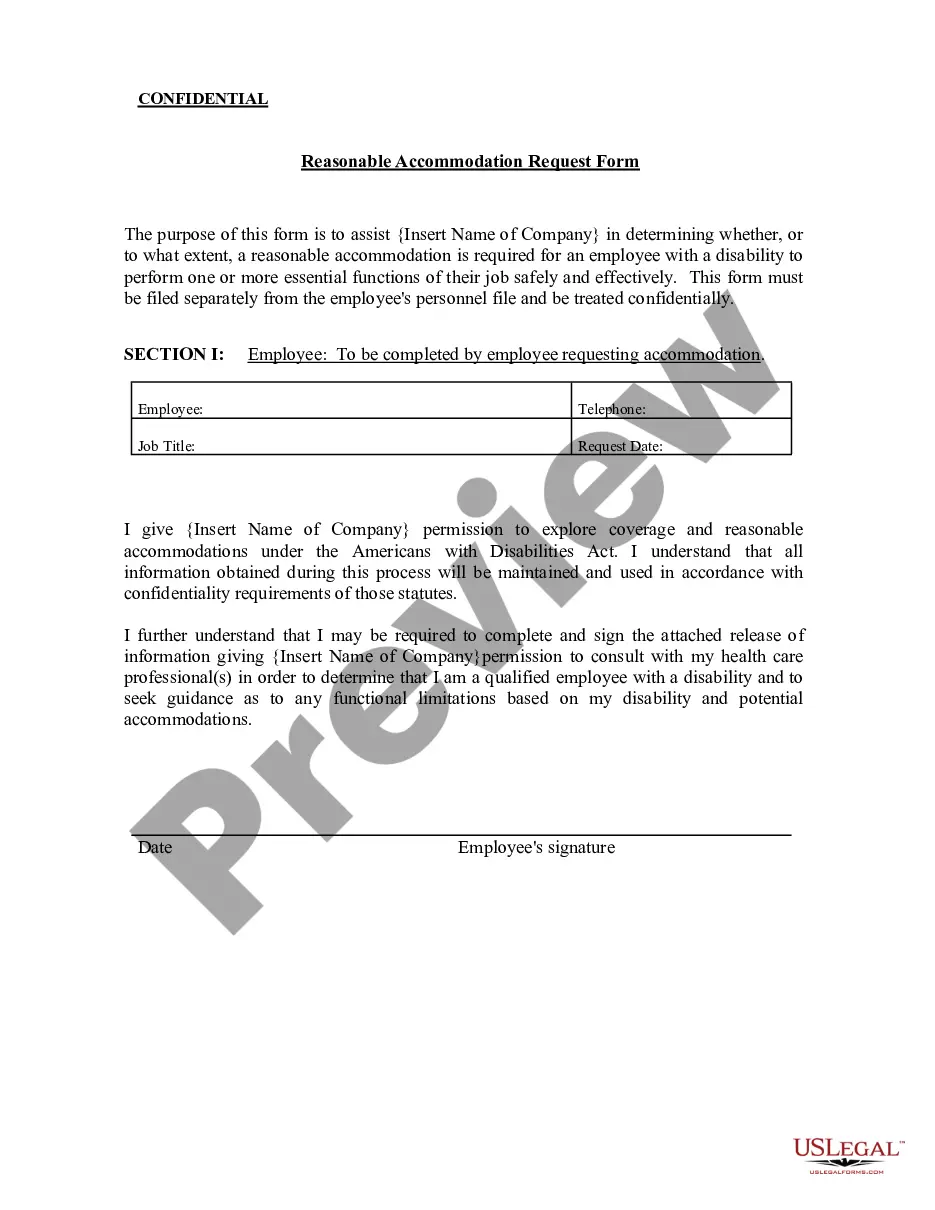
How to fill out Request For Accommodation Under The ADA?
Regardless of whether for commercial reasons or personal matters, everyone must handle legal issues at some point in their life.
Completing legal documentation requires meticulous attention, beginning with choosing the right form template. For instance, if you select an incorrect version of the Accommodation Act Under Forrest, it will be rejected upon submission. Therefore, it is crucial to find a reliable source for legal documents such as US Legal Forms.
With an extensive US Legal Forms catalog available, you do not need to waste time searching for the suitable template online. Utilize the library's straightforward navigation to locate the correct form for any situation.
- Locate the template you require by using the search field or browsing the catalog.
- Review the form’s details to ensure it corresponds with your situation, state, and county.
- Click on the form’s preview to take a closer look.
- If it is the wrong form, return to the search feature to find the Accommodation Act Under Forrest template you need.
- Obtain the template if it aligns with your criteria.
- If you possess a US Legal Forms account, simply click Log in to access previously saved documents in My documents.
- In case you do not have an account yet, you can acquire the form by clicking Buy now.
- Choose the appropriate pricing option.
- Complete the profile registration form.
- Select your payment method: use a credit card or PayPal account.
- Choose the file format you desire and download the Accommodation Act Under Forrest.
- Once saved, you can fill out the form using editing software or print it and complete it by hand.
Form popularity
FAQ
Because of my disability, I need the following accommodations: [LIST ACCOMMODATIONS]. A medical provider has prescribed this accommodation for my disability. I would like to meet with you to discuss these and any other accommodations that will enable me to have an equal opportunity to live in and enjoy this residence.
What types of accommodations are generally considered reasonable? Change job tasks. Provide reserved parking. Improve accessibility in a work area. Change the presentation of tests and training materials. Provide or adjust a product, equipment, or software. Allow a flexible work schedule.
In your reasonable accommodation letter, you should provide all the information your employer will need to begin the accommodation process, including what your disability is, how it affects you, which aspects of your job might require modification, and proposed accommodations.
Employment: Requesting an Accommodation ? The Three Step Process Describe the specific work limitation. Explain that the work limitation results from a health condition protected under the ADA. Request an accommodation that will lessen the limitation. Propose ideas for potential accommodations.
Steps Recognize the need for accommodation. Remove discriminatory barriers, examples to recognize the need for accommodation. Gather relevant information and assess needs. Talk about barriers, gather information, discuss options. Make an informed decision. ... Implement the decision. ... Keep records and follow up.