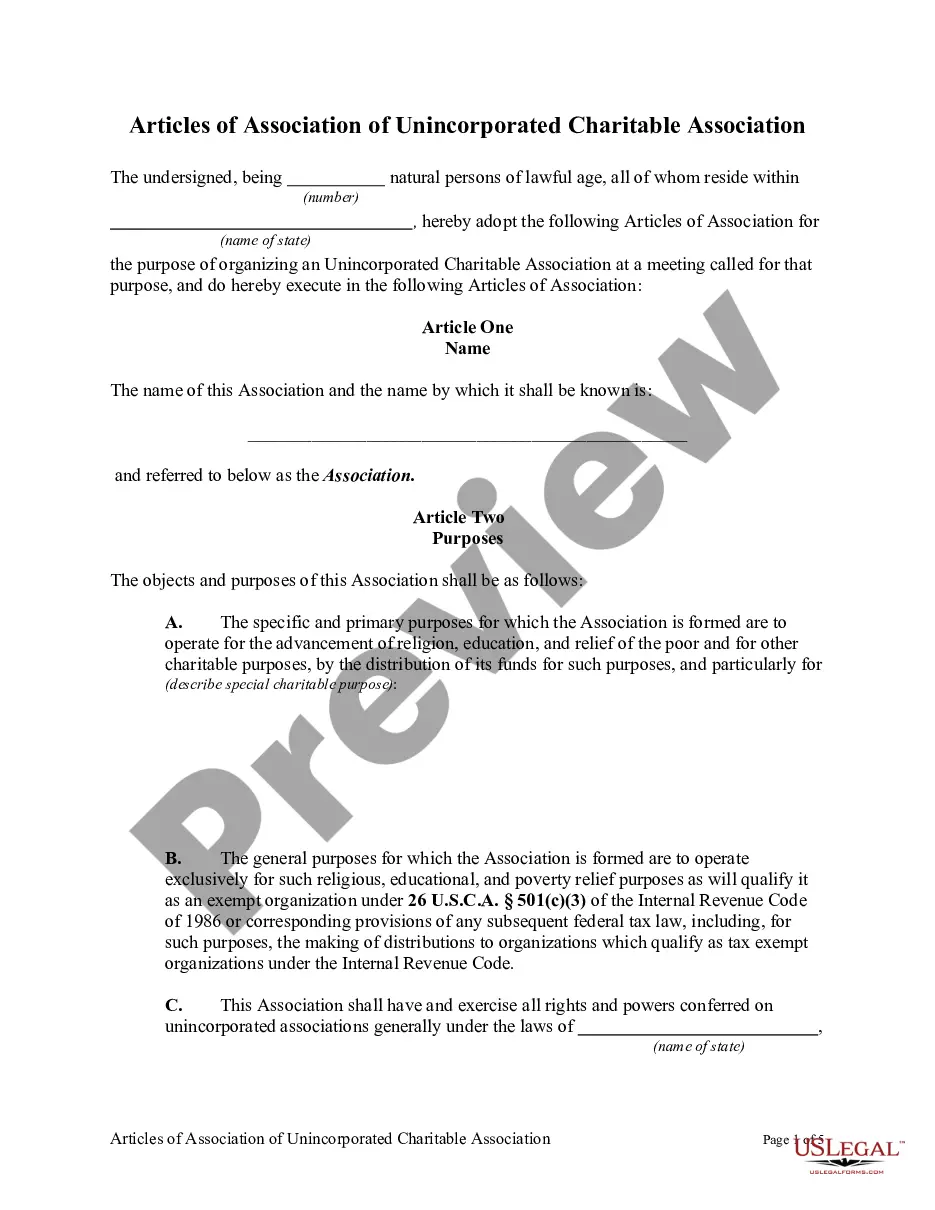
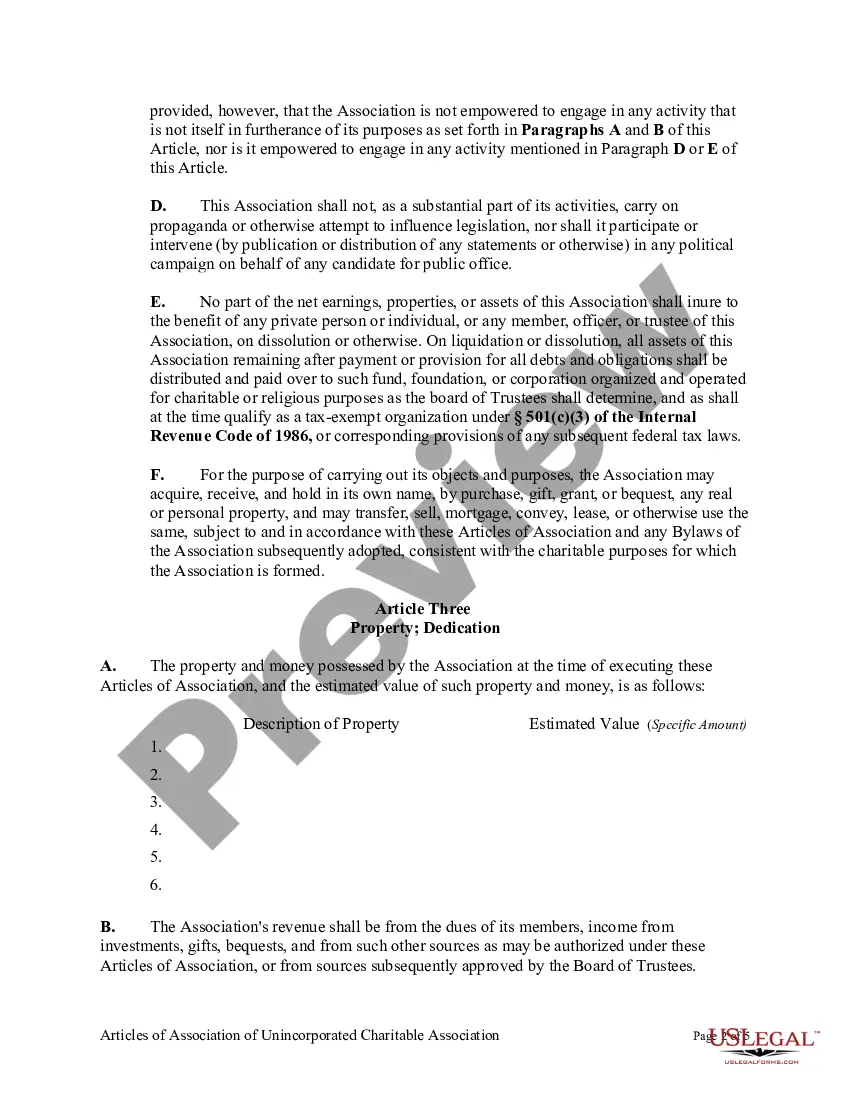
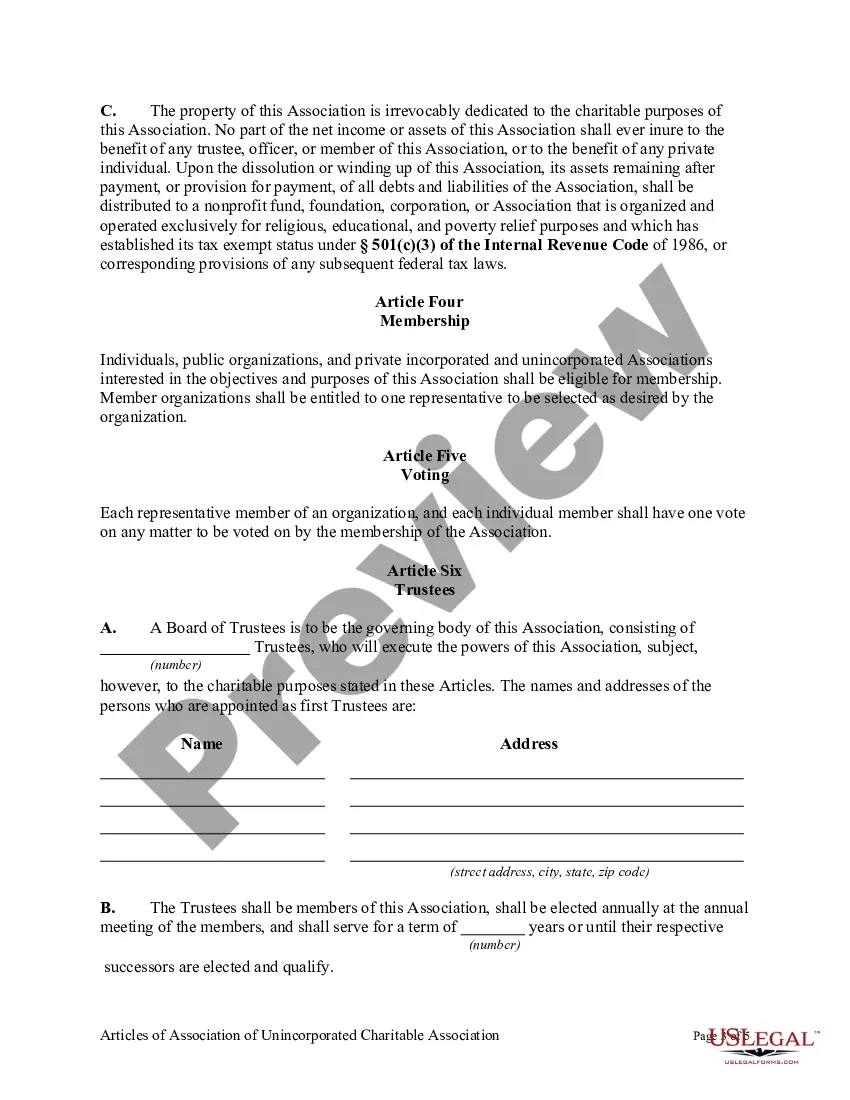
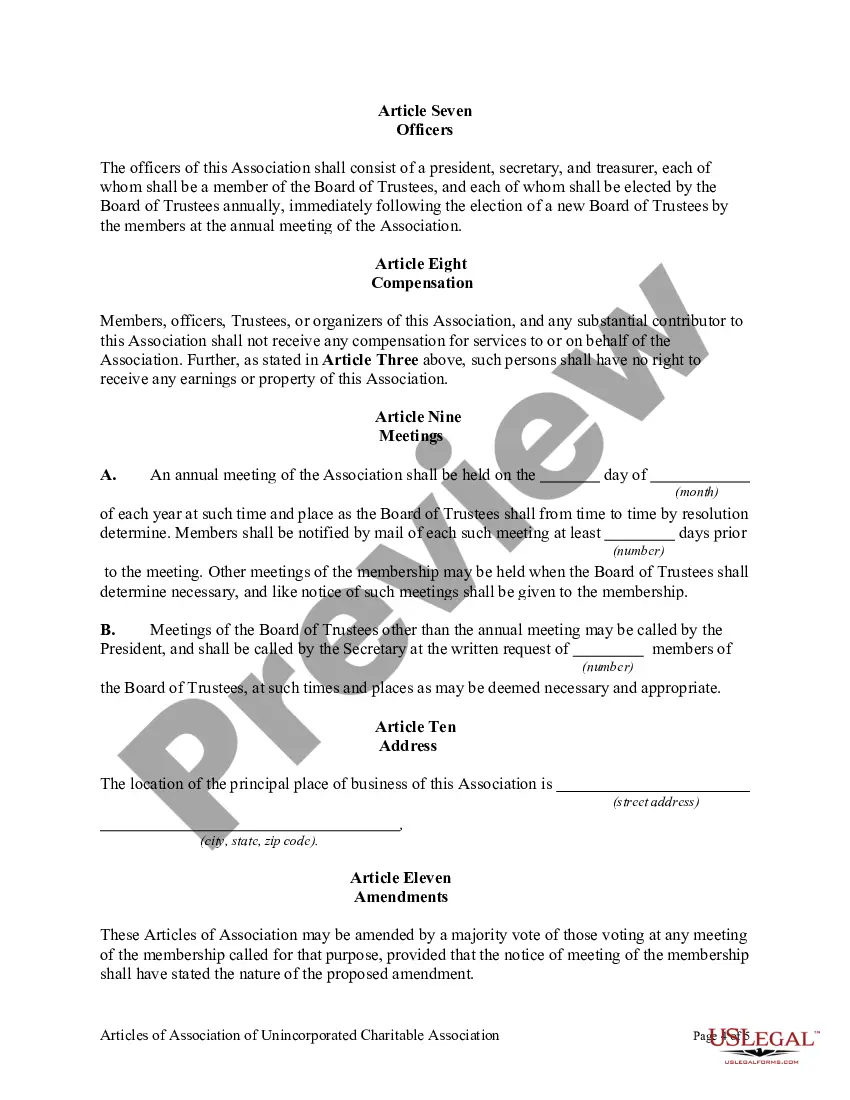
Articles Association Unincorporated With City
Description
Get your form ready online
Our built-in tools help you complete, sign, share, and store your documents in one place.
Make edits, fill in missing information, and update formatting in US Legal Forms—just like you would in MS Word.
Download a copy, print it, send it by email, or mail it via USPS—whatever works best for your next step.
Sign and collect signatures with our SignNow integration. Send to multiple recipients, set reminders, and more. Go Premium to unlock E-Sign.
If this form requires notarization, complete it online through a secure video call—no need to meet a notary in person or wait for an appointment.
We protect your documents and personal data by following strict security and privacy standards.

Make edits, fill in missing information, and update formatting in US Legal Forms—just like you would in MS Word.

Download a copy, print it, send it by email, or mail it via USPS—whatever works best for your next step.

Sign and collect signatures with our SignNow integration. Send to multiple recipients, set reminders, and more. Go Premium to unlock E-Sign.

If this form requires notarization, complete it online through a secure video call—no need to meet a notary in person or wait for an appointment.

We protect your documents and personal data by following strict security and privacy standards.
Looking for another form?



How to fill out Articles Of Association Of Unincorporated Charitable Association?
The Unincorporated Articles Association with City displayed on this site is a reusable official format developed by skilled attorneys in accordance with national and municipal statutes and guidelines.
For over 25 years, US Legal Forms has supplied individuals, enterprises, and legal practitioners with over 85,000 validated, state-specific documents suitable for any business and personal circumstance. It’s the fastest, most straightforward, and most reliable method to obtain the documentation you require, as the service promises the utmost level of data protection and anti-malware safeguards.
Register with US Legal Forms to gain access to verified legal templates for all of life’s events.
- Search for the document you require and examine it.
- Review the file you looked for and preview it or view the form’s description to confirm it meets your needs. If it doesn’t, use the search bar to find the right one. Click 'Buy Now' once you’ve located the template you need.
- Select and Log Into your account.
- Pick the pricing option that fits you and create an account. Use PayPal or a credit card for a swift payment. If you already possess an account, Log In and review your subscription to continue.
- Download the editable template.
- Choose the format you prefer for your Articles Association Unincorporated With City (PDF, DOCX, RTF) and download the document to your device.
- Fill out and sign the paperwork.
- Print the template to complete it manually. Alternatively, use an online versatile PDF editor to quickly and accurately fill out and sign your document with a legally-binding electronic signature.
- Re-download your documents one more time.
- Utilize the same document again whenever necessary. Open the 'My documents' tab in your profile to redownload any previously saved documents.
Form popularity
FAQ
One significant disadvantage of an unincorporated association is the lack of legal protection for its members, which can expose individuals to personal liability for the group's actions. Additionally, unincorporated associations may find it challenging to secure funding or enter contracts, as they lack formal legal status. This limitation can hinder growth and sustainability. To mitigate these issues, consider using resources like US Legal Forms to create your articles association unincorporated with city.
An unincorporated association generally includes any group of individuals who come together for a common purpose without formal incorporation. This can include volunteer organizations, social clubs, and advocacy groups that operate based on a shared mission. They may have bylaws or articles to govern their activities, but they do not possess the legal status of a corporation. If your group fits this description, you can consider drafting articles association unincorporated with city.
An unincorporated association is a group formed for a common purpose without formal incorporation under state laws. This type of organization operates based on established bylaws or articles and usually consists of members who share interests or goals. While unincorporated associations lack the legal protections of incorporated entities, they can still function effectively. They often draft articles association unincorporated with city to outline their objectives and governance.
The 33% rule for nonprofits refers to the guideline that no single individual can control more than one-third of the organization’s decision-making power. This rule helps ensure that nonprofits maintain a balance of authority and promote collective governance. If your organization is unincorporated, adhering to this rule can enhance credibility and improve relationships with stakeholders. Incorporating these principles can also streamline the creation of your articles association unincorporated with city.
Common examples of unincorporated associations include clubs, community groups, and informal organizations like neighborhood watch groups. These groups usually operate with a defined mission but do not have the legal status of a corporation. They often function through a set of articles association unincorporated with city guidelines, which help them manage activities and membership. Understanding these examples can help you determine if your organization fits this category.
An organization is considered unincorporated if it has not filed formal paperwork with the state to become a corporation. Typically, these organizations operate based on a set of bylaws or articles that outline their purpose and structure. If your group has members and a common goal but lacks official incorporation, it likely qualifies as an unincorporated association. You can check your state’s requirements to confirm your status.
An association does not need to be incorporated to function, but incorporation offers legal protections and benefits. Incorporation can limit personal liability for members and enhance the association's credibility. If you decide to incorporate, you will need to file Articles of Incorporation with the city. However, if you prefer to remain unincorporated, understanding your rights and responsibilities is essential.
To be considered unincorporated, an association must operate as a group without formal incorporation. This often involves having a defined purpose, a set of governing rules, and a group of members who share common goals. While specific requirements may vary by state or city, many unincorporated associations do not need extensive documentation. Always check your local regulations to ensure compliance.
You typically do not have to register an unincorporated association, but registering can still be beneficial. While registration is not mandatory, it can help clarify your group's purpose and protect its name. If you choose to file Articles of Association Unincorporated with the city, it can enhance your association's legitimacy and facilitate smoother operations.
An unincorporated association is a group formed for a common purpose that operates without formal incorporation. This means it does not have a separate legal identity from its members. Members share responsibilities and liabilities, which can be a simpler way to manage group activities. However, understanding the implications of being unincorporated is crucial, especially regarding legal and financial matters.