Mediation Vs Arbitration Definition For Court
Description



Get your form ready online
Our built-in tools help you complete, sign, share, and store your documents in one place.
Make edits, fill in missing information, and update formatting in US Legal Forms—just like you would in MS Word.
Download a copy, print it, send it by email, or mail it via USPS—whatever works best for your next step.
Sign and collect signatures with our SignNow integration. Send to multiple recipients, set reminders, and more. Go Premium to unlock E-Sign.
If this form requires notarization, complete it online through a secure video call—no need to meet a notary in person or wait for an appointment.
We protect your documents and personal data by following strict security and privacy standards.
Make edits, fill in missing information, and update formatting in US Legal Forms—just like you would in MS Word.
Download a copy, print it, send it by email, or mail it via USPS—whatever works best for your next step.
Sign and collect signatures with our SignNow integration. Send to multiple recipients, set reminders, and more. Go Premium to unlock E-Sign.

If this form requires notarization, complete it online through a secure video call—no need to meet a notary in person or wait for an appointment.
We protect your documents and personal data by following strict security and privacy standards.
Looking for another form?
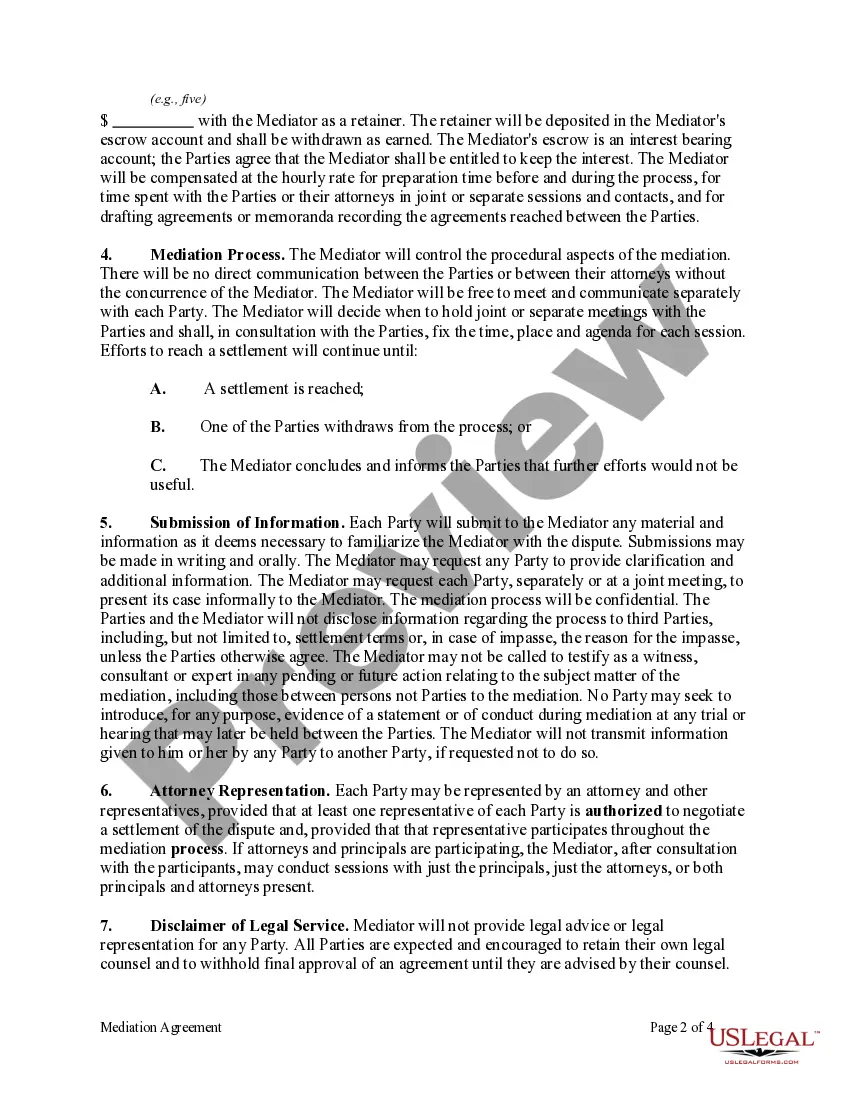
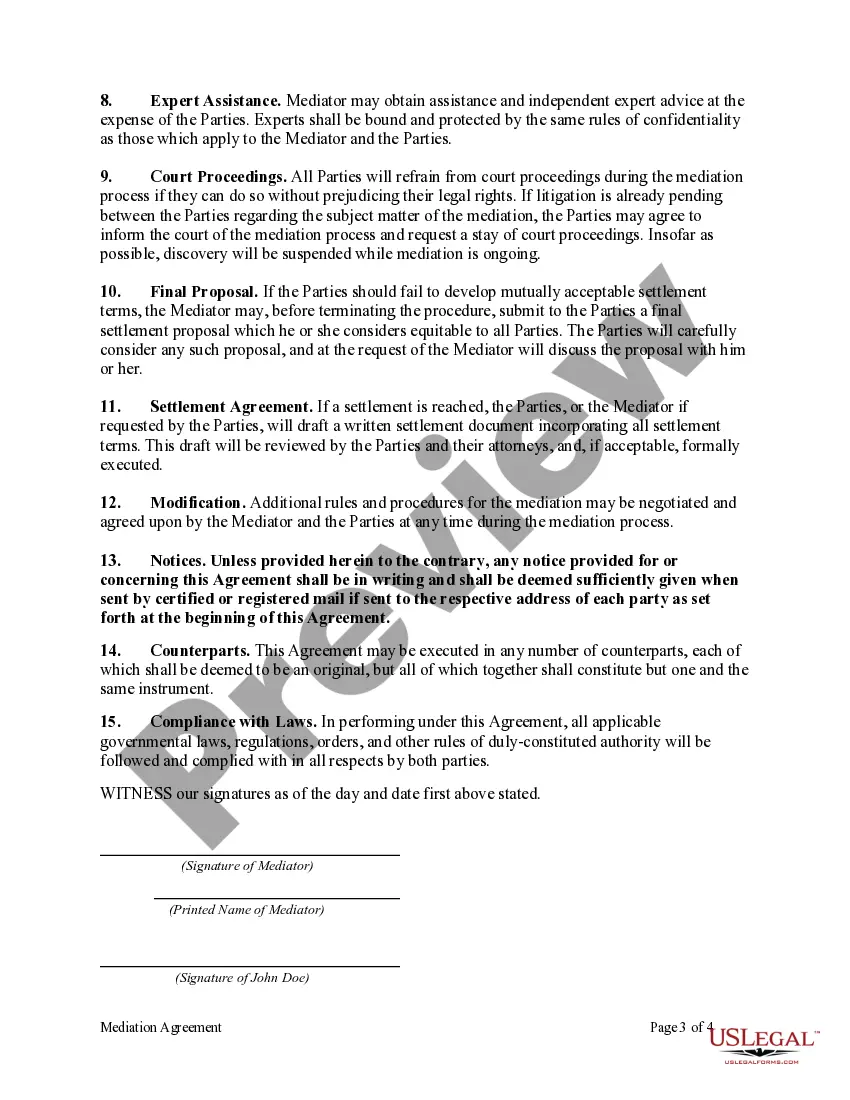
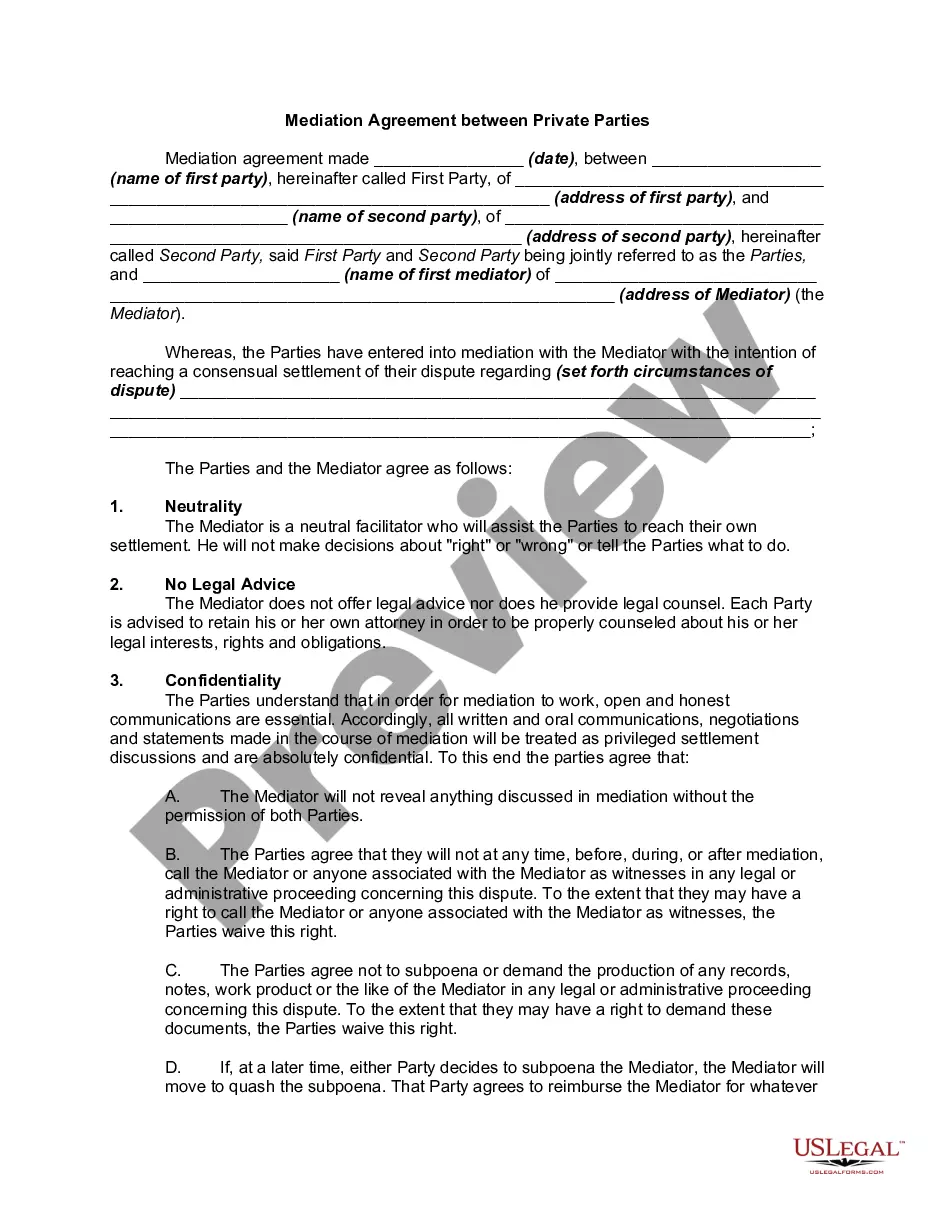
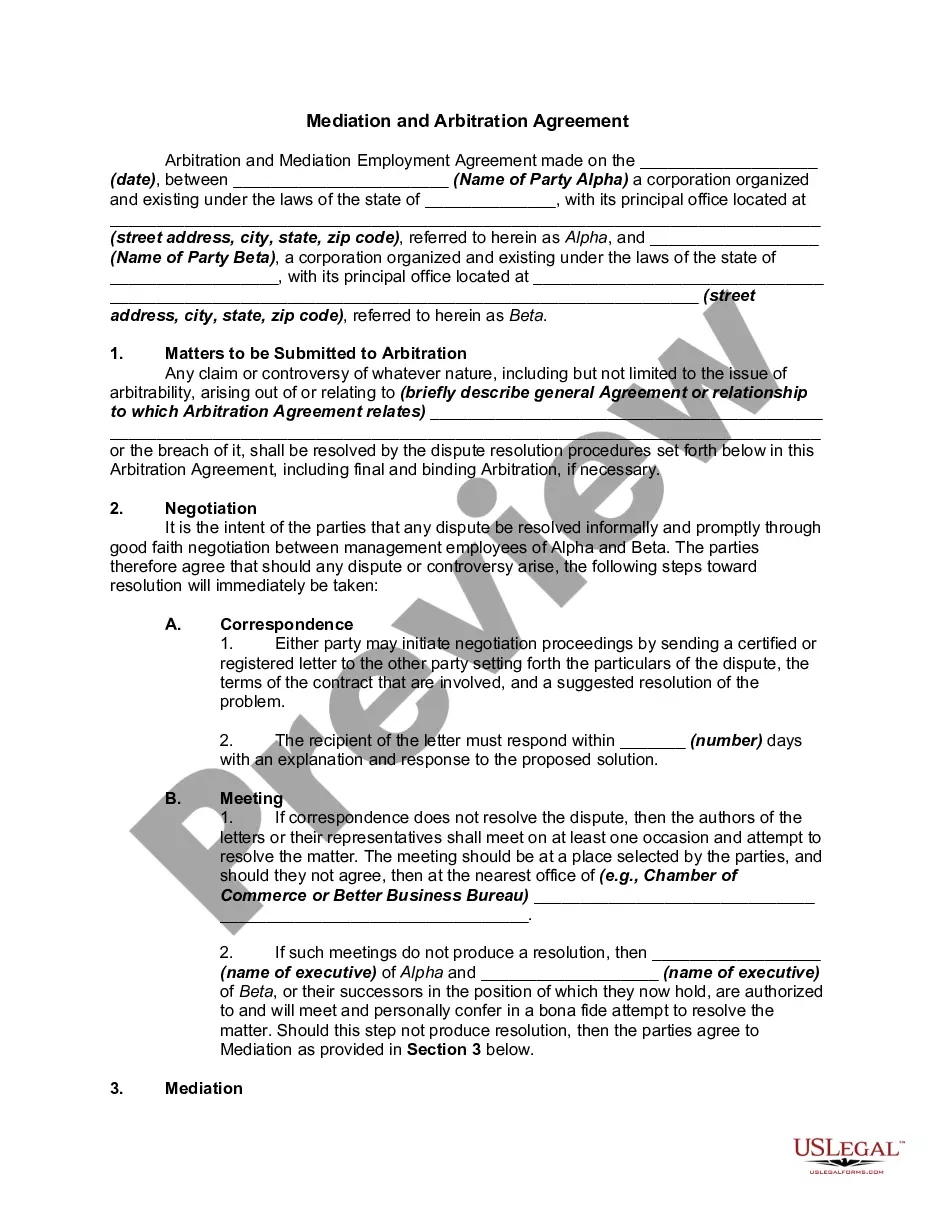
How to fill out Mediation Agreement?
Managing legal paperwork and procedures could be a lengthy addition to your whole day.
Mediation vs Arbitration Explanation for Court and similar forms frequently require you to seek them out and figure out how to fill them out correctly.
As a result, if you are addressing financial, legal, or personal issues, leveraging a comprehensive and functional online repository of forms at your disposal will greatly assist you.
US Legal Forms is the premier online platform for legal templates, providing over 85,000 state-specific documents and various tools to help you complete your paperwork effortlessly.
Is this your first experience with US Legal Forms? Create and establish a complimentary account in just a few minutes, and you will gain access to the form library and Mediation vs Arbitration Explanation for Court. Next, follow the steps outlined below to complete your form.
- Explore the collection of relevant documents available to you with just a single click.
- US Legal Forms offers state- and county-specific documents accessible anytime for downloading.
- Protect your document management procedures by utilizing a high-quality service that enables you to prepare any form within minutes without additional or hidden fees.
- Simply Log In to your account, locate Mediation vs Arbitration Explanation for Court, and obtain it instantly in the My documents section.
- You can also retrieve previously downloaded forms.
Form popularity
FAQ
Typically, mediation comes first when parties want to resolve their dispute amicably. If mediation fails to produce a resolution, parties may then proceed to arbitration. This sequential approach allows for exploring all avenues of settlement before resorting to a more formal and binding process.
I would recommend arbitration to a friend in such situations because it provides a structured and definitive resolution. Arbitration results in a legally binding decision, which can be essential for disputes involving significant claims or legal complexities. While mediation focuses on collaboration, arbitration ensures that there is a clear outcome that the parties must adhere to.
Mediation should be used when parties are open to negotiation and want to maintain their relationships. It is particularly effective in disputes where communication is key, such as family matters or business partnerships. By using mediation early in a conflict, parties can often resolve issues before they escalate into more significant legal battles.
Many individuals choose mediation over arbitration because it offers a less formal setting and a greater chance for creative solutions. Mediation encourages dialogue, allowing parties to express their needs and desires openly. This often results in solutions that satisfy all parties involved, whereas arbitration can lead to a win-lose scenario.
Choosing between mediation and arbitration depends on the specifics of your dispute. Mediation is suitable when both parties are willing to negotiate and seek a collaborative solution. In contrast, arbitration may be appropriate when you need a binding decision from a neutral third party, especially in complex cases that require a definitive resolution.
Lawyers often prefer mediation because it promotes open communication and collaboration between parties. Mediation allows for a more flexible process where parties can find common ground and reach a mutually beneficial resolution. This approach can lead to quicker outcomes and lower costs compared to arbitration or trial, making mediation a practical choice for many disputes.
When considering the mediation vs arbitration definition for court, it's important to understand their order of operations. Typically, mediation occurs first as a way to resolve disputes amicably before escalating to arbitration. Mediation encourages open communication and collaboration between parties, aiming for a mutual agreement. If mediation fails to yield a resolution, arbitration serves as the next step, providing a more formal process with a binding decision.