Mediation Any Legal Without Consent
Description



Get your form ready online
Our built-in tools help you complete, sign, share, and store your documents in one place.
Make edits, fill in missing information, and update formatting in US Legal Forms—just like you would in MS Word.
Download a copy, print it, send it by email, or mail it via USPS—whatever works best for your next step.
Sign and collect signatures with our SignNow integration. Send to multiple recipients, set reminders, and more. Go Premium to unlock E-Sign.
If this form requires notarization, complete it online through a secure video call—no need to meet a notary in person or wait for an appointment.
We protect your documents and personal data by following strict security and privacy standards.

Make edits, fill in missing information, and update formatting in US Legal Forms—just like you would in MS Word.

Download a copy, print it, send it by email, or mail it via USPS—whatever works best for your next step.

Sign and collect signatures with our SignNow integration. Send to multiple recipients, set reminders, and more. Go Premium to unlock E-Sign.

If this form requires notarization, complete it online through a secure video call—no need to meet a notary in person or wait for an appointment.

We protect your documents and personal data by following strict security and privacy standards.
Looking for another form?

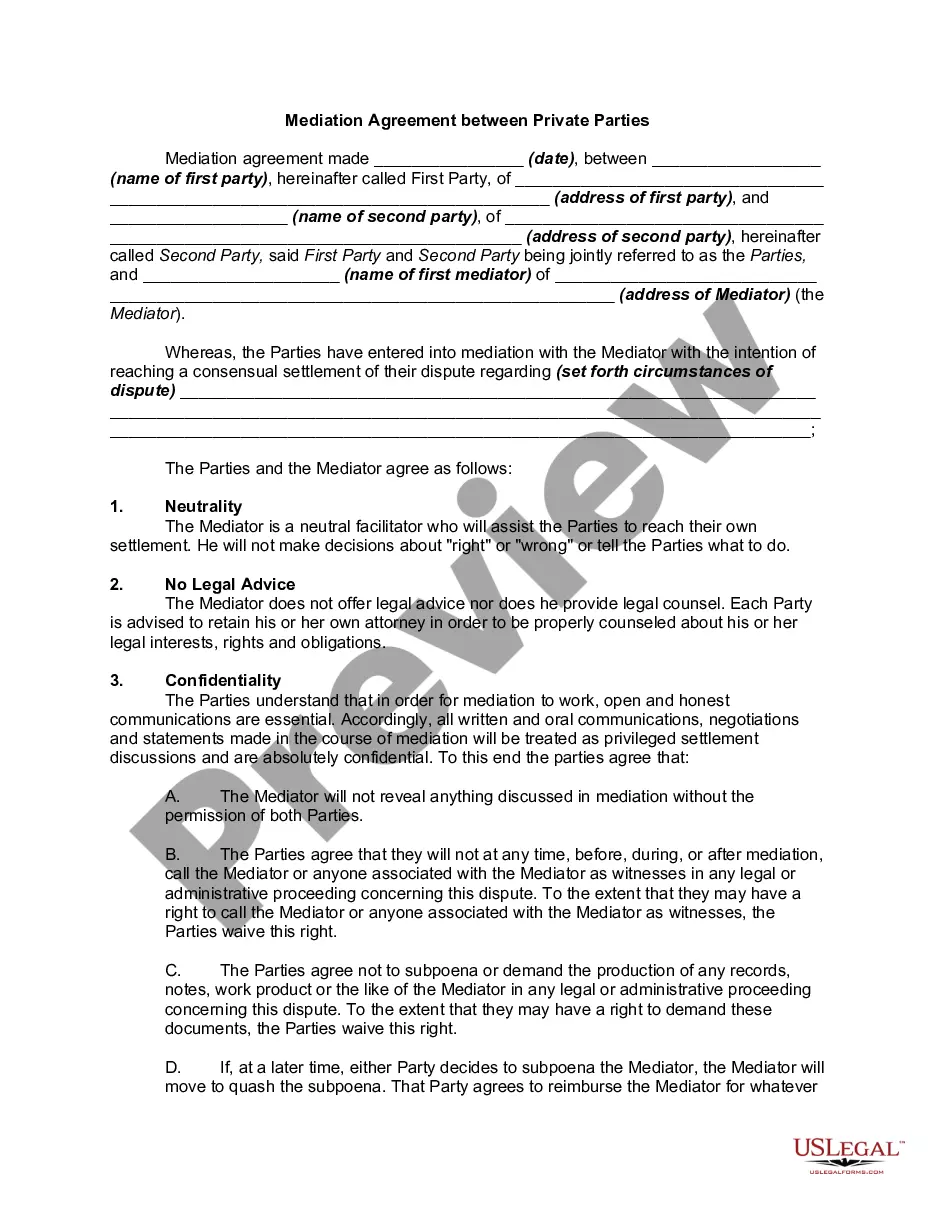
How to fill out Mediation Agreement Between Private Parties?
The Mediation Any Legal Without Consent you observe on this page is a versatile official template crafted by experienced attorneys in accordance with federal and local statutes and regulations.
For over 25 years, US Legal Forms has supplied individuals, organizations, and legal practitioners with more than 85,000 authenticated, state-specific forms for any business and personal occasion. It’s the quickest, most straightforward, and most reliable means to acquire the documents you require, as the service ensures the highest level of data protection and anti-malware safety.
Register with US Legal Forms to access verified legal templates for every situation in life.
- Browse for the document you require and review it.
- Sign up and Log In.
- Obtain the fillable template.
- Complete and sign the documents.
- Download your forms again.
Form popularity
FAQ
Refusing mediation can result in the court proceeding with a lawsuit, which may not be in your best interest. Courts often look favorably upon those who attempt mediation, as it demonstrates a willingness to resolve disputes amicably. Additionally, mediation any legal without consent could offer you a chance to negotiate terms that suit your needs. Therefore, consider the potential benefits of engaging in mediation before opting out.
If you do not agree to mediation, the legal process may continue without your participation in the alternative dispute resolution. This could lead to a more contentious court process, where decisions are made without considering your perspective. Mediation any legal without consent can facilitate dialogue and lead to outcomes that may satisfy all parties involved. It's essential to weigh the benefits of mediation before making a final decision.
When a parent refuses to attend mediation, the court may view this as a lack of willingness to resolve issues amicably. This could lead to the court making decisions without the parent's input, potentially resulting in outcomes that may not be favorable. Mediation any legal without consent can provide an opportunity for parents to voice their concerns and reach a collaborative solution. Engaging in this process is often in everyone's best interest.
The golden rule of mediation is to maintain open communication and respect for all parties involved. This principle encourages participants to listen actively and express their views without hostility. Sticking to this rule can foster a collaborative environment, making mediation any legal without consent more effective. Remember, the goal is to reach a mutually acceptable agreement.
You can choose to skip mediation and proceed directly to court, but this approach may not always be wise. Courts may require evidence of attempts to mediate before allowing a case to proceed. Engaging in mediation any legal without consent can often lead to quicker resolutions, saving time and resources. Therefore, it's worth exploring mediation as a first step.
Refusing mediation may create a negative impression in legal proceedings. It can suggest that you are unwilling to cooperate or find common ground. Courts often favor parties who attempt to resolve disputes amicably, as it shows a willingness to communicate. Therefore, considering mediation any legal without consent could be beneficial.
Five Keys to a Successful Mediation Attitude adjustment. This is probably the most important thing that you can do to help reach a successful conclusion in the mediation of your dispute. ... Prepare, prepare, prepare. ... State your case clearly and keep the emotion out. ... Be flexible. ... Be patient.
It may be easy to establish who is at fault, but you do not want to go into mediation saying things like, ?This is all your fault? or ?If not for you, I wouldn't have been injured.? Placing blame can raise the other party's guard, which could make them less likely to compromise.
Mediation/conciliation sessions and meetings are private. Only the concerned parties or their counsel or power of attorney holders can attend. Other persons may attend only with the consent of the parties and with the permission of the mediator/conciliator.
As per the Arbitration and Conciliation Act and the Commercial Court Act, mediation agreements are deemed to be on the same level as arbitral awards, and therefore, can be challenged for the same reasons as arbitral awards.