Community Property Separately Filing For Texas Married
Description
Get your form ready online
Our built-in tools help you complete, sign, share, and store your documents in one place.
Make edits, fill in missing information, and update formatting in US Legal Forms—just like you would in MS Word.
Download a copy, print it, send it by email, or mail it via USPS—whatever works best for your next step.
Sign and collect signatures with our SignNow integration. Send to multiple recipients, set reminders, and more. Go Premium to unlock E-Sign.
If this form requires notarization, complete it online through a secure video call—no need to meet a notary in person or wait for an appointment.
We protect your documents and personal data by following strict security and privacy standards.

Make edits, fill in missing information, and update formatting in US Legal Forms—just like you would in MS Word.

Download a copy, print it, send it by email, or mail it via USPS—whatever works best for your next step.

Sign and collect signatures with our SignNow integration. Send to multiple recipients, set reminders, and more. Go Premium to unlock E-Sign.

If this form requires notarization, complete it online through a secure video call—no need to meet a notary in person or wait for an appointment.

We protect your documents and personal data by following strict security and privacy standards.
Looking for another form?
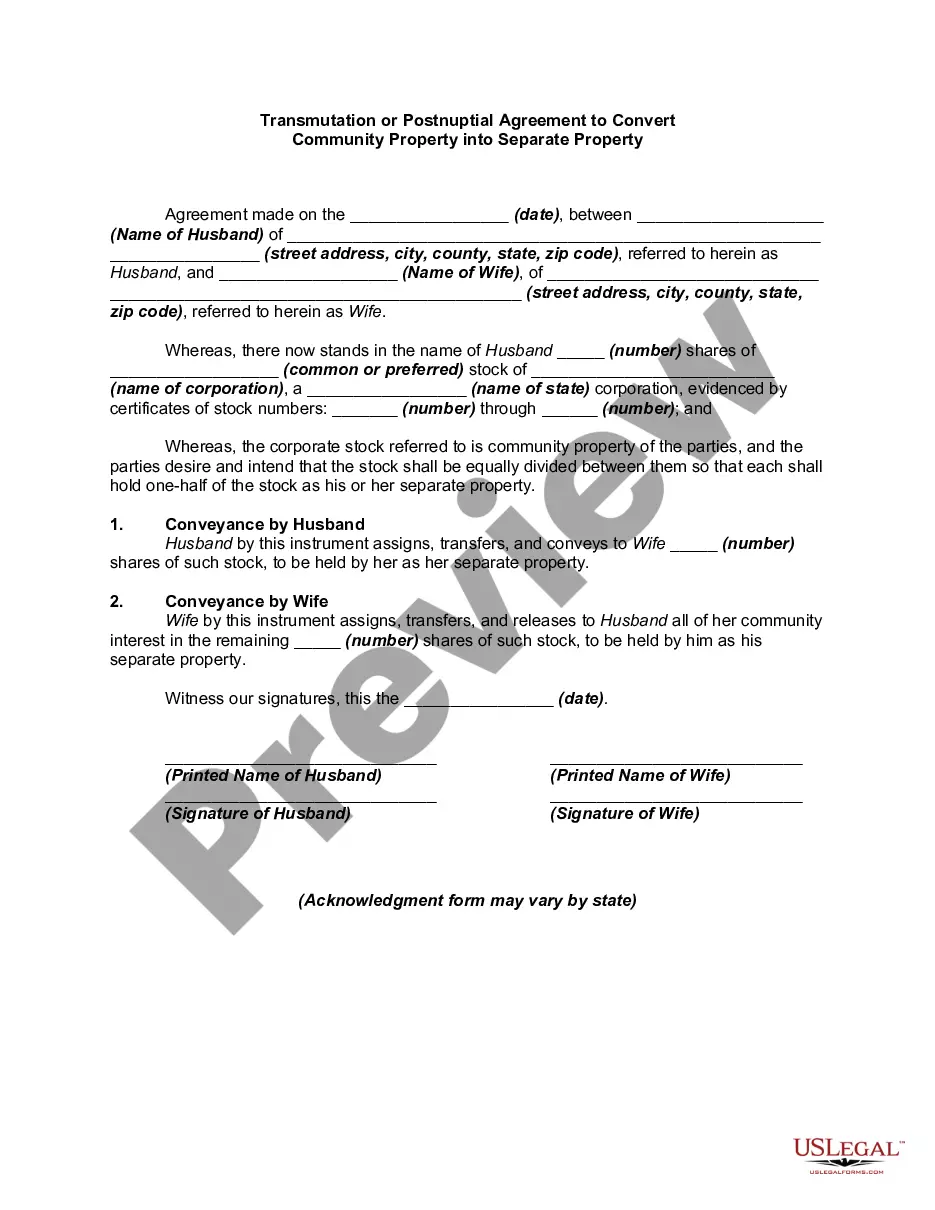
How to fill out Transmutation Or Postnuptial Agreement To Convert Community Property Into Separate Property?
Whether for professional reasons or personal matters, everyone encounters legal situations at some stage in their life.
Completing legal documents requires meticulous attention, starting with selecting the appropriate form template. For example, if you choose an incorrect version of a Community Property Separately Filing For Texas Married, it will be rejected upon submission.
With a comprehensive US Legal Forms catalog available, there’s no need to waste time searching for the right sample online. Use the library’s straightforward navigation to find the correct template for any situation.
- Locate the template you need by using the search bar or browsing the catalog.
- Review the form’s details to confirm it aligns with your circumstances, state, and locality.
- Click on the form’s preview to inspect it.
- If it is the incorrect document, return to the search feature to find the Community Property Separately Filing For Texas Married template you need.
- Download the document when it meets your criteria.
- If you already possess a US Legal Forms account, click Log in to access previously saved templates in My documents.
- If you do not have an account yet, you can download the form by clicking Buy now.
- Select the suitable pricing option.
- Complete the account registration form.
- Choose your payment method: use a credit card or PayPal account.
- Select the document format you wish and download the Community Property Separately Filing For Texas Married.
- Once saved, you can fill out the form using editing software or print it and complete it by hand.
Form popularity
FAQ
It means that you and your spouse each report income, deductions, credits and exemptions on separate tax returns instead of on one return jointly. For example, a couple choosing to file separately would each file their own Form 1040 and any accompanying schedules, like Schedule 1, Schedule A or Schedule D.
Section 4.203 - Formalities of Agreement (a) An agreement to convert separate property to community property: (1) must be in writing and: (A) be signed by the spouses; (B) identify the property being converted; and (C) specify that the property is being converted to the spouses' community property; and (2) is ...
Though most married couples file joint tax returns, filing separately may be better in certain situations. Couples can benefit from filing separately if there's a big disparity in their respective incomes, and the lower-paid spouse is eligible for substantial itemizable deductions.
Married couples have the option to file jointly or separately on their federal income tax returns. The IRS strongly encourages most couples to file joint tax returns by extending several tax breaks to those who file together.
Because Texas is a community property state, all family income is owned equally by both spouses. This means that in order to file a Married Filing Separately (MFS) return for married taxpayers living in Texas, both spouses must equally divide the total income.