Workers With Hearing Loss
Description


Get your form ready online
Our built-in tools help you complete, sign, share, and store your documents in one place.
Make edits, fill in missing information, and update formatting in US Legal Forms—just like you would in MS Word.
Download a copy, print it, send it by email, or mail it via USPS—whatever works best for your next step.
Sign and collect signatures with our SignNow integration. Send to multiple recipients, set reminders, and more. Go Premium to unlock E-Sign.
If this form requires notarization, complete it online through a secure video call—no need to meet a notary in person or wait for an appointment.
We protect your documents and personal data by following strict security and privacy standards.

Make edits, fill in missing information, and update formatting in US Legal Forms—just like you would in MS Word.

Download a copy, print it, send it by email, or mail it via USPS—whatever works best for your next step.

Sign and collect signatures with our SignNow integration. Send to multiple recipients, set reminders, and more. Go Premium to unlock E-Sign.

If this form requires notarization, complete it online through a secure video call—no need to meet a notary in person or wait for an appointment.

We protect your documents and personal data by following strict security and privacy standards.
Looking for another form?


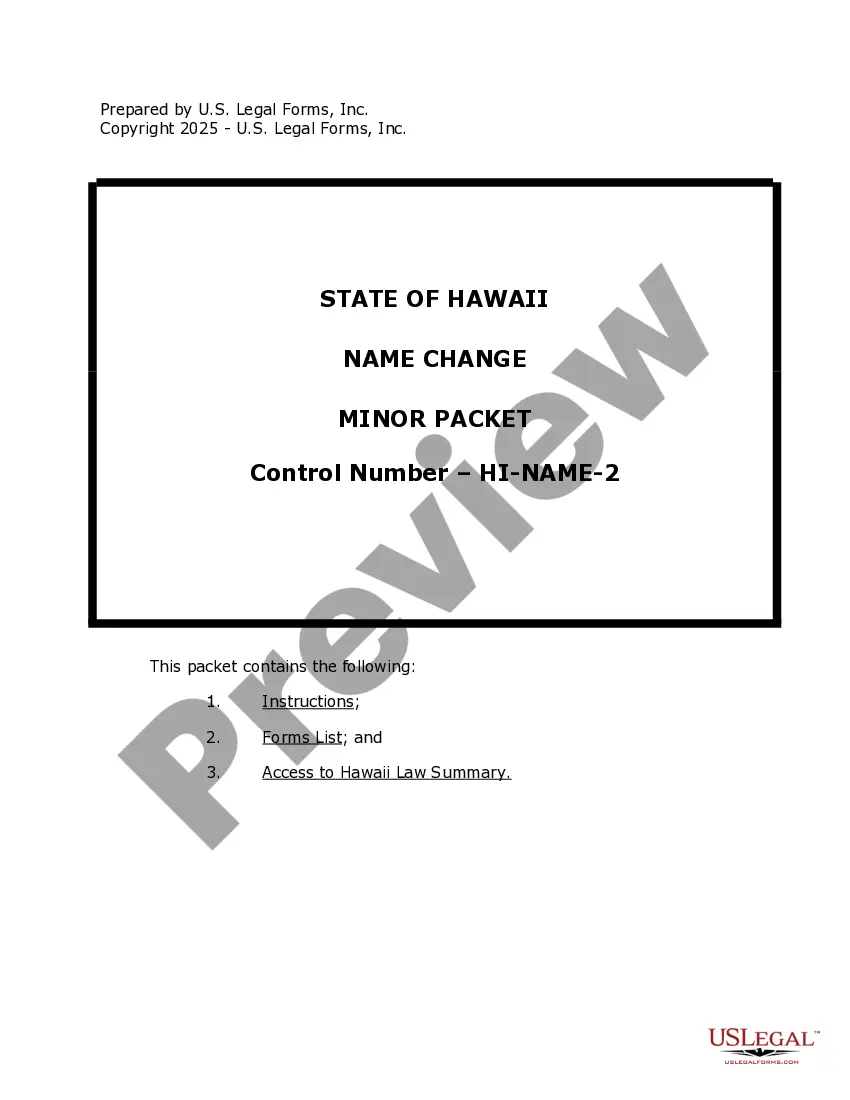
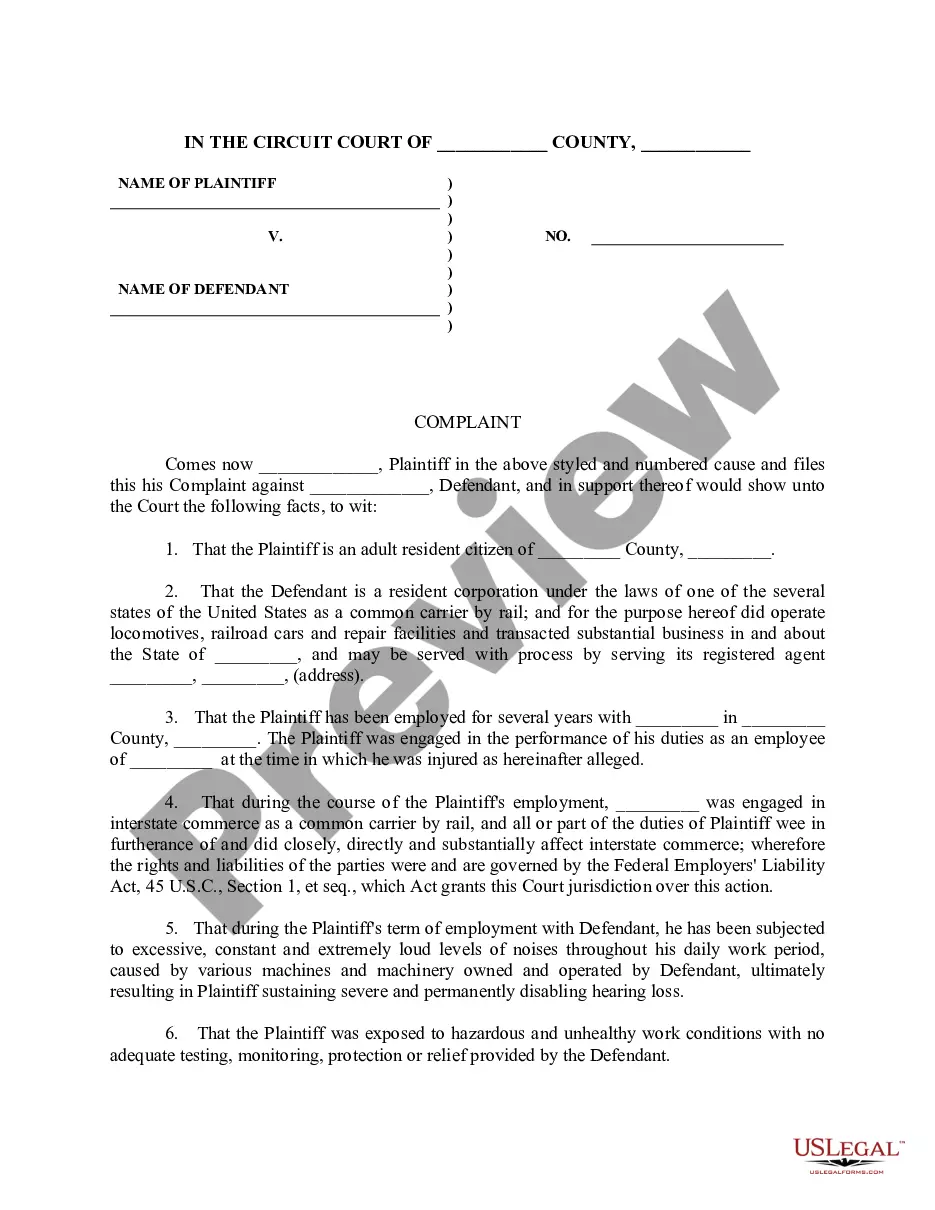
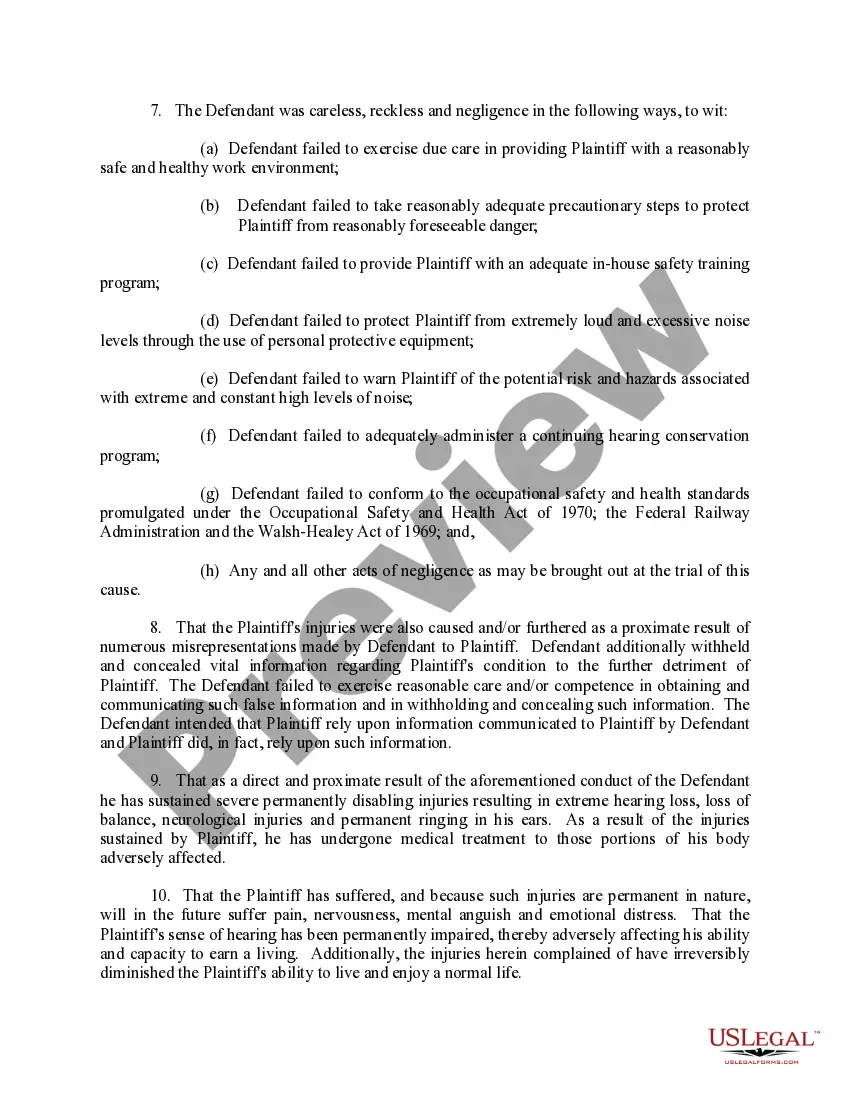
How to fill out Complaint Against Railroad By Employee For Hearing Loss?
The Laborers With Auditory Impairment you observe on this page is a reusable formal template crafted by professional attorneys in accordance with federal and local statutes and regulations.
For over 25 years, US Legal Forms has supplied individuals, enterprises, and legal experts with more than 85,000 authenticated, state-specific forms suitable for any commercial and personal circumstance. It’s the quickest, simplest, and most trustworthy method to acquire the documents you require, as the service guarantees top-tier data security and anti-malware safeguards.
Subscribe to US Legal Forms to have verified legal templates for all of life’s situations at your fingertips.
- Search for the document you require and review it.
- Browse through the sample you searched and preview it or examine the form description to ensure it meets your specifications. If it does not, use the search bar to locate the appropriate one. Click Buy Now when you have found the template you need.
- Subscribe and Log In.
- Choose the pricing plan that fits you and create an account. Use PayPal or a credit card for a swift payment. If you already own an account, Log In and verify your subscription to proceed.
- Obtain the editable template.
- Select the format you wish for your Workers With Hearing Loss (PDF, DOCX, RTF) and save the sample on your device.
- Fill out and sign the document.
- Print the template to fill it out by hand. Alternatively, employ an online multifunctional PDF editor to swiftly and accurately complete and sign your form with a valid signature.
- Download your documents once again.
- Re-utilize the same document whenever needed. Access the My documents tab in your profile to redownload any previously acquired forms.
Form popularity
FAQ
In audiology, the 60-60 rule also refers to the recommended audio listening settings. This guidance helps prevent hearing damage among workers with hearing loss by suggesting a maximum volume of 60% for listening durations not exceeding 60 minutes. It's vital to establish these habits to maintain hearing health.
Documentation of hearing impairments should be a comprehensive audiological evaluation. The report should include results of an audiogram that shows the type of hearing loss (i.e., conductive, otosclerosis, congenital, or sensory-neural) and the degree of hearing loss.
You can't be fired for disclosing hearing loss?, but ?your duties could change or your job ?could end if your hearing loss poses a serious safety threat. ?It is better to disclose your disability and request accommodations before job performance suffers,? the group notes.
Office set-up for hearing loss Make sure the office is well lit. ... Remove glass barriers, as they can muffle sounds. Keep close when speaking. ... Give the person with a hearing impairment an office or working space with minimal background noise.
EFFECTIVE ? AND COMFORTABLE ? HEARING PROTECTION There's no getting around it. To be effective in helping prevent workplace-related hearing loss in noisy environments, HPDs must be worn constantly when noise levels are high. That means they must be comfortable enough for workers to wear them for as long as necessary.
Employers are under a legal obligation to make reasonable adjustments to ensure that an employee with hearing loss can perform their role without unfair disadvantage.