Write With Down
Description



Get your form ready online
Our built-in tools help you complete, sign, share, and store your documents in one place.
Make edits, fill in missing information, and update formatting in US Legal Forms—just like you would in MS Word.
Download a copy, print it, send it by email, or mail it via USPS—whatever works best for your next step.
Sign and collect signatures with our SignNow integration. Send to multiple recipients, set reminders, and more. Go Premium to unlock E-Sign.
If this form requires notarization, complete it online through a secure video call—no need to meet a notary in person or wait for an appointment.
We protect your documents and personal data by following strict security and privacy standards.

Make edits, fill in missing information, and update formatting in US Legal Forms—just like you would in MS Word.

Download a copy, print it, send it by email, or mail it via USPS—whatever works best for your next step.

Sign and collect signatures with our SignNow integration. Send to multiple recipients, set reminders, and more. Go Premium to unlock E-Sign.

If this form requires notarization, complete it online through a secure video call—no need to meet a notary in person or wait for an appointment.

We protect your documents and personal data by following strict security and privacy standards.
Looking for another form?
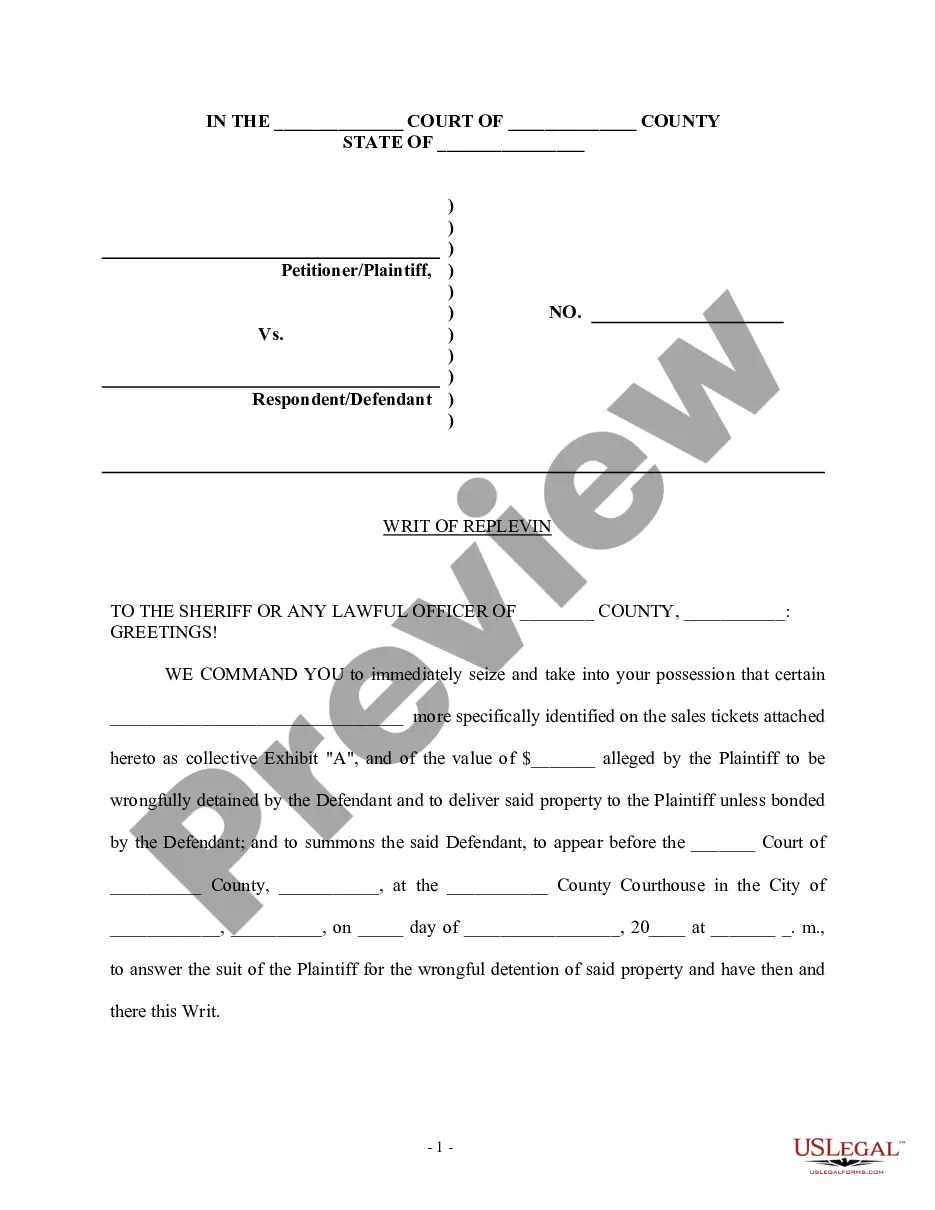
How to fill out Writ Of Replevin Or Repossession?
- If you're a returning user, login to your account to download the desired form template by clicking the Download button. Ensure your subscription is active, and if not, renew it based on your chosen payment plan.
- For first-time users, start by browsing through the Preview mode and form descriptions to find the legal document that best fits your needs while complying with your local jurisdiction.
- If your selected template has discrepancies, use the Search feature to locate an alternative that meets your requirements. Proceed when you find the correct one.
- Purchase the appropriate document by clicking the Buy Now button, then select your preferred subscription plan. You'll need to create an account to gain access to the extensive library.
- Complete your purchase by entering your credit card information or using a PayPal account to finalize the subscription.
- Finally, download the completed form to your device for future use. Access this document at any time via the My Forms section of your account.
By following these simple steps, you can efficiently utilize US Legal Forms’ extensive library of over 85,000 ready-to-fill legal documents.
Start benefiting from expert assistance today—navigate legal matters with confidence and ease!
Form popularity
FAQ
The terms 'write' and 'write-down' differ in their usage and implications. 'Write' refers to the general act of putting information onto paper or digital media, while 'write-down' specifically relates to documenting something important that might require further review or consideration. When you choose to write with down, you express a focused intent to retain crucial information that matters to you. Understanding these differences allows you to communicate more clearly and effectively in your writing.
The term that means to write-down is 'record.' When you record something, you are actively capturing information for future use, which aligns perfectly with the concept of writing down important details. By opting to write with down, you reinforce the need to maintain clarity and organization in your notes. This habit can significantly enhance your information management skills and ensure you can easily refer back to the recorded details.
You should use 'write-down' when you talk about the process of reducing the book value of an asset or recognizing a decrease in its worth. Additionally, in everyday situations, this term can apply when you need to document important information that will guide future decisions. Emphasizing that you take the action to write with down reinforces your commitment to staying organized and informed. Understanding when to use this term can improve your communication, especially in financial and professional settings.
The main difference between 'write down' and 'write' lies in the intent and specificity of the action. 'Write' is a broad term that encompasses any act of writing, while 'write down' specifically implies recording information for future reference. Therefore, when you choose to write with down, you are emphasizing the importance of capturing details in a format that you can revisit later. This distinction helps you use these terms effectively in various contexts.
The phrase 'write this down' refers to the action of recording information in a written format. People often use this expression to remind someone to document important details or instructions. By writing things down, you improve retention and ensure that you have a reliable reference. This practice can enhance your organization skills, making it easier to manage tasks and responsibilities.
If you find it challenging to put your thoughts into writing, it may be due to a fear of inadequacy or perfectionism. It’s important to allow yourself the freedom to write without self-criticism. Start writing with down, focusing on getting your ideas on paper first before refining them.
Writing down is one of the best methods to study effectively. It not only helps in memorizing information but also aids in organizing your thoughts for better comprehension. Experiment with different techniques, such as outlining or summarizing, to discover what works best for you.
When you learn by writing things down, it is often referred to as 'note-taking' or 'written learning.' This process helps establish a connection between what you learn and your understanding. By writing down, you actively participate in your learning journey instead of passively consuming information.
It can be hard to write down your thoughts due to pressure to formulate perfect sentences or fear of critique. Often, we place unnecessary barriers on our expression. Instead, focus on the act of writing with down as a way to liberate your thoughts and ideas.
Absolutely, you can learn effectively by writing down information. This technique reinforces the connections between ideas, making them more memorable. Plus, taking notes can help you engage with the material deeply, enhancing your overall understanding.