Writ Of Execution With A Suit
Description




Get your form ready online
Our built-in tools help you complete, sign, share, and store your documents in one place.
Make edits, fill in missing information, and update formatting in US Legal Forms—just like you would in MS Word.
Download a copy, print it, send it by email, or mail it via USPS—whatever works best for your next step.
Sign and collect signatures with our SignNow integration. Send to multiple recipients, set reminders, and more. Go Premium to unlock E-Sign.
If this form requires notarization, complete it online through a secure video call—no need to meet a notary in person or wait for an appointment.
We protect your documents and personal data by following strict security and privacy standards.

Make edits, fill in missing information, and update formatting in US Legal Forms—just like you would in MS Word.

Download a copy, print it, send it by email, or mail it via USPS—whatever works best for your next step.

Sign and collect signatures with our SignNow integration. Send to multiple recipients, set reminders, and more. Go Premium to unlock E-Sign.

If this form requires notarization, complete it online through a secure video call—no need to meet a notary in person or wait for an appointment.

We protect your documents and personal data by following strict security and privacy standards.
Looking for another form?

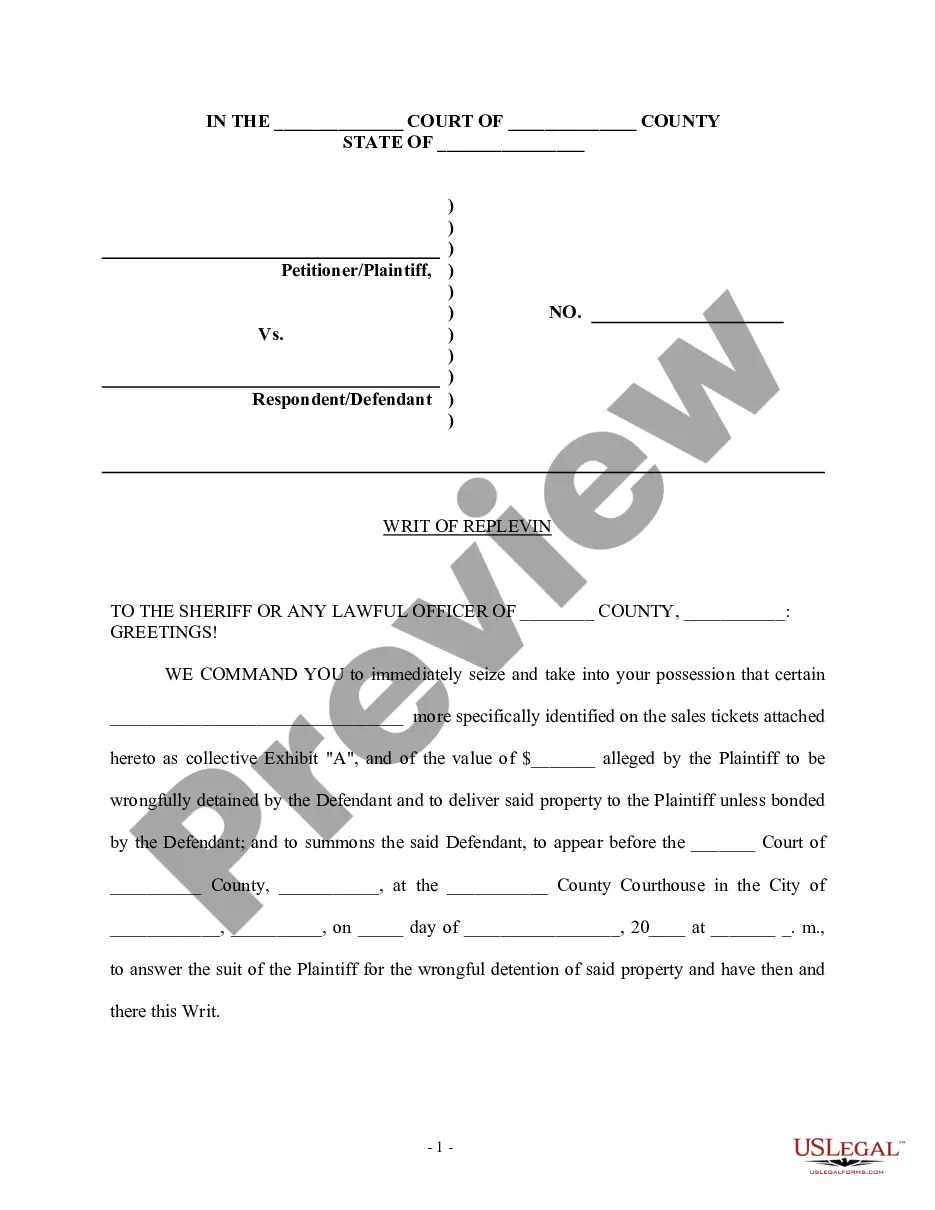
How to fill out Writ Of Replevin Or Repossession?
- For returning users, log in to your account and locate the required form in the library. Ensure your subscription is up to date to download.
- If you are new to US Legal Forms, start by reviewing the form preview and description to confirm it meets your specific needs and aligns with local jurisdiction requirements.
- Use the Search tab if the form does not fit your needs, enabling you to find alternative templates that suit your requirements.
- Select the correct document and click on the Buy Now button, choosing the subscription plan that works for you. Remember, an account is necessary to access the resources.
- Complete your purchase by entering your payment information—either credit card details or through PayPal.
- Download your completed form directly to your device and access it anytime through the My Forms section.
By leveraging US Legal Forms, you gain quick access to an extensive library of over 85,000 editable legal forms, ensuring you find exactly what you need. Each document is crafted for accuracy and compliance with local laws.
Don't let legal paperwork become overwhelming. Visit US Legal Forms today to efficiently secure your writ of execution with a suit and streamline your legal processes!
Form popularity
FAQ
Yes, a writ of execution with a suit can potentially lead to the seizure of your house if you owe a considerable debt. However, specific legal processes must be followed, and exemptions may apply based on state laws. It's essential to understand your rights and the implications of a writ of execution in your situation. For guidance, consider using the resources available on the USLegalForms platform to ensure you are well-informed.
The purpose of a writ of execution with a suit is to enforce a court's judgment. This legal document empowers the winning party to retrieve assets or property from the losing party. Essentially, it acts as a tool to ensure compliance with the court's decision. Utilizing a writ of execution can help you secure the compensation or assets you are entitled to.
To fight a writ of execution in Texas, you can file a motion to contest the execution or appeal the underlying judgment in the suit. It's crucial to act quickly, as there are deadlines for these legal actions. Consulting with an attorney or utilizing resources from USLegalForms can provide you with insights and templates to aid in your defense. Understanding your rights is an important step in challenging such legal orders.
An example of a writ of execution might involve a situation where a court has ruled that a debtor owes $10,000 to a creditor. The creditor can request a writ of execution, giving them the authority to seize property, such as bank funds or real estate, to collect that debt. This illustrates how a writ of execution with a suit functions to enforce court decisions effectively.
The main difference between a writ of execution and attachment lies in their purpose and timing. A writ of execution is used to enforce a judgment after it has been awarded in a suit, allowing creditors to take property to satisfy debts. On the other hand, an attachment is typically filed before a judgment to seize a debtor's property in anticipation of a future court decision. Understanding these distinctions can help you navigate legal proceedings more effectively.
A writ of execution in simple terms is a legal order that allows a creditor to enforce a judgment by taking possession of a debtor's property. This process usually occurs after a court has ruled in favor of the creditor during a suit. Essentially, it gives the creditor the power to collect what is owed to them through legal means. You can find helpful resources on USLegalForms to guide you through the process.
A writ of possession is a court order that allows a landlord to regain possession of a rental unit, while a writ of execution focuses on seizing property to satisfy a debt judgment. Although both are part of legal enforcement, they serve different purposes and contexts. Being informed about these distinctions is essential when dealing with a writ of execution with a suit.
A writ of execution may allow creditors to seize a variety of assets, including bank accounts, real estate, and personal property. The specific items that can be taken vary by state law and the nature of the judgment. It’s wise to seek guidance or use platforms like UsLegalForms to understand your rights and options when confronted with a writ of execution with a suit.
Certain types of income are exempt from collection under a writ of execution, including Social Security benefits, unemployment benefits, and child support payments. These protections are in place to ensure that individuals maintain a basic standard of living. If you face a writ of execution with a suit, it's crucial to identify what income remains untouched.
A writ of execution typically cannot touch certain assets deemed exempt by law. These may include retirement accounts, personal property up to a specific value, and necessary personal items. Knowing what is exempt can help you safeguard your essential assets while dealing with a writ of execution with a suit.