Writ Of Execution With
Description




Get your form ready online
Our built-in tools help you complete, sign, share, and store your documents in one place.
Make edits, fill in missing information, and update formatting in US Legal Forms—just like you would in MS Word.
Download a copy, print it, send it by email, or mail it via USPS—whatever works best for your next step.
Sign and collect signatures with our SignNow integration. Send to multiple recipients, set reminders, and more. Go Premium to unlock E-Sign.
If this form requires notarization, complete it online through a secure video call—no need to meet a notary in person or wait for an appointment.
We protect your documents and personal data by following strict security and privacy standards.

Make edits, fill in missing information, and update formatting in US Legal Forms—just like you would in MS Word.

Download a copy, print it, send it by email, or mail it via USPS—whatever works best for your next step.

Sign and collect signatures with our SignNow integration. Send to multiple recipients, set reminders, and more. Go Premium to unlock E-Sign.

If this form requires notarization, complete it online through a secure video call—no need to meet a notary in person or wait for an appointment.

We protect your documents and personal data by following strict security and privacy standards.
Looking for another form?
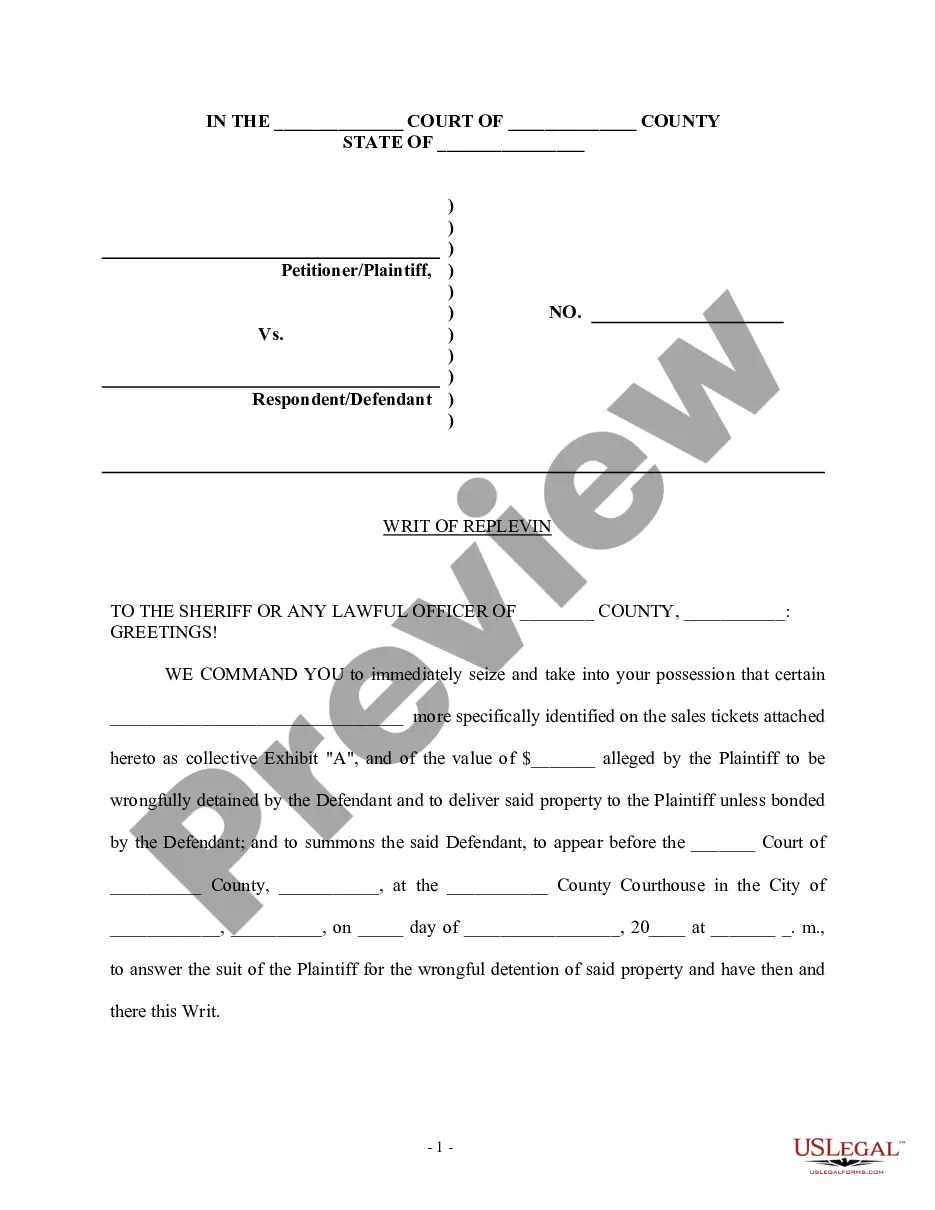
How to fill out Writ Of Replevin Or Repossession?
Regardless of whether for corporate motives or personal matters, everyone encounters legal issues at some time in their lifetime.
Completing legal paperwork requires meticulous consideration, starting from selecting the correct form template. For example, if you choose an incorrect version of the Writ Of Execution With, it will be rejected upon submission.
With an extensive US Legal Forms catalog available, there is no need to waste time searching for the right template online. Utilize the library's straightforward navigation to find the suitable form for any circumstance.
- Locate the template you require by using the search bar or browsing the catalog.
- Review the form's details to ensure it aligns with your circumstances, state, and locality.
- Select the form's preview to examine it.
- If it is not the appropriate form, return to the search tool to find the Writ Of Execution With template you need.
- Obtain the template once it meets your specifications.
- If you possess a US Legal Forms account, simply click Log in to access previously saved documents in My documents.
- If you do not have an account as of yet, you may download the form by selecting Buy now.
- Select the appropriate payment option.
- Fill out the account registration form.
- Choose your method of payment: either with a credit card or PayPal.
- Select the document format you wish and download the Writ Of Execution With.
- After downloading, you can fill out the form using editing software or print it and complete it by hand.
Form popularity
FAQ
To fill out a writ of habeas corpus, begin by writing the case title and docket number. Clearly state your reasons for seeking relief and ensure you include relevant details about your detention. For assistance, consider using resources from UsLegalForms, which can guide you through each step, while also helping you understand the interplay with processes like the writ of execution with.
An example of a writ of execution is a court order directing the sheriff to seize a debtor’s property to satisfy a judgment. This legal document enables the creditor to claim what is owed to them by law. When you examine such examples, you can also see how they relate to the overall process involved with the writ of execution with, which is critical in the fulfillment of court decisions.
To fill out a writ of habeas corpus, start by identifying the court where you will file the document. Gather necessary information such as the reasons for your petition, your personal details, and any supporting evidence. By carefully preparing your writ, you not only reinforce your case but also better understand connections to related processes, such as the writ of execution with.
Common grounds for habeas corpus relief include illegal detention, ineffective assistance of counsel, and violation of due process rights. Individuals seeking relief often cite specific circumstances that led to their unjust imprisonment. Familiarizing yourself with these grounds is crucial, especially as it relates to the broader topic of the writ of execution with, which serves to enforce court judgments.
A good sentence for habeas corpus might be, 'The prisoner filed a writ of habeas corpus to challenge the legality of his detention.' This sentence showcases the essential purpose of habeas corpus, which is to contest unlawful incarceration. Understanding how to use this term effectively can help you navigate legal discussions involving the writ of execution with precision.
Execution refers broadly to the enforcement of a court judgment through various means, including the seizure of assets, while foreclosure is specifically the process of reclaiming property due to unpaid mortgage loans. Hence, a writ of execution with serves a broader purpose than a foreclosure, allowing for the collection of different types of debts. Recognizing these distinctions can significantly influence how you approach debt resolution.
In New Jersey, a writ of execution is generally valid for 20 years from the date of entry of the judgment. This long validity period allows creditors ample time to pursue the collection of the debt. Being aware of the duration of a writ of execution with in New Jersey can help you manage outstanding debts effectively.
A writ of execution authorizes law enforcement to collect or seize assets from the losing party to satisfy a judgment. This may include garnishing wages, or seizing bank accounts or property. Therefore, if a creditor has won a judgment against you, understanding what a writ of execution with can do is essential in navigating your financial obligations.
A writ of execution is a court order aimed at enforcing a judgment, while foreclosure specifically refers to the legal process of repossessing real estate due to unpaid mortgage debt. Essentially, a writ of execution with can apply to various types of debts, whereas foreclosure is only relevant to mortgages. Understanding these differences ensures you identify the correct legal options for your situation.
After a writ of execution is served in North Carolina, the sheriff will typically take action to seize the debtor’s property or assets specified in the writ. This process often involves the identification and valuation of the property. Knowing what follows when a writ of execution with is served can help you prepare for the potential ramifications.