Writ Of Execution In Nigeria
Description



Get your form ready online
Our built-in tools help you complete, sign, share, and store your documents in one place.
Make edits, fill in missing information, and update formatting in US Legal Forms—just like you would in MS Word.
Download a copy, print it, send it by email, or mail it via USPS—whatever works best for your next step.
Sign and collect signatures with our SignNow integration. Send to multiple recipients, set reminders, and more. Go Premium to unlock E-Sign.
If this form requires notarization, complete it online through a secure video call—no need to meet a notary in person or wait for an appointment.
We protect your documents and personal data by following strict security and privacy standards.

Make edits, fill in missing information, and update formatting in US Legal Forms—just like you would in MS Word.

Download a copy, print it, send it by email, or mail it via USPS—whatever works best for your next step.

Sign and collect signatures with our SignNow integration. Send to multiple recipients, set reminders, and more. Go Premium to unlock E-Sign.

If this form requires notarization, complete it online through a secure video call—no need to meet a notary in person or wait for an appointment.

We protect your documents and personal data by following strict security and privacy standards.
Looking for another form?




How to fill out Writ Of Replevin Or Repossession?
Utilizing legal document templates that comply with federal and state regulations is essential, and the internet presents a wealth of choices to select from.
However, what’s the benefit of spending time searching for the suitable Writ Of Execution In Nigeria example online when the US Legal Forms digital library already consolidates these templates in one location.
US Legal Forms is the premier online legal repository featuring over 85,000 editable templates created by attorneys for any business and personal circumstance.
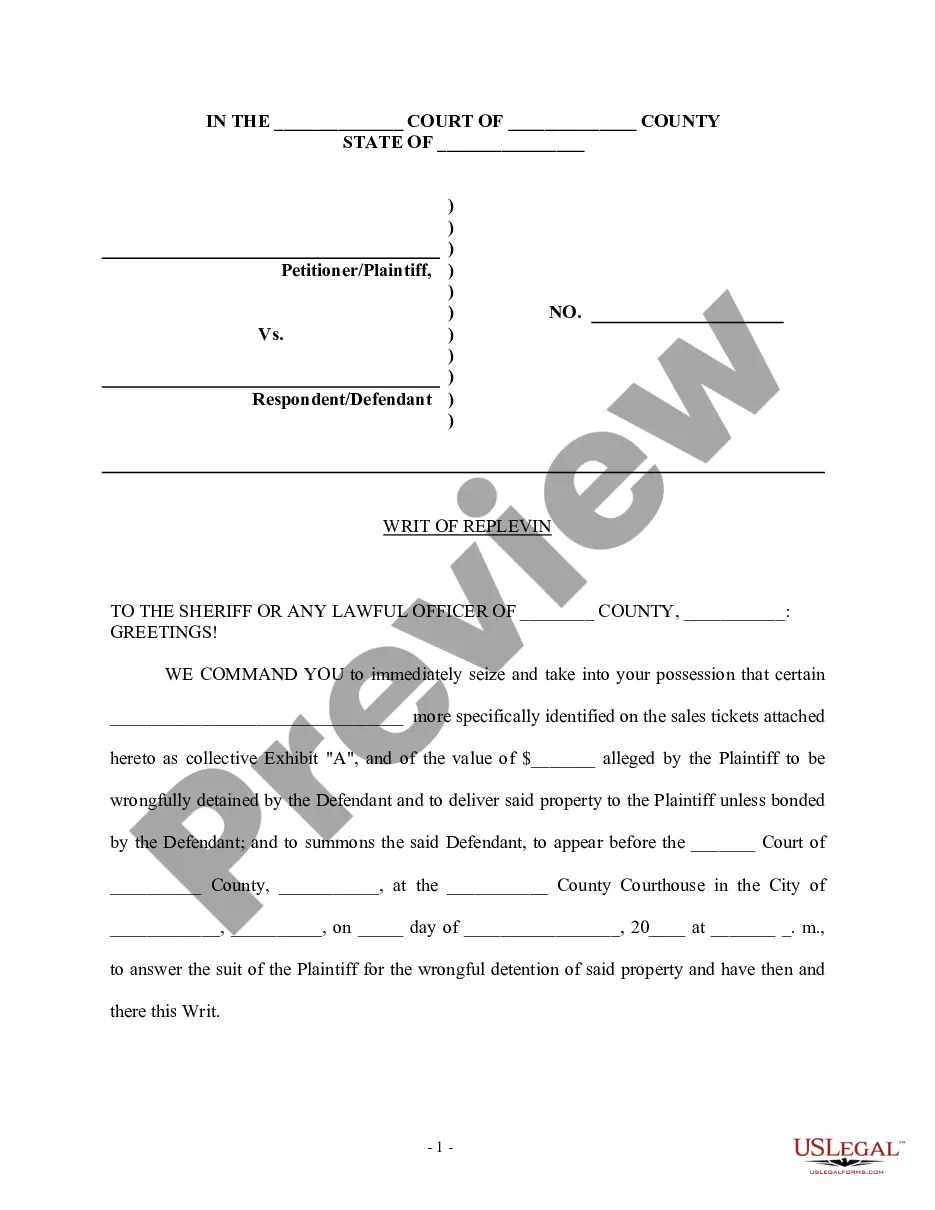
Review the template using the Preview feature or through the text description to confirm it suits your requirements.
- They are easy to navigate with all documents categorized by state and intended use.
- Our experts stay informed about legislative changes, so you can always trust that your documents are current and compliant when obtaining a Writ Of Execution In Nigeria from our site.
- Acquiring a Writ Of Execution In Nigeria is quick and straightforward for both existing and new users.
- If you have an account with a valid subscription, Log In and save the document template you require in your preferred format.
- If you are a newcomer to our website, follow the steps below.
Form popularity
FAQ
A writ of possession allows a landlord or property owner to reclaim possession of property from a tenant following a court order, while a writ of execution in Nigeria is used to enforce a judgment by seizing property to satisfy a debt. Essentially, the writ of possession focuses on regaining control of a physical asset, whereas the writ of execution targets a financial obligation. Understanding these distinctions helps you navigate legal processes more effectively. If you seek to enforce a judgment or reclaim property, consider using USLegalForms to obtain the necessary legal documents easily.
Ignoring a writ of execution in Nigeria can lead to serious consequences. Law enforcement may proceed to enforce the writ without your cooperation, potentially resulting in the seizure of your assets or property. Additionally, failure to comply with the writ can further complicate your legal situation and may lead to additional legal action against you. To avoid these outcomes, it is wise to seek advice and assistance from platforms such as US Legal Forms to understand your obligations.
A writ is primarily issued to enforce legal rights established by a court decision. In the case of a writ of execution in Nigeria, the aim is to ensure that a judgment creditor can collect debts owed as determined by the court. Writs can also facilitate the recovery of specific property or assets that a court has identified in a ruling. By using services like US Legal Forms, you can access the necessary documents to initiate this enforcement process.
The writ of possession in Nigeria is a court order that allows a successful plaintiff to recover possession of property. It is typically issued after a judgment has been made in favor of the plaintiff, particularly in cases of landlord-tenant disputes or repossession of property. This writ mandates that law enforcement return the property to the rightful owner, safeguarding the rights established by the court. Utilizing resources from US Legal Forms can help you understand how to effectively navigate this process.
A writ of execution in Nigeria serves as a legal order that allows a court to enforce a judgment. This document empowers law enforcement to take specific actions, such as seizing property or assets owned by the debtor. Essentially, the writ ensures that the creditor can collect the amounts owed to them following a court decision. If you are unfamiliar with the process, consider using a platform like US Legal Forms to guide you through obtaining a writ of execution.
Enforcing a court judgment in Nigeria involves a few key steps, starting with obtaining a writ of execution. You will submit this writ to the relevant court, prompting enforcement mechanisms, such as the seizure of assets. Platforms like USLegalForms provide guidance and necessary forms to help you navigate this process effectively.
To enforce a judgment in Nigeria, you generally need to file a writ of execution in the appropriate court. This writ directs law enforcement to take action, such as seizing property, to satisfy the judgment. Utilizing resources like USLegalForms can help streamline this process and ensure compliance with legal requirements.
If a defendant does not appear in court in Nigeria, the court may proceed to hear the case in their absence. Typically, this can lead to a default judgment being entered against the defendant. As a claimant, you may then have the opportunity to file a writ of execution in Nigeria to enforce this judgment.
In Nigeria, the limitation period for enforcing a judgment is six years from the date of the judgment. This means you must initiate the writ of execution in Nigeria within this timeframe if you want to enforce your rights. Failing to act within this period can result in the loss of your right to enforce the judgment.
Form 48 in Nigeria is a legal document used in the enforcement of a judgment. It serves as a notice of disobedience to a court order. When you file a writ of execution in Nigeria, the court may use Form 48 to compel compliance from a defendant who has not fulfilled their legal obligations.