Advance Notice On Arrival
Description
Get your form ready online
Our built-in tools help you complete, sign, share, and store your documents in one place.
Make edits, fill in missing information, and update formatting in US Legal Forms—just like you would in MS Word.
Download a copy, print it, send it by email, or mail it via USPS—whatever works best for your next step.
Sign and collect signatures with our SignNow integration. Send to multiple recipients, set reminders, and more. Go Premium to unlock E-Sign.
If this form requires notarization, complete it online through a secure video call—no need to meet a notary in person or wait for an appointment.
We protect your documents and personal data by following strict security and privacy standards.

Make edits, fill in missing information, and update formatting in US Legal Forms—just like you would in MS Word.

Download a copy, print it, send it by email, or mail it via USPS—whatever works best for your next step.

Sign and collect signatures with our SignNow integration. Send to multiple recipients, set reminders, and more. Go Premium to unlock E-Sign.

If this form requires notarization, complete it online through a secure video call—no need to meet a notary in person or wait for an appointment.

We protect your documents and personal data by following strict security and privacy standards.
Looking for another form?

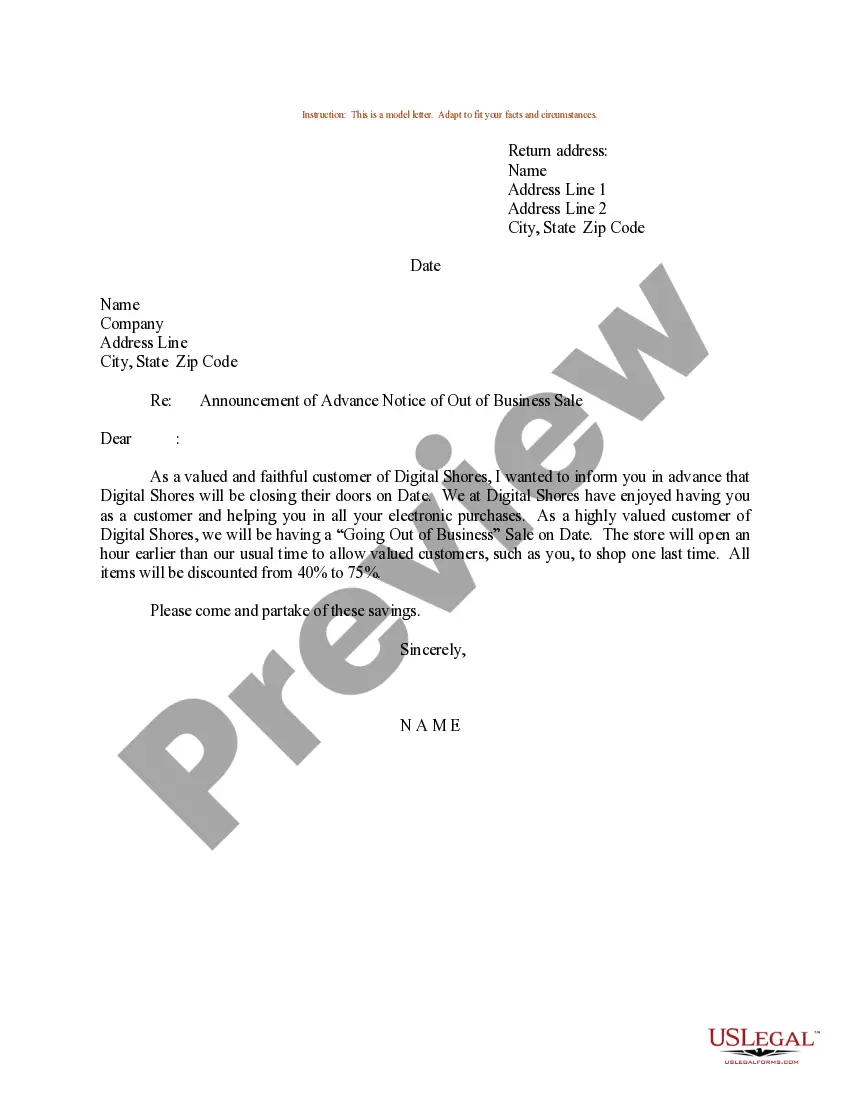
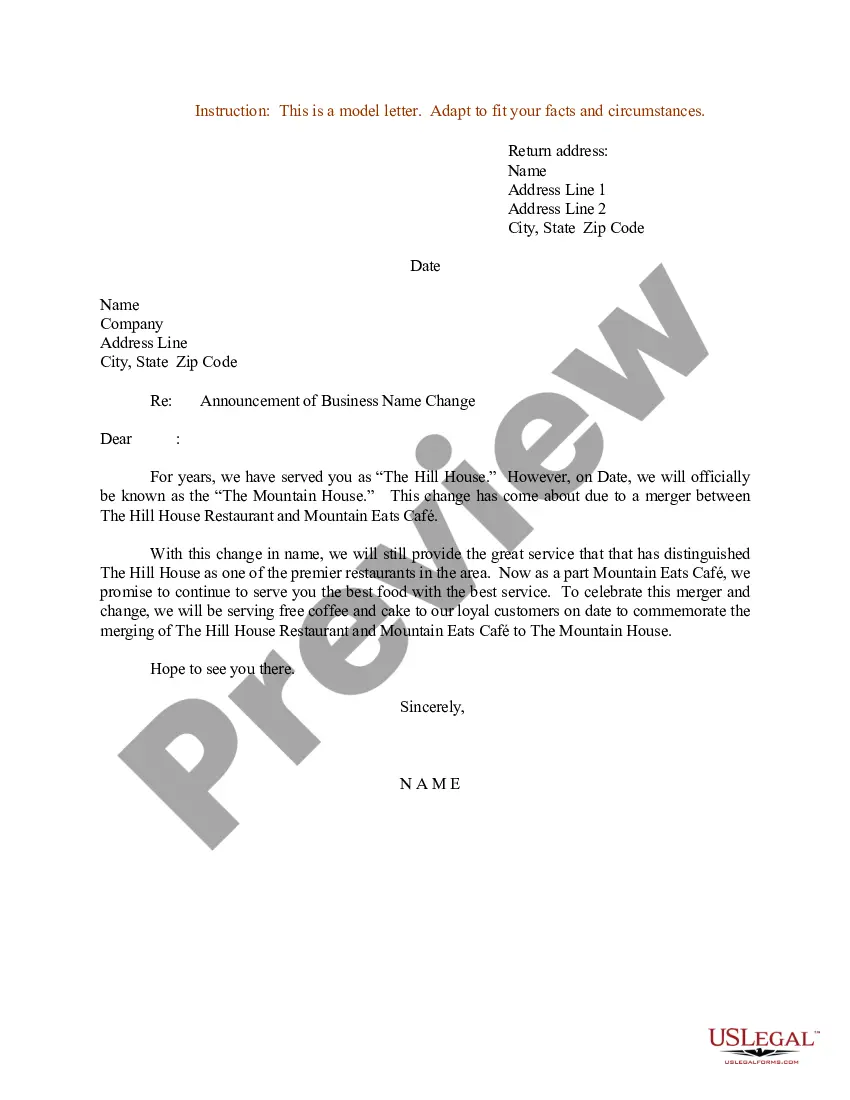
How to fill out Sample Letter For Announcement Of Advance Notice Of Out Of Business Sale?
Acquiring legal document samples that adhere to federal and state regulations is crucial, and the web provides numerous choices to choose from.
However, what’s the sense in spending time searching for the accurately constructed Advance Notice On Arrival template online when the US Legal Forms digital library already has such resources compiled in one location.
US Legal Forms is the largest online legal repository boasting over 85,000 editable templates prepared by attorneys for any commercial and personal situation.
Review the template using the Preview feature or through the text description to confirm it fits your needs.
- They are easy to navigate with all documents organized by state and intended purpose.
- Our experts stay updated on legislative modifications, ensuring that your form is current and compliant when obtaining an Advance Notice On Arrival from our platform.
- Receiving an Advance Notice On Arrival is quick and straightforward for both existing and new users.
- If you already possess an account with an active subscription, Log In and download the document template you require in your preferred format.
- If you are unfamiliar with our site, follow the outlined procedures below.
Form popularity
FAQ
Any individual who has more than $33 of PA taxable income ($1 of tax), or a net loss from any income class, must file a PA income tax return. However, commonly recognized retirement benefits are not taxable for Pennsylvania purposes if you retired and met the requirements for retirement under your employer's plan.
Fiscal year pass-through entities are allowed to file the PA- 40 NRC on behalf of its nonresident individual owners as long as the nonresident individual qualifies and elects to be included in the filing.
Every resident, part-year resident or nonresident individual must file a Pennsylvania Income Tax Return (PA-40) when he or she realizes income generating $1 or more in tax, even if no tax is due (e.g., when an employee receives compensation where tax is withheld).
Businesses that elect federal subchapter S status are considered Pennsylvania S corporations and are subject to the 9.99 percent corporate net income tax only to the extent of built-in-gains. Rather, shareholders in the businesses considered S Corporations are taxed at the personal income tax rate, 3.07 percent.
Some types of income are exempt from Pennsylvania state income tax, including child support, alimony, unemployment payments, and some capital gains on the sale of a primary residence. Some deductions are allowed for contributions to educational savings accounts and medical or health savings accounts.
Filing as an S Corp in Pennsylvania Step 1: Choose a Business Name. ... Step 2: Appoint Directors and a Registered Agent. ... Step 3: File Articles of Organization. ... Step 4: Create an S Corp Operating Agreement. ... Step 5: Apply for an Employer Identification Number. ... Step 6: File Form 2553 for S Corporation Election.
Every resident, part-year resident or nonresident individual must file a Pennsylvania Income Tax Return (PA-40) when he or she realizes income generating $1 or more in tax, even if no tax is due (e.g., when an employee receives compensation where tax is withheld).
If you are a PA resident, nonresident or a part-year PA resident, you must file a 2022 PA tax return if: ? You received total PA gross taxable income in excess of $33 during 2022, even if no tax is due with your PA return; and/or ? You incurred a loss from any transaction as an individual, sole proprietor, partner in a ...