Direct Deposit Form Blank For Wells Fargo In Travis
Description
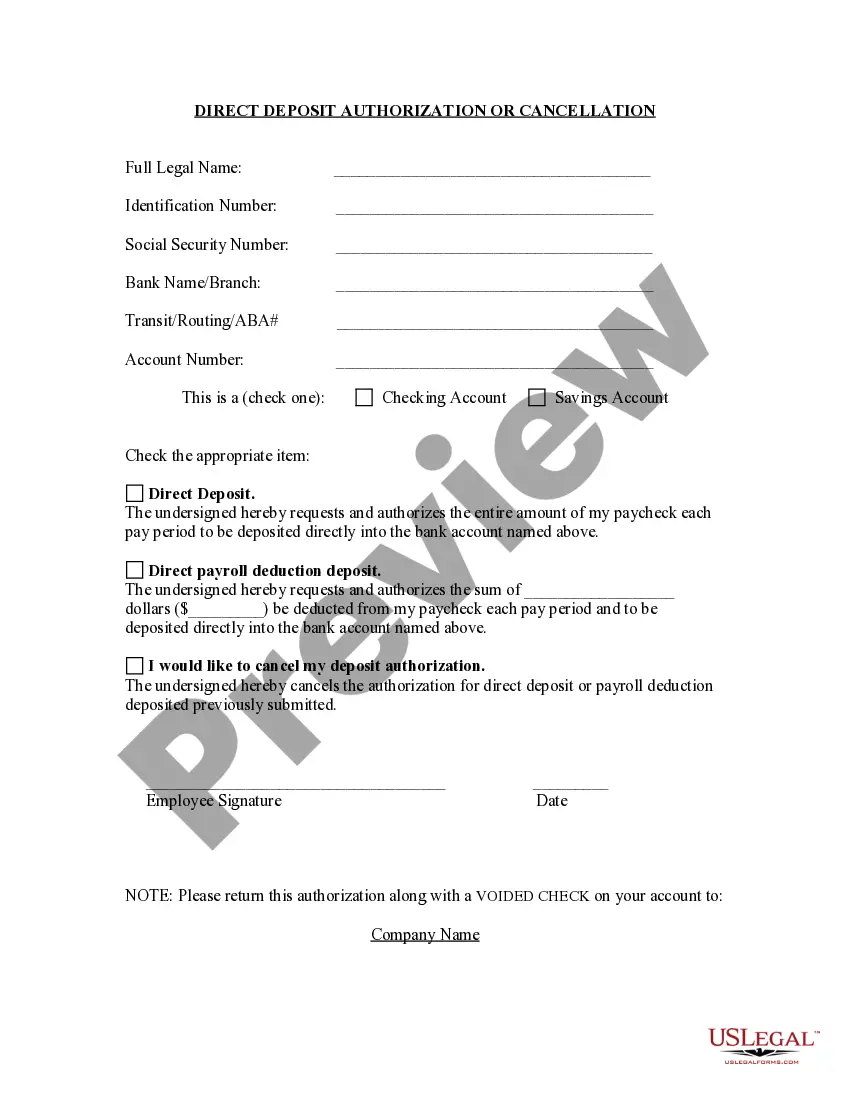
Get your form ready online
Our built-in tools help you complete, sign, share, and store your documents in one place.
Make edits, fill in missing information, and update formatting in US Legal Forms—just like you would in MS Word.
Download a copy, print it, send it by email, or mail it via USPS—whatever works best for your next step.
Sign and collect signatures with our SignNow integration. Send to multiple recipients, set reminders, and more. Go Premium to unlock E-Sign.
If this form requires notarization, complete it online through a secure video call—no need to meet a notary in person or wait for an appointment.
We protect your documents and personal data by following strict security and privacy standards.

Make edits, fill in missing information, and update formatting in US Legal Forms—just like you would in MS Word.

Download a copy, print it, send it by email, or mail it via USPS—whatever works best for your next step.

Sign and collect signatures with our SignNow integration. Send to multiple recipients, set reminders, and more. Go Premium to unlock E-Sign.

If this form requires notarization, complete it online through a secure video call—no need to meet a notary in person or wait for an appointment.

We protect your documents and personal data by following strict security and privacy standards.
Looking for another form?
Form popularity
FAQ
Use our pre-filled form You can also download a blank Direct Deposit/Automatic Payments Set-up Guide (PDF) and fill in the information yourself.
Let them know you're signing up for direct deposits and they'll give you the information you need. The payor might also ask you for a void cheque. They do this to verify the accuracy of the information you provide to them. It's safe to give your payor a blank cheque for this purpose.
Let them know you're signing up for direct deposit and they'll give you the information you need. Alternatively, many online banking services provide account holders with direct deposit information that you can provide to the payor, including a form you can download and use in place of a void cheque.
Unauthorized or unprotected transmission of employee banking details through email could result in regulatory penalties and damage the company's reputation. Additionally, email servers are often not encrypted end-to-end, making email inherently less secure for transmitting sensitive information.
Get a direct deposit form from your employer. Fill in account information. Confirm the deposit amount. Attach a voided check or deposit slip, if required. Submit the form.
Simply sign on to Wells Fargo Online to access transfers, and click Add Non-Wells Fargo Accounts to get started. To enable non-Wells Fargo accounts for Transfers, additional security measures are required. Verification may take 1-3 business days.
Check with your employer's payroll office, you may be able to set up your direct deposit through an online portal. If not: Complete a direct deposit form. Provide the form to your employer's payroll office.
Instead of a voided check, you might be able to provide: A direct deposit authorization form. When you complete this type of form, be very careful not to make any mistakes when you fill in your bank's routing number and your account number. A voided counter check. A deposit slip. A photocopy of a check or deposit slip.
Get a direct deposit form from your employer. Ask for a written or online direct deposit form. If that isn't available, ask your bank or credit union for one.
How do I set up direct deposit? Complete the direct deposit form. Deliver the form and a voided check to your employer. If you're eligible, your employer will deposit your paycheck directly into your account.

