Covenant Agreement In Spanish In Texas
Description

Get your form ready online
Our built-in tools help you complete, sign, share, and store your documents in one place.
Make edits, fill in missing information, and update formatting in US Legal Forms—just like you would in MS Word.
Download a copy, print it, send it by email, or mail it via USPS—whatever works best for your next step.
Sign and collect signatures with our SignNow integration. Send to multiple recipients, set reminders, and more. Go Premium to unlock E-Sign.
If this form requires notarization, complete it online through a secure video call—no need to meet a notary in person or wait for an appointment.
We protect your documents and personal data by following strict security and privacy standards.

Make edits, fill in missing information, and update formatting in US Legal Forms—just like you would in MS Word.

Download a copy, print it, send it by email, or mail it via USPS—whatever works best for your next step.

Sign and collect signatures with our SignNow integration. Send to multiple recipients, set reminders, and more. Go Premium to unlock E-Sign.

If this form requires notarization, complete it online through a secure video call—no need to meet a notary in person or wait for an appointment.

We protect your documents and personal data by following strict security and privacy standards.
Looking for another form?
Form popularity
FAQ
If it passes, a bill introduced in the Texas House—House Bill 931—would make Texas one of four states that allow "covenant marriage." House Republicans are pushing the bill, although it is uncertain whether or not it will pass.
The covenant not to sue works to protect the company in case the release is not effective. The provision also provides a release from any liability the company or any releasee may incur under those claims, if the participant breaches the covenant not to sue.
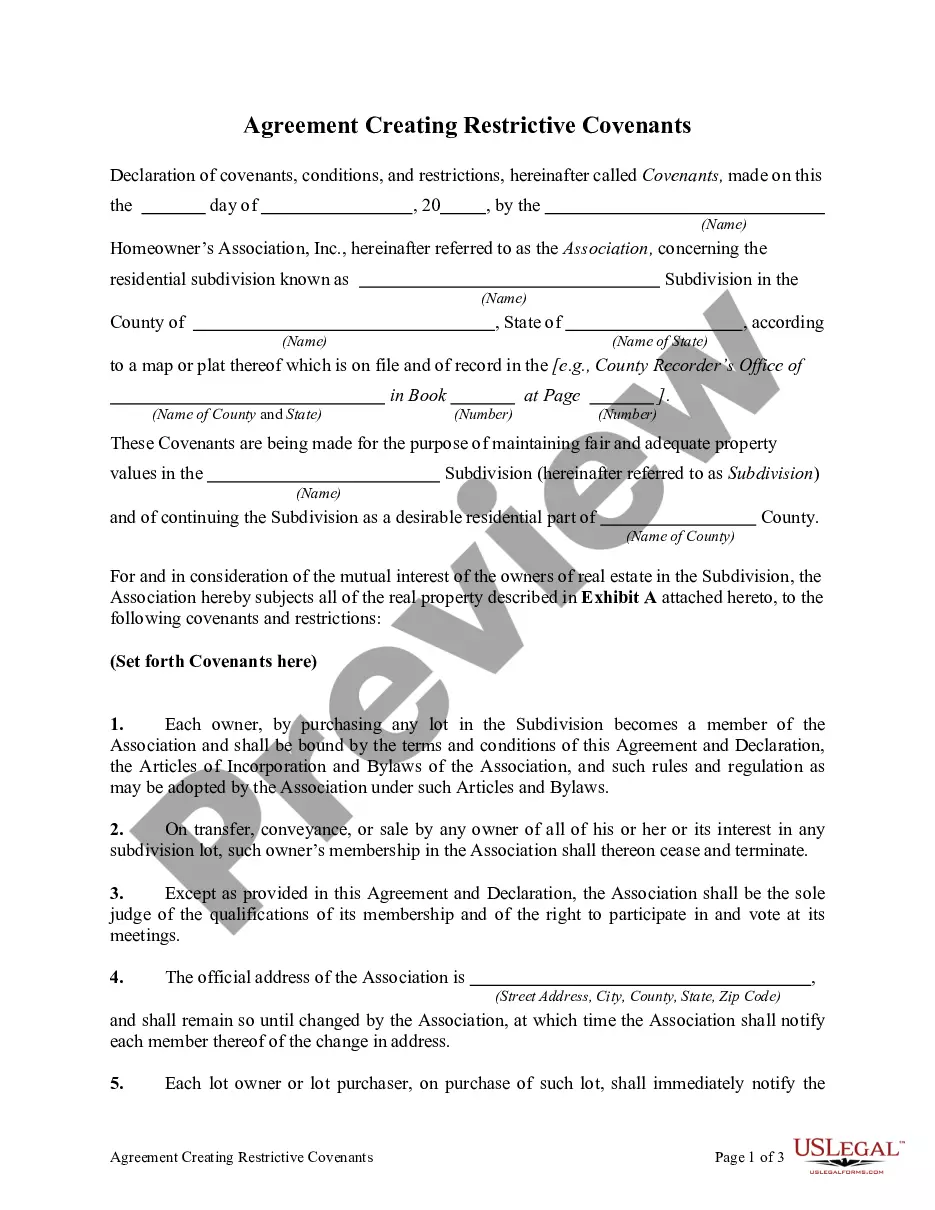
The new law will require that homeowners association policies must include general categories of restrictive covenants for which the association may assess fines, a schedule of fines for each category of violation, and information on hearings.
A bill was introduced in Texas in 2007 to create covenant marriage in the state, but it failed to pass. Biblical teachings are the backbone of covenant marriage, with the belief that marriage is a lifelong promise between both parties to the marriage and God.
The bill requires couples to file a notarized affidavit stating their understanding that a covenant marriage is a lifelong commitment and that they will make reasonable efforts to preserve their marriage.
A covenant agreement is akin to a contractual agreement between parties. It often outlines terms and conditions where a party will perform a certain action or refrain from performing a certain action. Covenants are legally binding and enforceable.
(a) A couple may not enter into a covenant marriage or designate a marriage as a covenant marriage unless the couple, at least seven days before the date the marriage is solemnized or designated, completes at least five hours of premarital counseling from a clergy member or a person legally authorized to engage in ...
To be enforceable, non-compete agreements in Texas must be reasonable and specific with regards to geographic area, the scope of activities, and the duration (i.e. how long the restriction lasts). A typical duration for non-competes in Texas is somewhere between six months and two years.
The Property Code is enforced through the court system.
How do I challenge a restrictive covenant? Express release: It may be possible to negotiate the release or variation of a restrictive covenant. Indemnity insurance: It is possible to obtain indemnity insurance to protect against the risk of a person with the benefit of a restrictive covenant seeking to enforce it.
