Habeas Corpus Petition Form With Motion In Maryland
Description

Get your form ready online
Our built-in tools help you complete, sign, share, and store your documents in one place.
Make edits, fill in missing information, and update formatting in US Legal Forms—just like you would in MS Word.
Download a copy, print it, send it by email, or mail it via USPS—whatever works best for your next step.
Sign and collect signatures with our SignNow integration. Send to multiple recipients, set reminders, and more. Go Premium to unlock E-Sign.
If this form requires notarization, complete it online through a secure video call—no need to meet a notary in person or wait for an appointment.
We protect your documents and personal data by following strict security and privacy standards.

Make edits, fill in missing information, and update formatting in US Legal Forms—just like you would in MS Word.

Download a copy, print it, send it by email, or mail it via USPS—whatever works best for your next step.

Sign and collect signatures with our SignNow integration. Send to multiple recipients, set reminders, and more. Go Premium to unlock E-Sign.

If this form requires notarization, complete it online through a secure video call—no need to meet a notary in person or wait for an appointment.

We protect your documents and personal data by following strict security and privacy standards.
Looking for another form?



Form popularity
FAQ
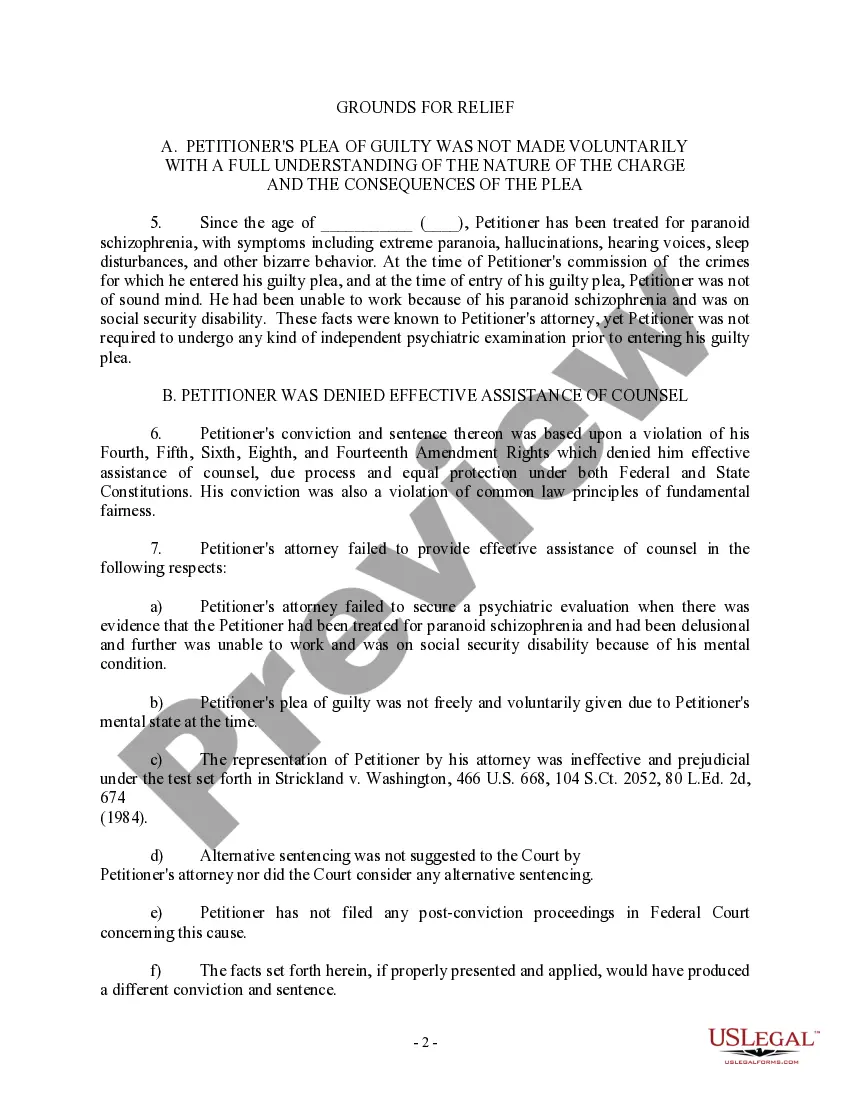
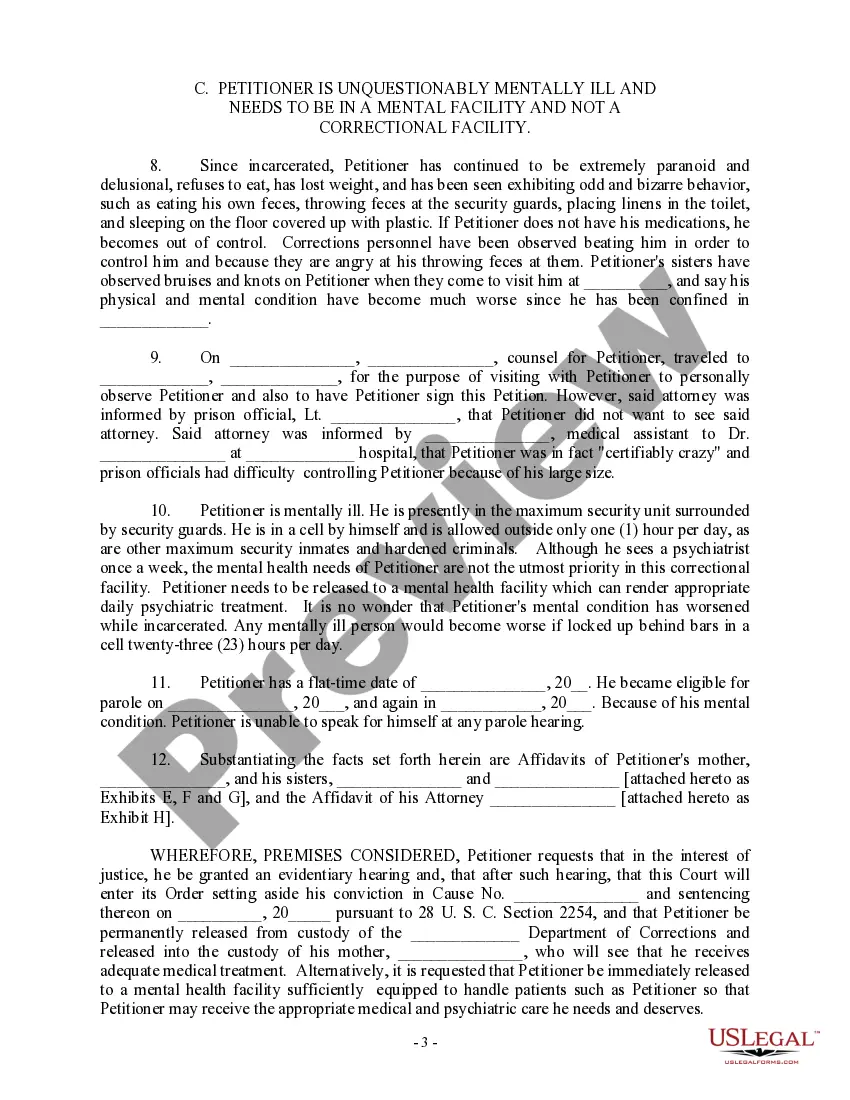
A writ of habeas corpus is used to bring a prisoner or other detainee (e.g. institutionalized mental patient) before the court to determine if the person's imprisonment or detention is lawful. A habeas petition proceeds as a civil action against the State agent (usually a warden) who holds the defendant in custody.
§ 2254 deals specifically with state custody, providing that habeas corpus shall apply only “in behalf of a person in custody pursuant to a judgment of a state court .”
A § 2254 petition is a motion for a writ of habeas corpus. This motion cannot be filed until the applicant has exhausted the remedies available in the courts of the State. This motion is used to challenge a conviction.
State every ground (reason) that supports your claim that you are being held in violation of the Constitution, laws, or treaties of the United States. Attach additional pages if you have more than four grounds. State the facts supporting each ground. Any legal arguments must be submitted in a separate memorandum.
§ 2254 by a person in custody challenging his or her current or future custody under a state-court judgment on the grounds that such custody violates the Constitution or laws or treaties of the United States.
Section 2255 governs an action by a person in custody under federal law who is challenging the validity of his or her conviction or sentence. Section 2254 governs an action by a person in custody under state law who is challenging the validity of his or her conviction or sentence.
A federal petition for writ of habeas corpus under 28 U.S.C. § 2254 is used by a (1) state prisoner (2) being held in state custody (3) to challenge the validity of a state criminal conviction or sentence (4) for the purpose of obtaining release from custody.
In most cases, after leaving time for the other parties to respond, the court will simply read the motion and response(s) and issue an order. In some cases, the court will schedule a hearing, to give you and the other party a chance to explain your arguments further.
A petition for a writ of habeas corpus shall be supported by affidavit of the petitioner and shall include: (1) a statement that the individual by or on behalf of whom the writ is sought is unlawfully confined or restrained; (2) the place where the individual is confined or restrained, if known;
The motion shall be filed (1) before issuance of the mandate or (2) within 30 days after the filing of the opinion of the Court, whichever is earlier. A response to a motion for reconsideration may not be filed unless requested on behalf of the Court by at least one judge who concurred in the opinion or order.
