Annual General Meeting Corporate Governance Checklist For Shareholders In Collin
Description



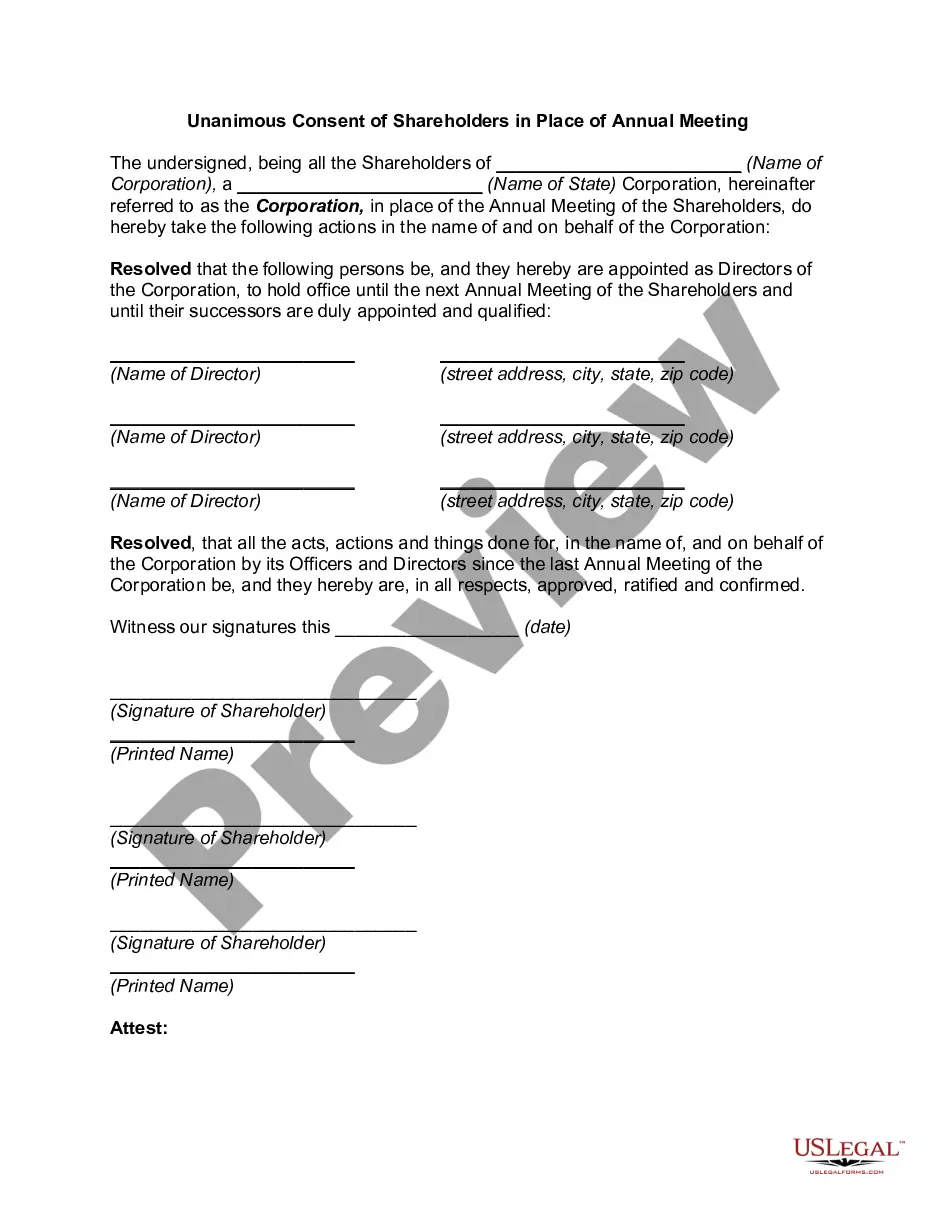
Get your form ready online
Our built-in tools help you complete, sign, share, and store your documents in one place.
Make edits, fill in missing information, and update formatting in US Legal Forms—just like you would in MS Word.
Download a copy, print it, send it by email, or mail it via USPS—whatever works best for your next step.
Sign and collect signatures with our SignNow integration. Send to multiple recipients, set reminders, and more. Go Premium to unlock E-Sign.
If this form requires notarization, complete it online through a secure video call—no need to meet a notary in person or wait for an appointment.
We protect your documents and personal data by following strict security and privacy standards.

Make edits, fill in missing information, and update formatting in US Legal Forms—just like you would in MS Word.

Download a copy, print it, send it by email, or mail it via USPS—whatever works best for your next step.

Sign and collect signatures with our SignNow integration. Send to multiple recipients, set reminders, and more. Go Premium to unlock E-Sign.

If this form requires notarization, complete it online through a secure video call—no need to meet a notary in person or wait for an appointment.

We protect your documents and personal data by following strict security and privacy standards.
Looking for another form?
Form popularity
FAQ
Shareholders play a pivotal governance role as partial owners who invest capital and elect company boards. Developing constructive relationships with shareholders provides valuable insights while helping align organisational and investor interests.
That the meeting is the AGM (if appropriate) the place, date and time of the meeting. the nature of the business to be transacted at the meeting, and. if a special resolution is proposed, the notice must also set out the terms of the resolution and a statement that it is intended to be passed as a special resolution.
Barring any exceptions imposed by the constitution of the company, all shareholders are entitled to receive notice of a general meeting, and to attend, speak at and vote at a general meeting. Within the limits of the law, shareholders generally have the right to request information about the company.
The role of shareholders in an AGM Shareholders vote on resolutions, either in person or electronically. Votes are usually reserved for significant decisions, such as financial statements, electing board members, strategic decisions and appointing auditors.
15 Basic Questions for shareholders to ask at the AGM Current financial position? ... Has the Board checked its figures – how was it done, show how it was robust? How has the Board minimised/limited/managed possible exchange rate fluctuations? Does the Board's plan for the future need working capital – how will it raise it?
An AGM is a mandatory annual meeting of shareholders. At the AGM, your company will present its financial statements (also known as "accounts") before the shareholders (also known as "members") so that they can raise any queries regarding the financial position of the company.
The business covered at an AGM may include, but isn't restricted to, the following: The annual financial report. The Director's report. Auditors report. Voting: Election of directors. Passing of resolutions. The appointing of the auditor.
In many companies, every shareholder or guarantor can attend and vote at general meetings. However, it depends on the rights attached to each member's shares (in a company limited by shares) or class of membership (in a company limited by guarantee).
Sometimes it may not be practical to attend an AGM because of the time and distance involved in relation to one's stake. Stakeholders may vote by "proxy". A proxy is a "substitute", i.e. you are authorizing someone of your choosing to vote on your behalf.

