Corporation First Meeting With Direct Reports In Texas
Description
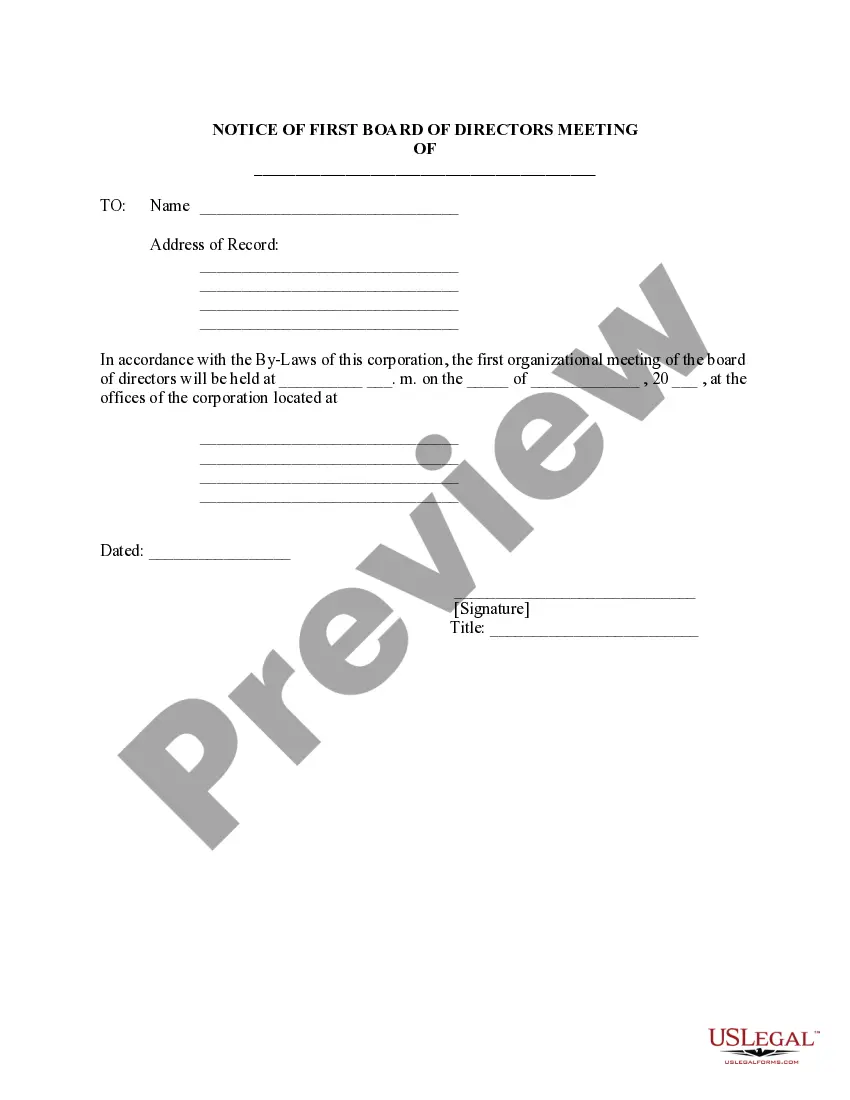


Get your form ready online
Our built-in tools help you complete, sign, share, and store your documents in one place.
Make edits, fill in missing information, and update formatting in US Legal Forms—just like you would in MS Word.
Download a copy, print it, send it by email, or mail it via USPS—whatever works best for your next step.
Sign and collect signatures with our SignNow integration. Send to multiple recipients, set reminders, and more. Go Premium to unlock E-Sign.
If this form requires notarization, complete it online through a secure video call—no need to meet a notary in person or wait for an appointment.
We protect your documents and personal data by following strict security and privacy standards.

Make edits, fill in missing information, and update formatting in US Legal Forms—just like you would in MS Word.

Download a copy, print it, send it by email, or mail it via USPS—whatever works best for your next step.

Sign and collect signatures with our SignNow integration. Send to multiple recipients, set reminders, and more. Go Premium to unlock E-Sign.

If this form requires notarization, complete it online through a secure video call—no need to meet a notary in person or wait for an appointment.

We protect your documents and personal data by following strict security and privacy standards.
Looking for another form?

Form popularity
FAQ
Under Article 2.21 of the Texas Business Corporation Act (TBCA), for example, shareholders or affiliates cannot be held liable for a corporation's contractual obligations unless they caused the corporation to be used to perpetrate “an actual fraud… primarily for the purpose of personal benefit”.
In contrast, an LLC affords members the flexibility to decide their own management structure and governance. An LLC usually has an “operating agreement,” which is a written contract between the members detailing exactly how to run the business. LLCs do not have to have formal corporate officers.
Statutory Preemptive Rights. (a) If the shareholders of a corporation have a preemptive right under this subchapter, the shareholders have a preemptive right to acquire proportional amounts of the corporation's unissued or treasury shares on the decision of the corporation's board of directors to issue the shares.
Section 22.220 - Action Without Meeting of Directors or Committee (a) The certificate of formation or bylaws of a corporation may provide that an action required by this chapter to be taken at a meeting of the corporation's directors or an action that may be taken at a meeting of the directors or a committee may be ...
Sec. 6.202. ACTION BY LESS THAN UNANIMOUS WRITTEN CONSENT. (a) This section applies to any action required or authorized to be taken under this code or the governing documents of a filing entity at an annual or special meeting of the owners or members of the entity.
21.057. BYLAWS. (a) The board of directors of a corporation shall adopt initial bylaws. (b) The bylaws may contain provisions for the regulation and management of the affairs of the corporation that are consistent with law and the corporation's certificate of formation.
(b) The owners or members or the governing authority of a filing entity, or a committee of the governing authority, may take action without holding a meeting, providing notice, or taking a vote if each person entitled to vote on the action signs a written consent or consents stating the action taken.
Encouraging open communication creates a more inclusive and collaborative environment. Make it a point to regularly check in with your direct reports and actively listen to their concerns, ideas, and feedback. Schedule one-on-one meetings where team members can speak candidly about their challenges and suggestions.
How to run your first one-on-one with a new direct report Create a collaborative meeting agenda. Send the meeting agenda in advance. Explain the purpose and your expectations. Start with an icebreaker. Choose a recurring day and time. Ask questions to get to know them. Create alignment on roles. Provide and ask for feedback.
What would you want a brand new direct report to ask you on day 1? Big picture, how do you view your role? What are the team's primary projects right now, and who is responsible for what? How do you stay synced with employees? Do you prefer to communicate by email, Teams, or in-person?

