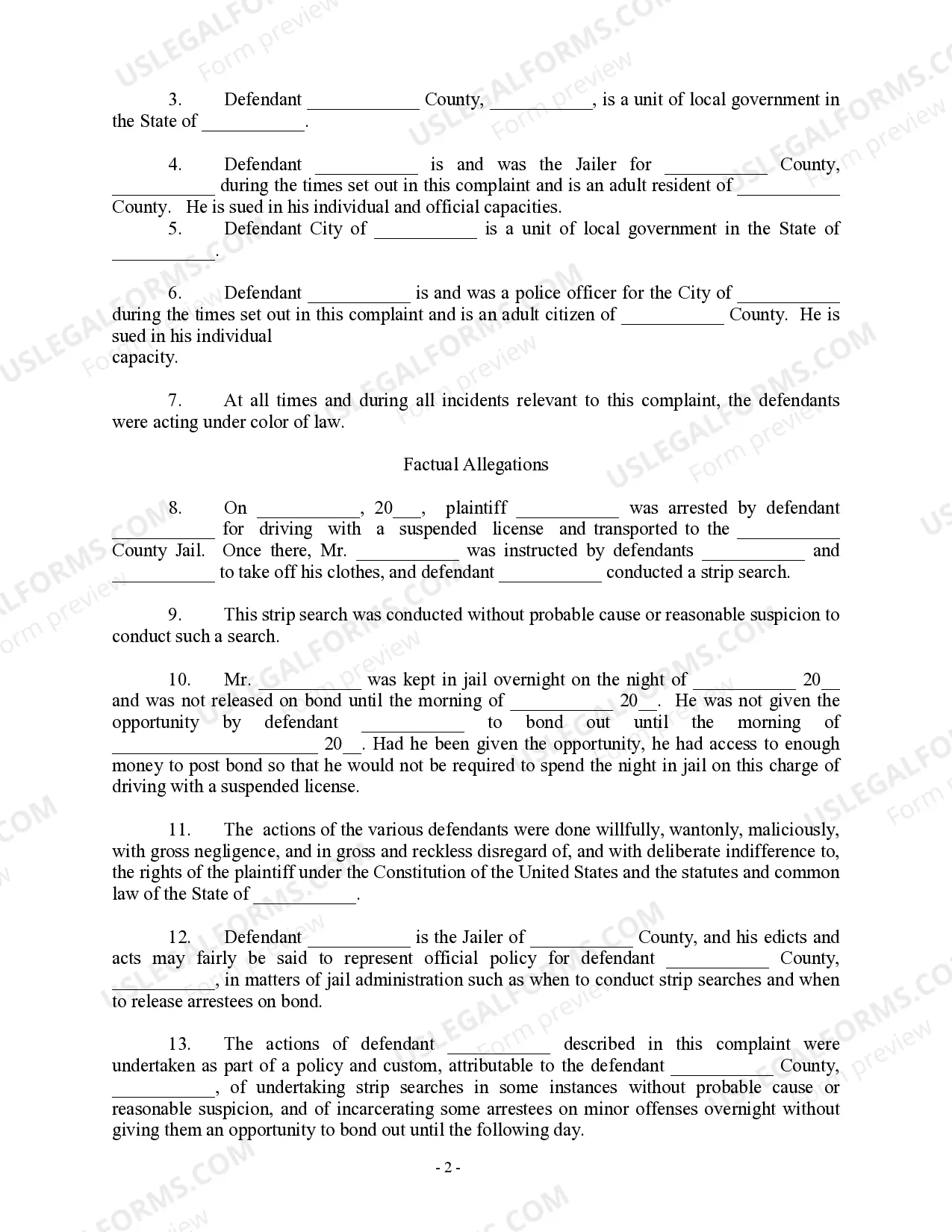
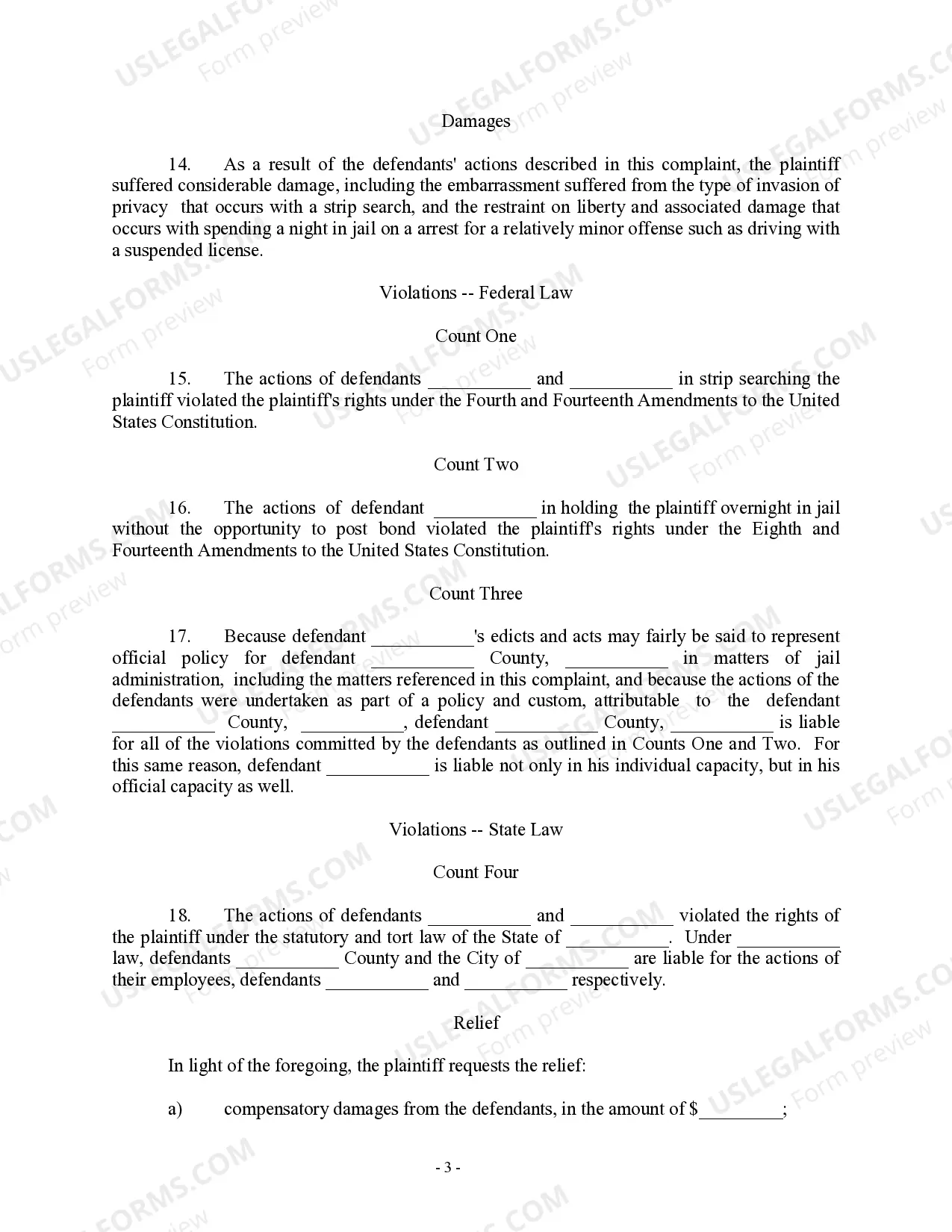
This form is a Complaint. This action was filed by the plaintiff due to a strip search which was conducted upon his/her person after an arrest. The plaintiff requests that he/she be awarded compensatory damages and punitive damages for the alleged violation of his/her constitutional rights.
Amendment Forbidding Search And Seizure In Allegheny
Category:
State:
Multi-State
County:
Allegheny
Control #:
US-000282
Format:
Word;
Rich Text
Instant download
Description
Free preview




Get your form ready online
Our built-in tools help you complete, sign, share, and store your documents in one place.
Built-in online Word editor
Make edits, fill in missing information, and update formatting in US Legal Forms—just like you would in MS Word.
Export easily
Download a copy, print it, send it by email, or mail it via USPS—whatever works best for your next step.
E-sign your document
Sign and collect signatures with our SignNow integration. Send to multiple recipients, set reminders, and more. Go Premium to unlock E-Sign.
Notarize online 24/7
If this form requires notarization, complete it online through a secure video call—no need to meet a notary in person or wait for an appointment.
Store your document securely
We protect your documents and personal data by following strict security and privacy standards.

Make edits, fill in missing information, and update formatting in US Legal Forms—just like you would in MS Word.

Download a copy, print it, send it by email, or mail it via USPS—whatever works best for your next step.

Sign and collect signatures with our SignNow integration. Send to multiple recipients, set reminders, and more. Go Premium to unlock E-Sign.

If this form requires notarization, complete it online through a secure video call—no need to meet a notary in person or wait for an appointment.

We protect your documents and personal data by following strict security and privacy standards.
Looking for another form?
Form popularity
FAQ
United States, 275 U.S. 192, 194 (1927) ( It has long been settled that the Fifth Amendment protects every person against incrimination by the use of evidence obtained through search or seizure made in violation of his rights under the Fourth Amendment. ).
Today the Fourth Amendment is understood as placing restraints on the government any time it detains (seizes) or searches a person or property.
The Third Amendment seems to have no direct constitutional relevance at present; indeed, not only is it the least litigated amendment in the Bill of Rights, but the Supreme Court has never decided a case on the basis of it.
The Fourth Amendment prohibits unreasonable searches and seizures without a warrant—generally, law enforcement must obtain a warrant when a search would violate a person's “reasonable expectation of privacy.” The Fourth Amendment also requires that warrants be supported by probable cause and describe with particularity ...
Pennsylvania Search & Seizure Laws As with the U.S. Constitution, the citizens of Pennsylvania are protected from “unreasonable searches and seizures” and a search warrant requires probable cause to search for specifically described items.
Both controversies led to the famous notion that a person's home is their castle, not easily invaded by the government. Today the Fourth Amendment is understood as placing restraints on the government any time it detains (seizes) or searches a person or property.
For example, a sudden search of a driver's motor vehicle after a speeding ticket stop may constitute an illegal search and seizure if the law enforcement officer did not have probable cause to believe that the driver had committed another crime.
Some groups consider stop and frisk a clear failure of public safety policy. However, the practice is legal under Pennsylvania's policing procedures, provided it is used appropriately to address suspicions of criminal activity.