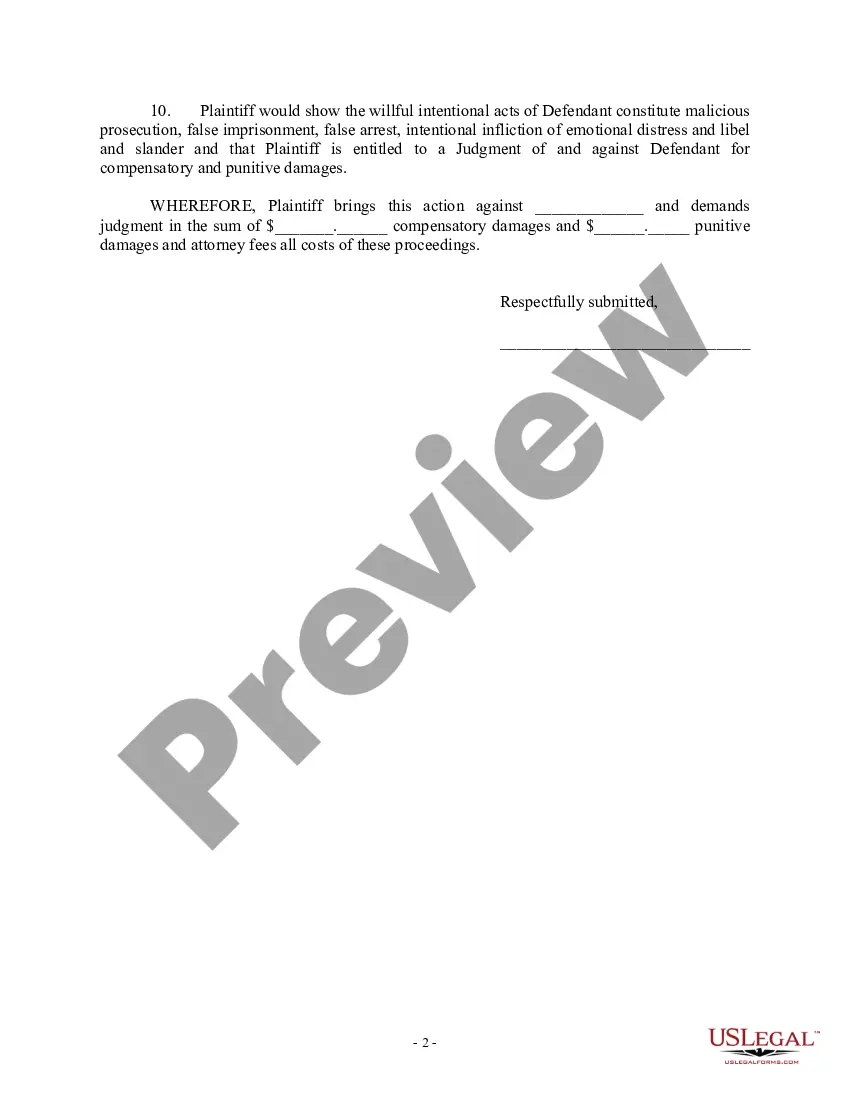
False Imprisonment Us With Law In North Carolina
Description
Get your form ready online
Our built-in tools help you complete, sign, share, and store your documents in one place.
Make edits, fill in missing information, and update formatting in US Legal Forms—just like you would in MS Word.
Download a copy, print it, send it by email, or mail it via USPS—whatever works best for your next step.
Sign and collect signatures with our SignNow integration. Send to multiple recipients, set reminders, and more. Go Premium to unlock E-Sign.
If this form requires notarization, complete it online through a secure video call—no need to meet a notary in person or wait for an appointment.
We protect your documents and personal data by following strict security and privacy standards.

Make edits, fill in missing information, and update formatting in US Legal Forms—just like you would in MS Word.

Download a copy, print it, send it by email, or mail it via USPS—whatever works best for your next step.

Sign and collect signatures with our SignNow integration. Send to multiple recipients, set reminders, and more. Go Premium to unlock E-Sign.

If this form requires notarization, complete it online through a secure video call—no need to meet a notary in person or wait for an appointment.

We protect your documents and personal data by following strict security and privacy standards.
Looking for another form?
Form popularity
FAQ
In general, to make out a false imprisonment claim, you'll need to show these four common elements: the intentional restraint of another person in a confined area. the restrained person doesn't consent to the restraint. the restrained person is aware of the restraint, and. the restraint is without legal justification.
The most common defense is consent. In other words, the victim voluntarily agreed to being confined.
In general, to make out a false imprisonment claim, you'll need to show these four common elements: the intentional restraint of another person in a confined area. the restrained person doesn't consent to the restraint. the restrained person is aware of the restraint, and.
To prove a false imprisonment claim as a tort in a civil lawsuit, the following elements must be present: There was a willful detention; The detention was without consent; and. The detention was unlawful.
Examples of false imprisonment: You prevent someone from leaving by grabbing that person's arm; You lock someone in a bedroom; You tie someone to a chair.
As such, the essential elements under this theory include: (1) the illegal restraint of a person, (2) by force or threat of force, and (3) without the other person's consent (or against their will). In other words, the defendant intentionally and unlawfully restrains or detains the plaintiff without his or her consent.
§ 11.404 False imprisonment. A person commits a misdemeanor if he or she knowingly restrains another unlawfully so as to interfere substantially with his or her liberty.
Penalties for Penal Code 236 False Imprisonment If convicted of a PC 236 felony crime, you could spend up to three years in a California state prison and be fined up to $10,000. It should be noted that if the victim was elderly or dependent, the sentence could increase to four years.
Felonious restraint is different than false imprisonment, which in North Carolina is considered a Class 1 misdemeanor and comes with a maximum 120-day imprisonment sentence. In NC, false imprisonment is the unlawful restrain or detainment of an individual without their consent.