14th Amendment In Us In Cuyahoga
Description






Get your form ready online
Our built-in tools help you complete, sign, share, and store your documents in one place.
Make edits, fill in missing information, and update formatting in US Legal Forms—just like you would in MS Word.
Download a copy, print it, send it by email, or mail it via USPS—whatever works best for your next step.
Sign and collect signatures with our SignNow integration. Send to multiple recipients, set reminders, and more. Go Premium to unlock E-Sign.
If this form requires notarization, complete it online through a secure video call—no need to meet a notary in person or wait for an appointment.
We protect your documents and personal data by following strict security and privacy standards.
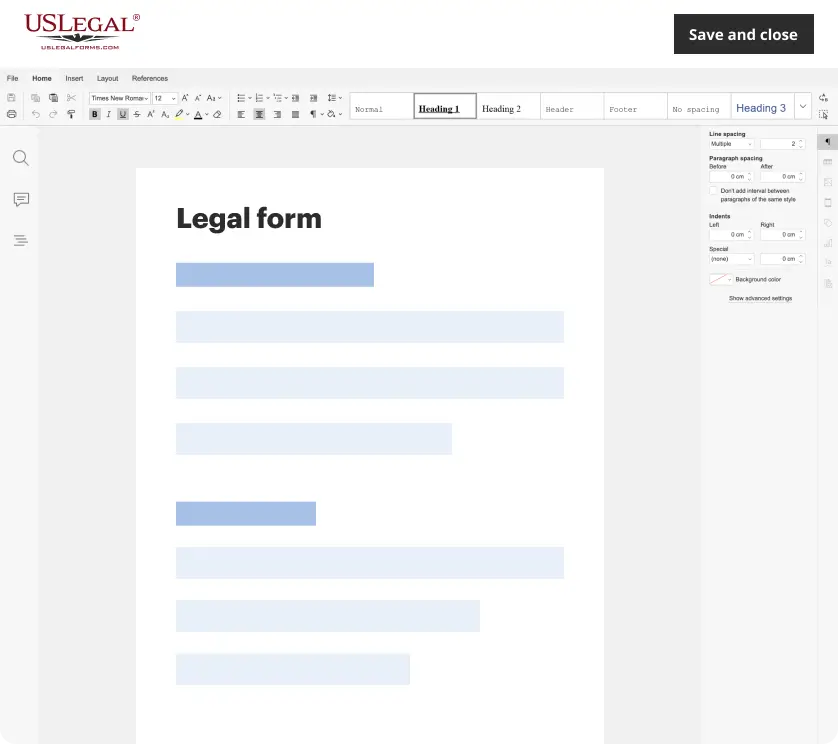
Make edits, fill in missing information, and update formatting in US Legal Forms—just like you would in MS Word.
Download a copy, print it, send it by email, or mail it via USPS—whatever works best for your next step.
Sign and collect signatures with our SignNow integration. Send to multiple recipients, set reminders, and more. Go Premium to unlock E-Sign.

If this form requires notarization, complete it online through a secure video call—no need to meet a notary in person or wait for an appointment.
We protect your documents and personal data by following strict security and privacy standards.
Looking for another form?

Form popularity
FAQ
Congress accepted the Constitution and President Jefferson approved it on February 19, 1803, after which Ohio was admitted to the Union as a state. The Constitution of 1802 made the legislature – a General Assembly comprising a House of Representatives and a Senate – the most powerful branch of state government.
Congress overrode Johnson's vetoes of the Freedmen's Bureau Bill of 1866 and the Civil Rights Act of 1866. Johnson also unsuccessfully opposed adoption of the 14th Amendment, which gave citizenship to former slaves.
14th Amendment Site. Ratification Process: The Fourteenth Amendment was ratified by Ohio on January 4; New York on January 10; Kansas on January 11; Illinois on January 15; West Virginia, Michigan, and Minnesota on January 16; Maine on January 19; Nevada on January 22; Indiana on January 23, and Missouri on January 25.
The Supreme Court's 5-4 decision overturned Mapp's conviction, on the grounds that evidence seized without a search warrant cannot be used in state criminal prosecutions under the 4th Amendment to the Constitution, which protects against unreasonable searches and seizures, and the 14th Amendment, which extends that ...
On July 28, 1868, the final state necessary for ratification of the amendment agreed to it. Many white Ohioans initially approved of the Fourteenth Amendment. Members of the Union Party, a group of Ohio's Republican Party and pro-war Democrats, strongly supported the amendment.
Passed by Congress June 13, 1866, and ratified July 9, 1868, the 14th Amendment extended liberties and rights granted by the Bill of Rights to formerly enslaved people.
The Fourteenth Amendment to the Constitution of the United States granted citizenship and equal civil and legal rights to anyone born in the United States or who became a citizen of the country. This included African Americans and slaves who had been freed after the American Civil War.
The Fourteenth Amendment of the U.S. Constitution contains a number of important concepts, most famously state action, privileges or immunities, citizenship, due process, and equal protection—all of which are contained in Section One.
No State shall make or enforce any law which shall abridge the privileges or immunities of citizens of the United States; nor shall any State deprive any person of life, liberty, or property, without due process of law; nor deny to any person within its jurisdiction the equal protection of the laws.
MAPP V. OHIO, decided on 20 June 1961, was a landmark court case originating in Cleveland, in which the U.S. Supreme Court ruled that under the 4th and 14th Constitutional amendments, illegally seized evidence could not be used in a state criminal trial.
