Tenant Landlord Failure For Lease Agreement
Description


Get your form ready online
Our built-in tools help you complete, sign, share, and store your documents in one place.
Make edits, fill in missing information, and update formatting in US Legal Forms—just like you would in MS Word.
Download a copy, print it, send it by email, or mail it via USPS—whatever works best for your next step.
Sign and collect signatures with our SignNow integration. Send to multiple recipients, set reminders, and more. Go Premium to unlock E-Sign.
If this form requires notarization, complete it online through a secure video call—no need to meet a notary in person or wait for an appointment.
We protect your documents and personal data by following strict security and privacy standards.

Make edits, fill in missing information, and update formatting in US Legal Forms—just like you would in MS Word.

Download a copy, print it, send it by email, or mail it via USPS—whatever works best for your next step.

Sign and collect signatures with our SignNow integration. Send to multiple recipients, set reminders, and more. Go Premium to unlock E-Sign.

If this form requires notarization, complete it online through a secure video call—no need to meet a notary in person or wait for an appointment.

We protect your documents and personal data by following strict security and privacy standards.
Looking for another form?
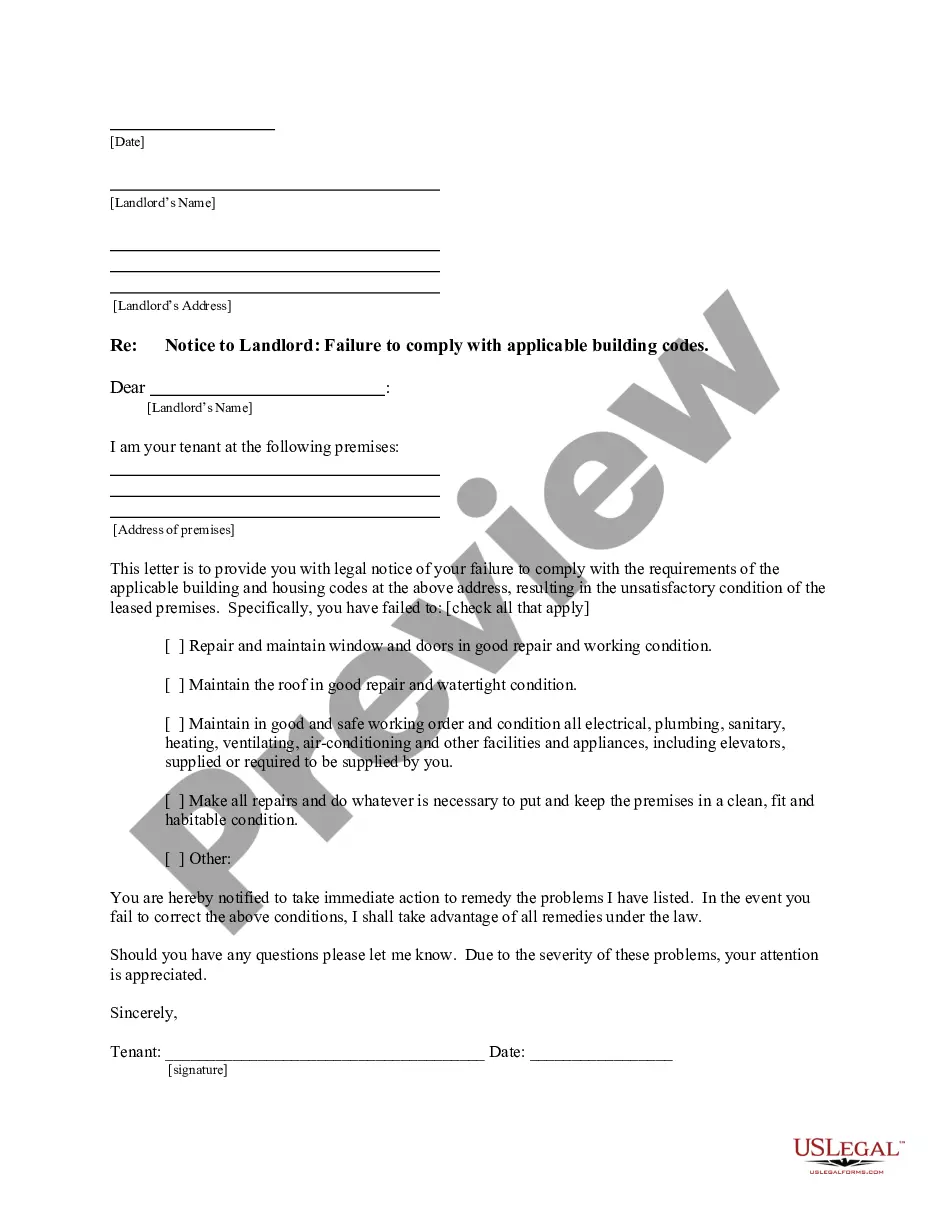
How to fill out New Mexico Letter From Tenant To Landlord For Failure Of Landlord To Comply With Building Codes Affecting Health And Safety Or Resulting In Untenantable Condition - Demand For Remedy?
- If you’re a returning user, log in to your account, ensuring your subscription is active. Then, download your desired form from the Download button.
- For first-time users, start by exploring the Preview mode of the forms. Review the description to pick a lease agreement that matches your legal jurisdiction's requirements.
- If you encounter discrepancies, utilize the Search feature above to find the correct document. Ensure it aligns with your needs before proceeding.
- Once you’ve found the right form, click the Buy Now button and select your preferred subscription plan. Registration is required for accessing the full legal library.
- Complete your purchase using your credit card or PayPal account.
- Finally, download the completed template to your device. You can access it later from the My Forms section in your profile.
With US Legal Forms, individuals and legal professionals benefit from an extensive selection of over 85,000 easy-to-use legal documents, ensuring both accuracy and comprehensiveness.
Don't let tenant landlord failures compromise your lease agreements. Start your journey with US Legal Forms today for seamless legal document execution.
Form popularity
FAQ
The most common action taken by landlords against tenants who breach a lease agreement is filing for eviction. This situation often arises when there is a tenant landlord failure for lease agreement, and the landlord seeks to regain possession of the property. It's important for tenants to be aware of their rights during this process. Legal resources like uslegalforms can offer valuable templates and guidance to help navigate these challenges.
Taking a landlord to court can be worthwhile, especially if you face significant issues that result from tenant landlord failure for lease agreement. It may provide you with a resolution or compensation for your troubles, depending on the nature of your claim. However, consider the potential costs and time involved. Consulting with an attorney can help you assess whether your case is strong enough to proceed.
A tenant who refuses to leave is often referred to as a 'holdover tenant.' This situation is a common problem that may lead to tenant landlord failure for lease agreement. If you find yourself in this scenario, it's crucial to understand your rights and legal recourse. You may need to seek legal help to initiate eviction proceedings properly.
To file a legal action against your landlord, start by gathering all relevant documents related to your tenancy. This includes your lease agreement and any correspondence that reflects the tenant landlord failure for lease agreement. Next, you can file a complaint in the appropriate court indicating the nature of the dispute, along with any evidence you have collected. Consulting with a legal professional can help you navigate this process smoothly.
If your landlord does not show up to court, the judge may rule in your favor automatically. This is particularly relevant in cases of tenant landlord failure for lease agreement disputes. However, it's essential to present solid evidence and documentation to support your position. You may still want to consult a legal expert to understand the implications of this outcome and plan next steps.
In Kansas, you can report landlords to the local housing authority or the Kansas Attorney General's office. If you experience tenant landlord failure for lease agreement issues, it is crucial to gather evidence such as photographs, emails, or written communications. This can aid your case when reporting the landlord and seeking legal remedies. It's wise to seek advice from a lawyer if the situation escalates.
In Texas, you can report your landlord to the local housing authority or the Texas Department of Housing and Community Affairs. It's important to document any tenant landlord failure for lease agreement incidents before making a report. This documentation can support your claims and help in resolving the issues effectively. Additionally, you may want to consider consulting with a legal professional for more guidance.
The 7 day landlord failure to comply in Florida refers to the period a landlord has to correct a lease violation after receiving a notice. If the landlord fails to make necessary repairs or address tenant concerns within this timeframe, the tenant may have grounds to take legal action. Understanding this process is essential in navigating tenant landlord failure for lease agreement situations.
In Florida, a tenant can generally be late on rent for about five days without facing any legal consequences. After this grace period, a landlord has the right to issue an eviction notice or take further action. Knowing these timelines is crucial, especially in cases of tenant landlord failure for lease agreement disputes.
When writing a letter of violation for a lease, clearly outline the specific lease terms the landlord has violated. Provide detailed examples along with any evidence you may have to strengthen your position. Creating a well-structured letter is essential to resolving issues related to tenant landlord failure for lease agreement situations effectively.