Notarizing For Family In Florida
Description
Get your form ready online
Our built-in tools help you complete, sign, share, and store your documents in one place.
Make edits, fill in missing information, and update formatting in US Legal Forms—just like you would in MS Word.
Download a copy, print it, send it by email, or mail it via USPS—whatever works best for your next step.
Sign and collect signatures with our SignNow integration. Send to multiple recipients, set reminders, and more. Go Premium to unlock E-Sign.
If this form requires notarization, complete it online through a secure video call—no need to meet a notary in person or wait for an appointment.
We protect your documents and personal data by following strict security and privacy standards.

Make edits, fill in missing information, and update formatting in US Legal Forms—just like you would in MS Word.

Download a copy, print it, send it by email, or mail it via USPS—whatever works best for your next step.

Sign and collect signatures with our SignNow integration. Send to multiple recipients, set reminders, and more. Go Premium to unlock E-Sign.

If this form requires notarization, complete it online through a secure video call—no need to meet a notary in person or wait for an appointment.

We protect your documents and personal data by following strict security and privacy standards.
Looking for another form?

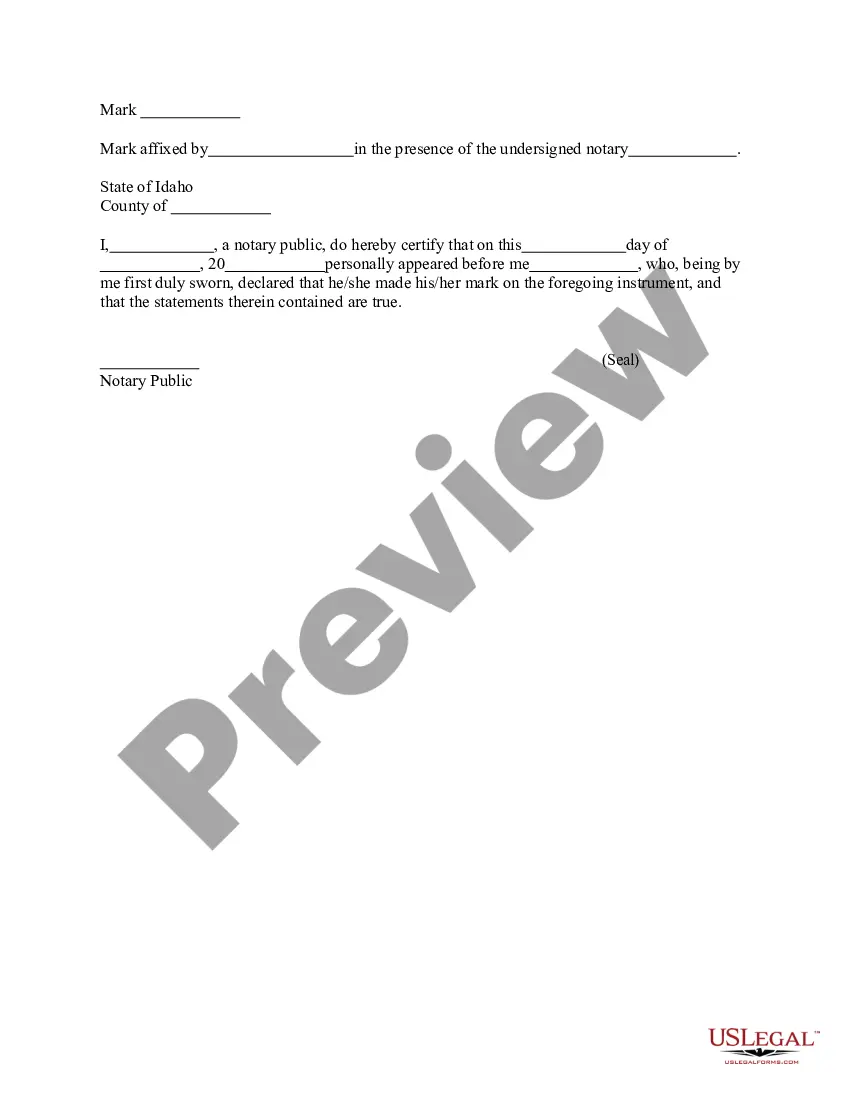
How to fill out Idaho Acknowledgment For Notarizing A Signature By Mark?
Whether for corporate objectives or personal affairs, everyone must manage legal matters at some point in their life.
Filling out legal documents requires meticulous consideration, starting with choosing the correct form template.
Once downloaded, you can complete the form using editing software or print it out and fill it in manually. With a comprehensive US Legal Forms library at your disposal, you will never need to waste time searching for the appropriate sample online.
- For instance, if you select an incorrect version of the Notarizing For Family In Florida, it will be rejected upon submission.
- Thus, it is essential to have a trustworthy source of legal documents like US Legal Forms.
- If you need to obtain a Notarizing For Family In Florida template, follow these simple steps.
- Locate the sample you require by using the search field or browsing the catalog.
- Review the form’s details to verify it aligns with your case, state, and county.
- Click on the form’s preview to view it.
- If it is the incorrect form, return to the search option to find the Notarizing For Family In Florida template you need.
- Download the file once it fulfills your requirements.
- If you already possess a US Legal Forms account, just click Log in to retrieve previously saved templates in My documents.
- In case you do not have an account yet, you may acquire the form by clicking Buy now.
- Select the appropriate pricing choice.
- Complete the profile registration form.
- Choose your payment method: either a credit card or PayPal account.
- Select the document format you desire and download the Notarizing For Family In Florida.
Form popularity
FAQ
Avoid Notarizing for Family Members This is explicitly stated under Section 117.107(11) of the Florida statutes, which stipulates that a Florida notary public may not notarize a document if the person whose signature is to be notarized is the spouse, son, daughter, mother, or father of the notary public.
Florida does not require exact wording, but the certificate must include elements spelled out in Florida Statutes, 117.05[4], including the venue, name of signer, type and date of notarization, form of identification used, the Notary's signature, name and seal, and whether the signer appeared via physical presence or ...
Oath. Sworn to (or affirmed) and subscribed before me by means of ? physical presence or ? online notarization, this day of , (year) , by (name of person making statement) .
Avoid Notarizing for Family Members This is explicitly stated under Section 117.107(11) of the Florida statutes, which stipulates that a Florida notary public may not notarize a document if the person whose signature is to be notarized is the spouse, son, daughter, mother, or father of the notary public.
The foregoing instrument was acknowledged before me by means of ? physical presence or ? online notarization, this [MM/DD/YYYY] by [SIGNER NAME], who is personally known to me or who has produced [TYPE OF ID] as identification.