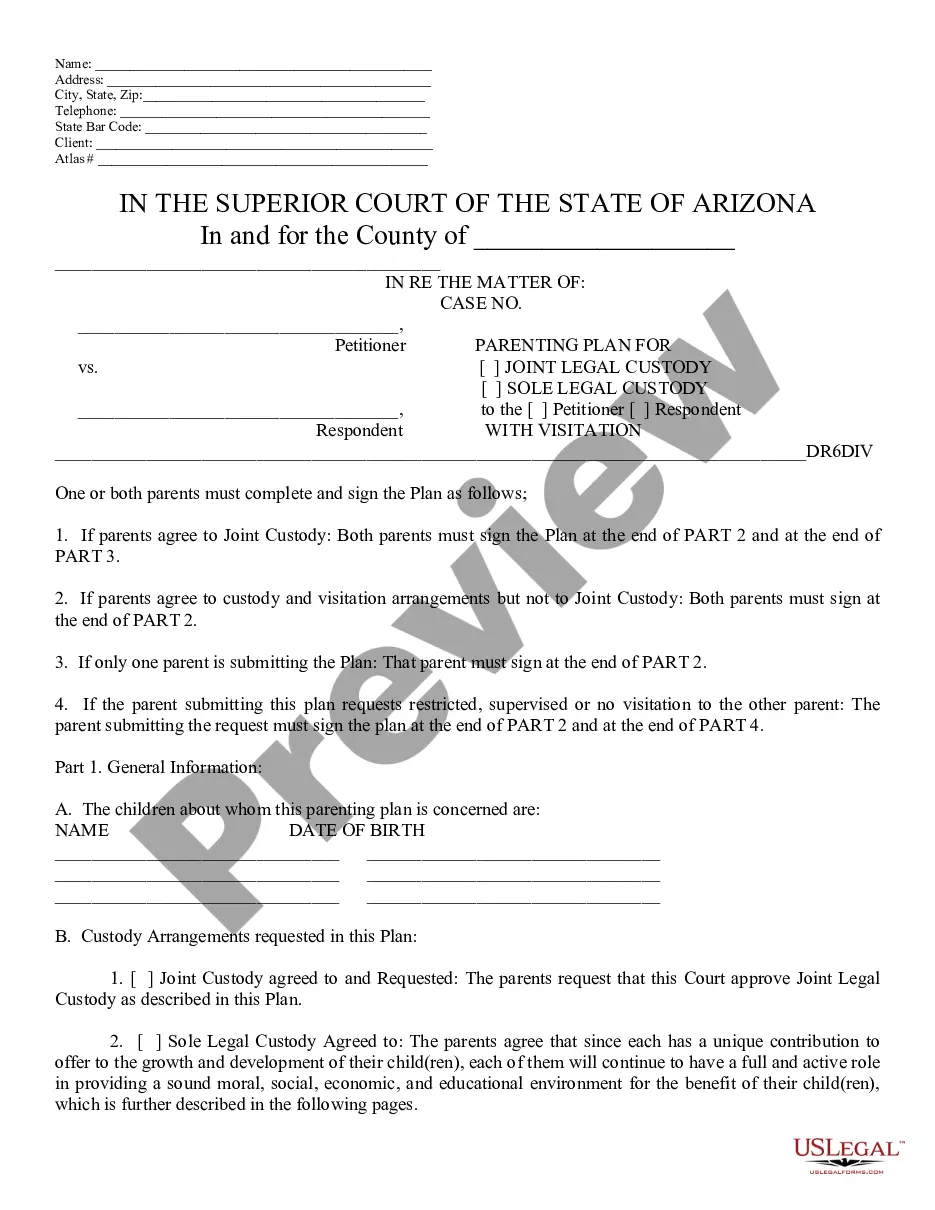
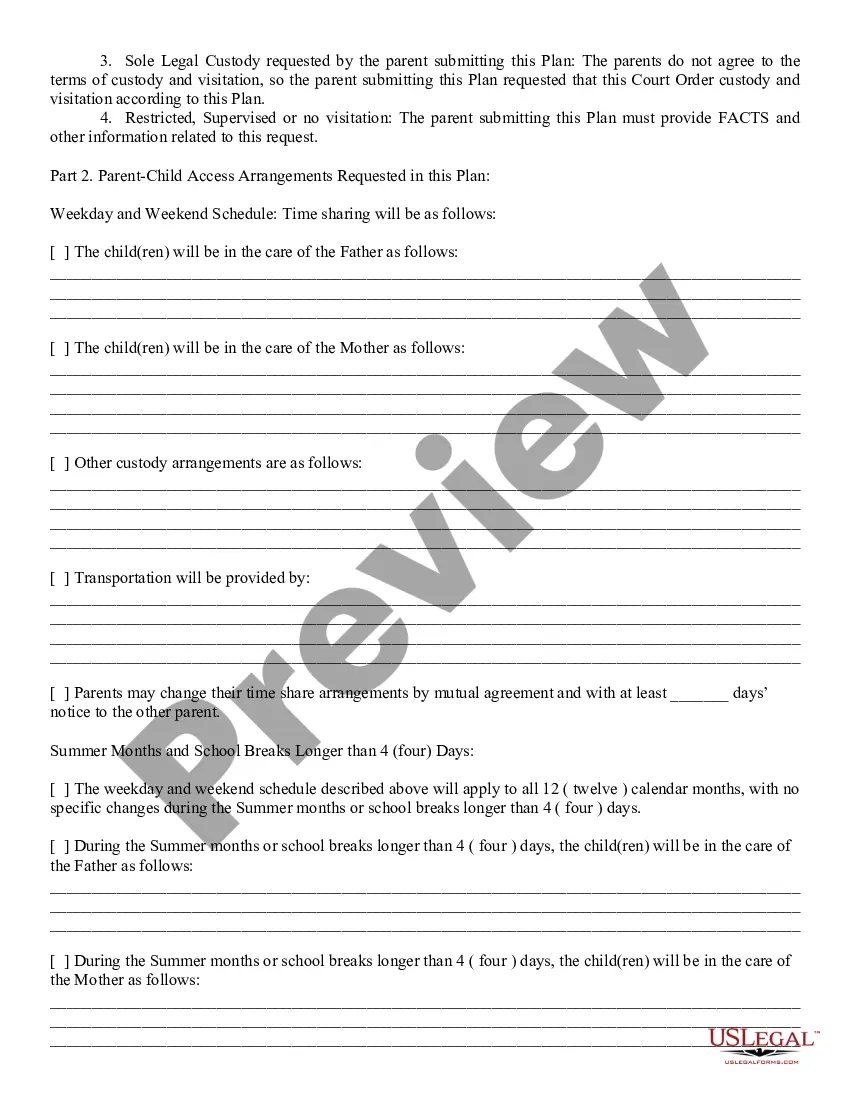
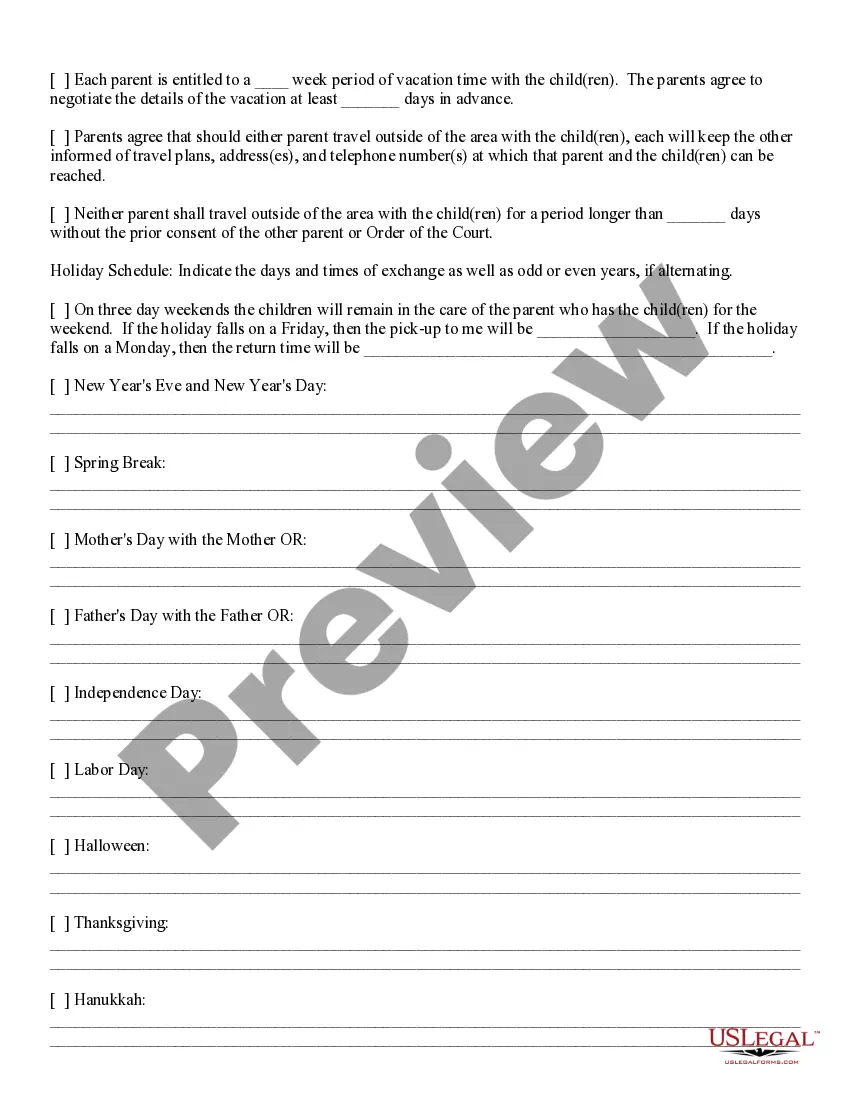
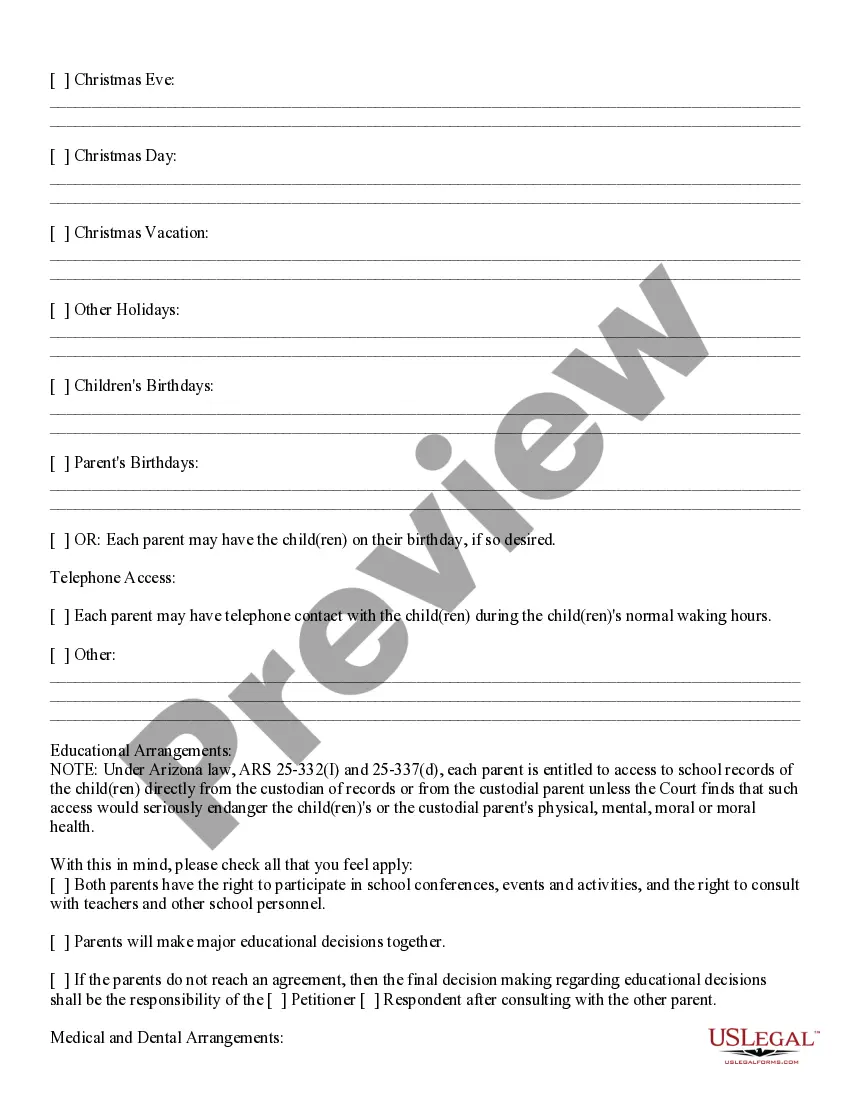
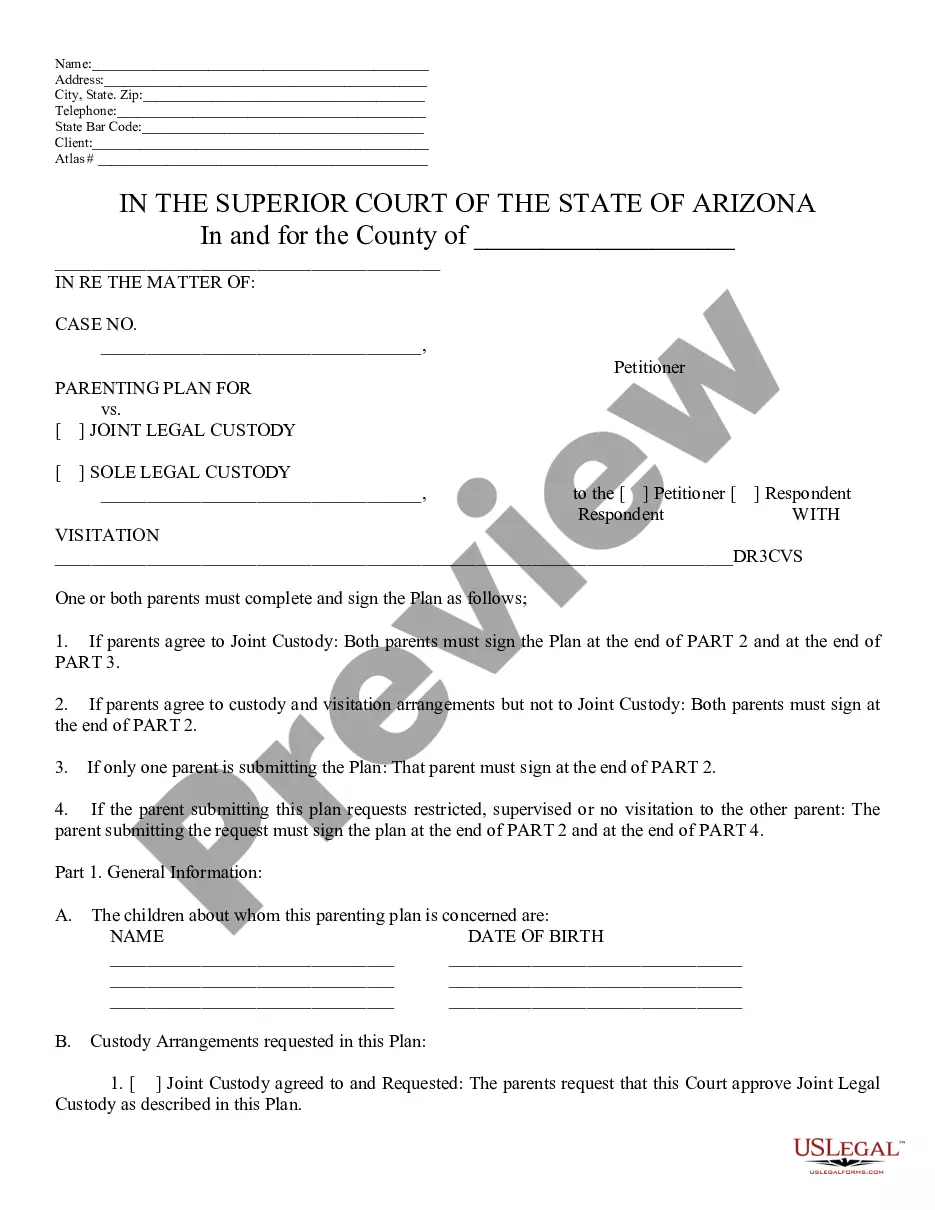
Parenting Plan Agreement Format
Description
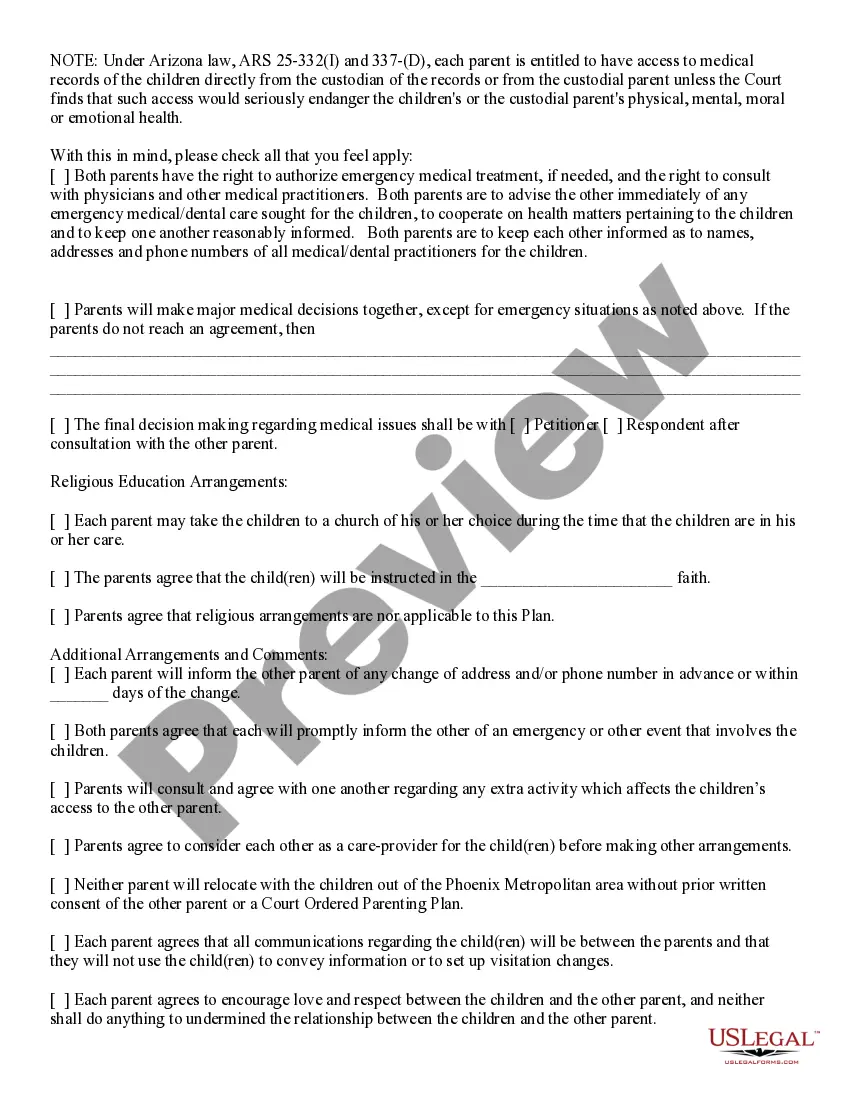
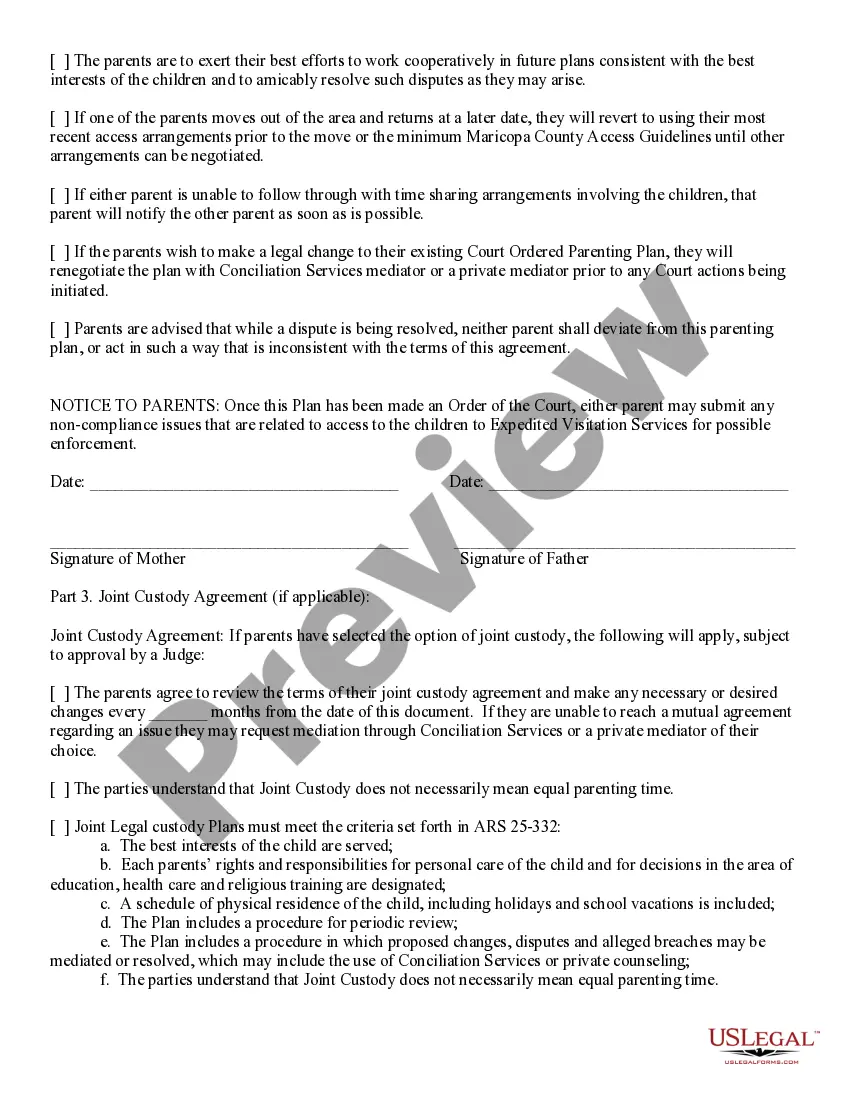
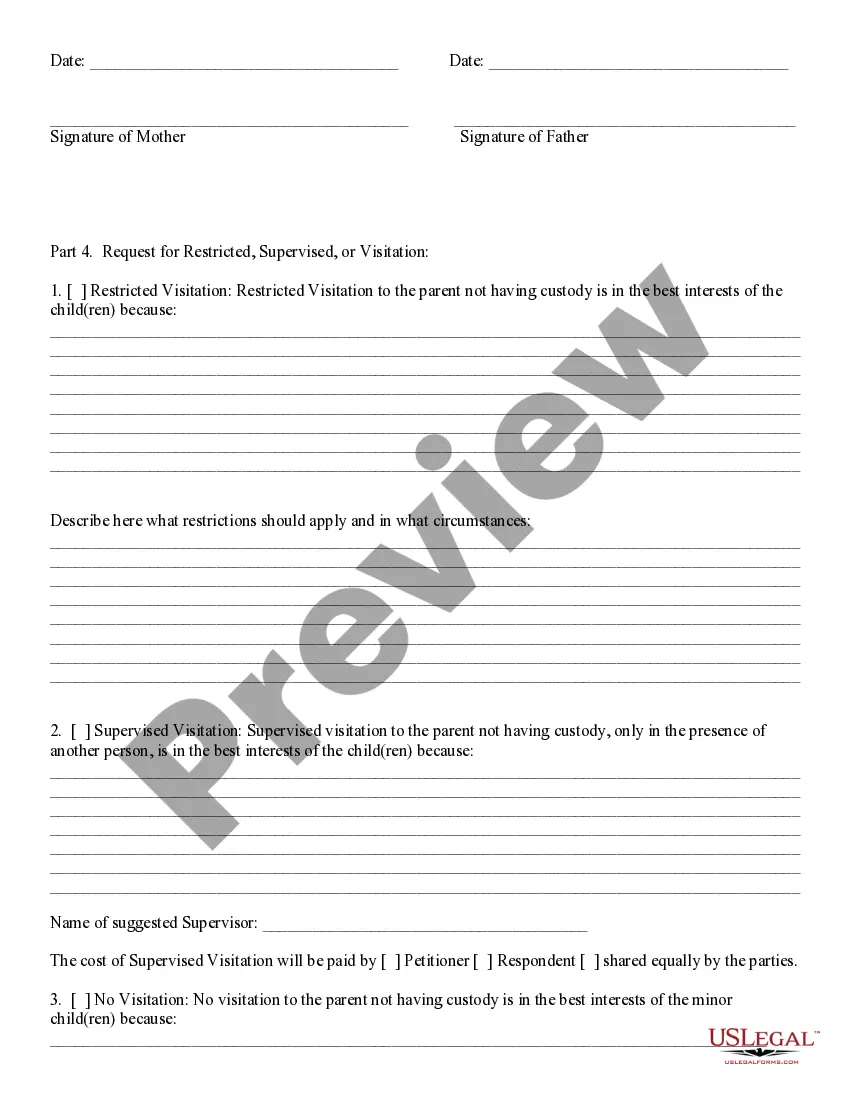
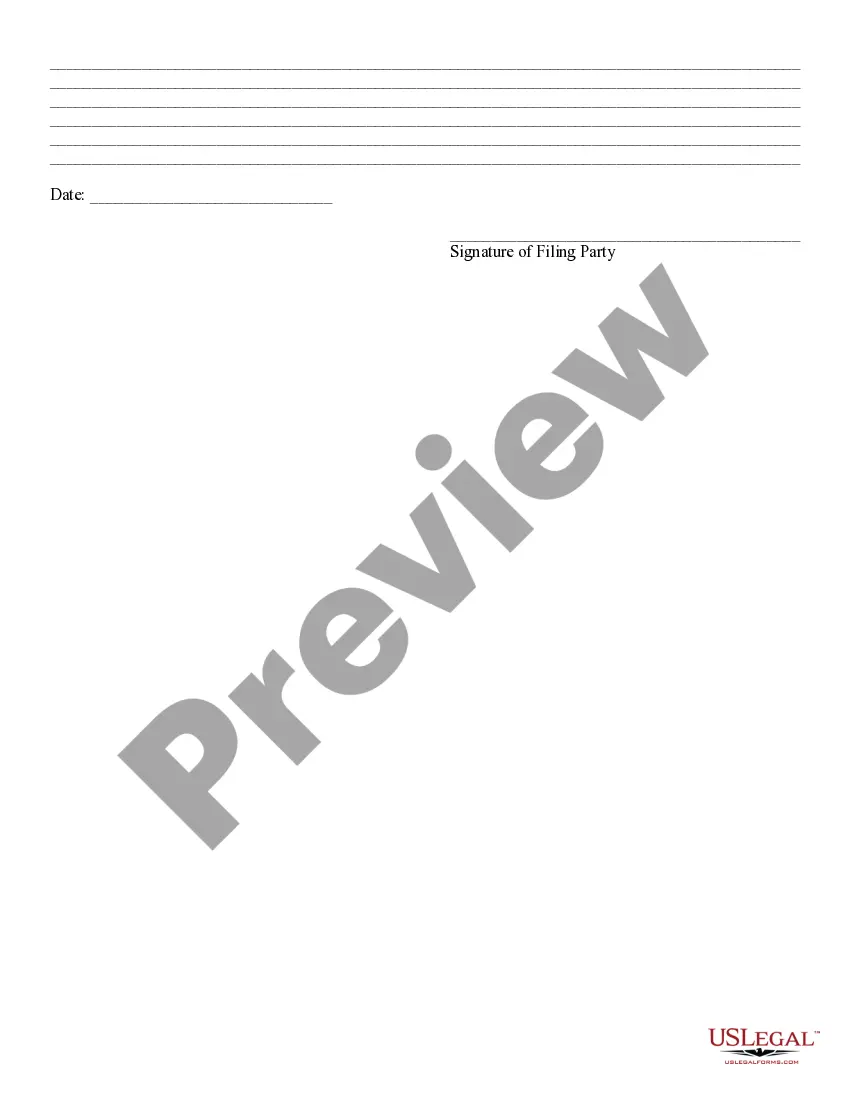
Get your form ready online
Our built-in tools help you complete, sign, share, and store your documents in one place.
Make edits, fill in missing information, and update formatting in US Legal Forms—just like you would in MS Word.
Download a copy, print it, send it by email, or mail it via USPS—whatever works best for your next step.
Sign and collect signatures with our SignNow integration. Send to multiple recipients, set reminders, and more. Go Premium to unlock E-Sign.
If this form requires notarization, complete it online through a secure video call—no need to meet a notary in person or wait for an appointment.
We protect your documents and personal data by following strict security and privacy standards.

Make edits, fill in missing information, and update formatting in US Legal Forms—just like you would in MS Word.

Download a copy, print it, send it by email, or mail it via USPS—whatever works best for your next step.

Sign and collect signatures with our SignNow integration. Send to multiple recipients, set reminders, and more. Go Premium to unlock E-Sign.

If this form requires notarization, complete it online through a secure video call—no need to meet a notary in person or wait for an appointment.

We protect your documents and personal data by following strict security and privacy standards.
Looking for another form?
How to fill out Arizona Parenting Plan And Guidelines?
Whether for business purposes or for individual matters, everyone has to handle legal situations at some point in their life. Completing legal papers needs careful attention, beginning from selecting the appropriate form sample. For instance, if you pick a wrong edition of the Parenting Plan Agreement Format, it will be declined when you send it. It is therefore crucial to have a dependable source of legal papers like US Legal Forms.
If you have to obtain a Parenting Plan Agreement Format sample, stick to these simple steps:
- Get the sample you need using the search field or catalog navigation.
- Check out the form’s description to ensure it suits your case, state, and region.
- Click on the form’s preview to see it.
- If it is the incorrect document, go back to the search function to locate the Parenting Plan Agreement Format sample you need.
- Get the file if it matches your needs.
- If you already have a US Legal Forms account, simply click Log in to access previously saved templates in My Forms.
- In the event you don’t have an account yet, you may download the form by clicking Buy now.
- Choose the proper pricing option.
- Finish the account registration form.
- Pick your payment method: you can use a credit card or PayPal account.
- Choose the file format you want and download the Parenting Plan Agreement Format.
- When it is saved, you can complete the form by using editing applications or print it and finish it manually.
With a large US Legal Forms catalog at hand, you do not need to spend time searching for the appropriate sample across the internet. Take advantage of the library’s straightforward navigation to get the correct template for any situation.
Form popularity
FAQ
The following are three methods parents may use to come to an agreement without going to the courtroom: mutual agreement, mediation and collaborative divorce.
Clearly outline obligations, timeframes and consequences if tasks are ignored. Post the contract where everyone can see it (e.g., on the fridge or family bulletin board). Be consistent, reasonable and fair in giving rewards and enforcing consequences. Renegotiate agreements as other skills and abilities develop.
In Texas, a notarized custody agreement is not worth the paper it's written on in most cases. It can be produced as an Exhibit to the judge in a court hearing but it is not binding on the judge. Please talk to an attorney in your area about how your state handles child custody.
A parallel parenting plan and custody order should specifically state: ? the start and end time of each custodial segment, ? the specific exchange place, and elimination of other issues that could cause conflict if there is miscommunication or the court order is vague. effort to avoid further litigations.
A 50/50 parenting schedule could be arranged in many ways, such as: Biweekly rotation - One week with one parent, and one week with the other parent. 2-2-5-5 rotation - Two days with one parent, and two days with the other parent. Then, five days back with the first parent, and five days with the other parent.