Az Form Death Document Without Consent
Description


Get your form ready online
Our built-in tools help you complete, sign, share, and store your documents in one place.
Make edits, fill in missing information, and update formatting in US Legal Forms—just like you would in MS Word.
Download a copy, print it, send it by email, or mail it via USPS—whatever works best for your next step.
Sign and collect signatures with our SignNow integration. Send to multiple recipients, set reminders, and more. Go Premium to unlock E-Sign.
If this form requires notarization, complete it online through a secure video call—no need to meet a notary in person or wait for an appointment.
We protect your documents and personal data by following strict security and privacy standards.

Make edits, fill in missing information, and update formatting in US Legal Forms—just like you would in MS Word.

Download a copy, print it, send it by email, or mail it via USPS—whatever works best for your next step.

Sign and collect signatures with our SignNow integration. Send to multiple recipients, set reminders, and more. Go Premium to unlock E-Sign.

If this form requires notarization, complete it online through a secure video call—no need to meet a notary in person or wait for an appointment.

We protect your documents and personal data by following strict security and privacy standards.
Looking for another form?
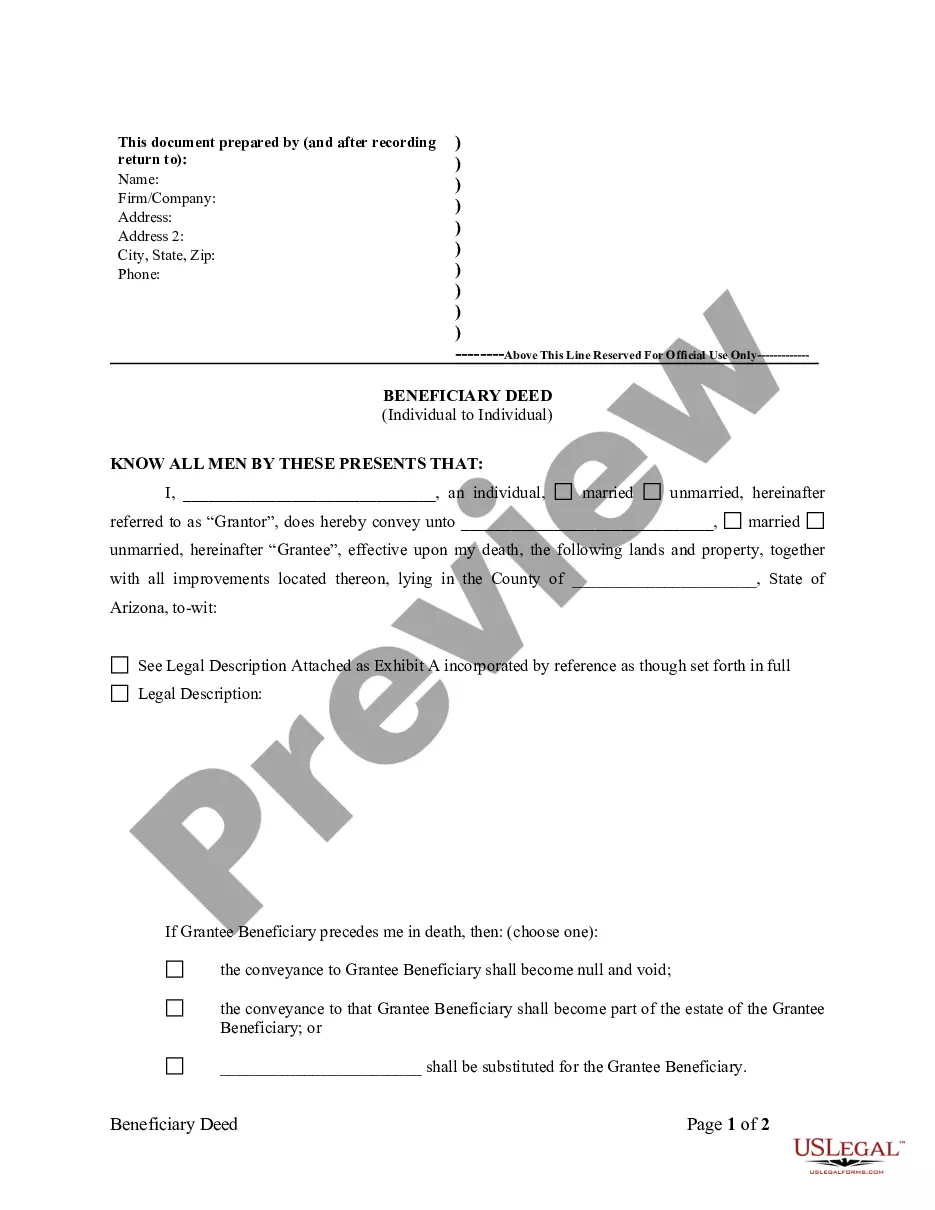
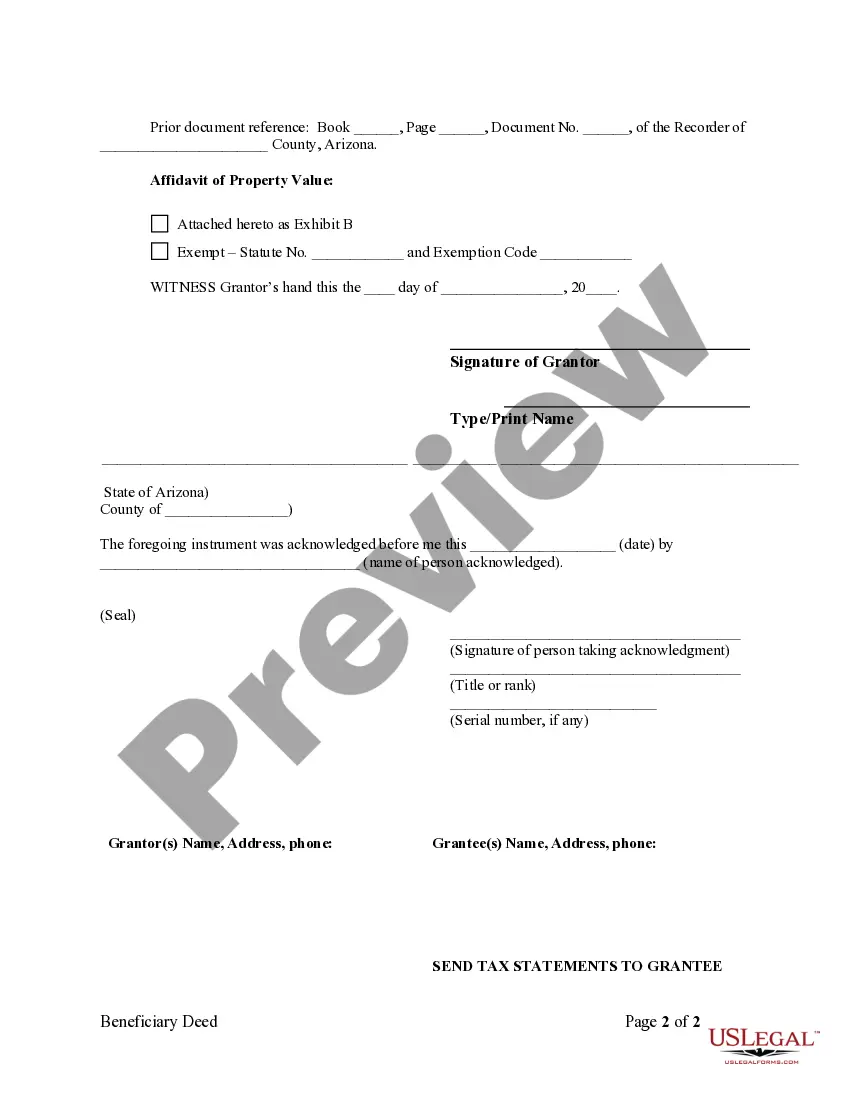
How to fill out Arizona Beneficiary Deed For Individual To Individual?
Getting a go-to place to take the most recent and appropriate legal samples is half the struggle of dealing with bureaucracy. Choosing the right legal papers demands accuracy and attention to detail, which explains why it is vital to take samples of Az Form Death Document Without Consent only from trustworthy sources, like US Legal Forms. An improper template will waste your time and delay the situation you are in. With US Legal Forms, you have little to worry about. You can access and check all the details concerning the document’s use and relevance for the situation and in your state or region.
Consider the following steps to complete your Az Form Death Document Without Consent:
- Utilize the library navigation or search field to locate your sample.
- View the form’s information to ascertain if it matches the requirements of your state and county.
- View the form preview, if there is one, to ensure the form is the one you are looking for.
- Go back to the search and locate the proper template if the Az Form Death Document Without Consent does not suit your requirements.
- When you are positive about the form’s relevance, download it.
- If you are an authorized user, click Log in to authenticate and gain access to your picked templates in My Forms.
- If you do not have an account yet, click Buy now to obtain the form.
- Choose the pricing plan that suits your preferences.
- Go on to the registration to complete your purchase.
- Finalize your purchase by selecting a transaction method (credit card or PayPal).
- Choose the document format for downloading Az Form Death Document Without Consent.
- Once you have the form on your device, you may change it using the editor or print it and finish it manually.
Remove the inconvenience that comes with your legal documentation. Check out the extensive US Legal Forms catalog to find legal samples, check their relevance to your situation, and download them immediately.
Form popularity
FAQ
There may be additional hearings to resolve contests, and the executor will probably need court approval before making major decisions and actions. Informal probate is obviously the quickest and can conclude in 4 ? 6 months. Formal probate may take up to a year or longer.
Once signed and notarized, the affidavits must be filed with the probate court in the county where the property is physically located. A certified copy of the death certificate and a copy of the will, if any, must be attached to each affidavit, along with title documents for real estate and other large assets.
Identity Theft Affidavit Complete this form if you think you are a victim of identity theft which may impact your Arizona tax return.
Informal probate requires that the deceased had a valid will at the time of death that has not been challenged and died less than 2 years before probate is opened. In an informal probate process, a personal representative is appointed by the court to administer the estate with minimal court supervision.
To open probate proceedings, a family member or friend will need to file a petition with the county court. If the family members are in agreement, the court can appoint one of them to serve as the estate's executor or personal representative.