California Divorce
Divorce documents facilitate the legal process of ending a marriage. Attorney-drafted templates are quick and easy to complete.

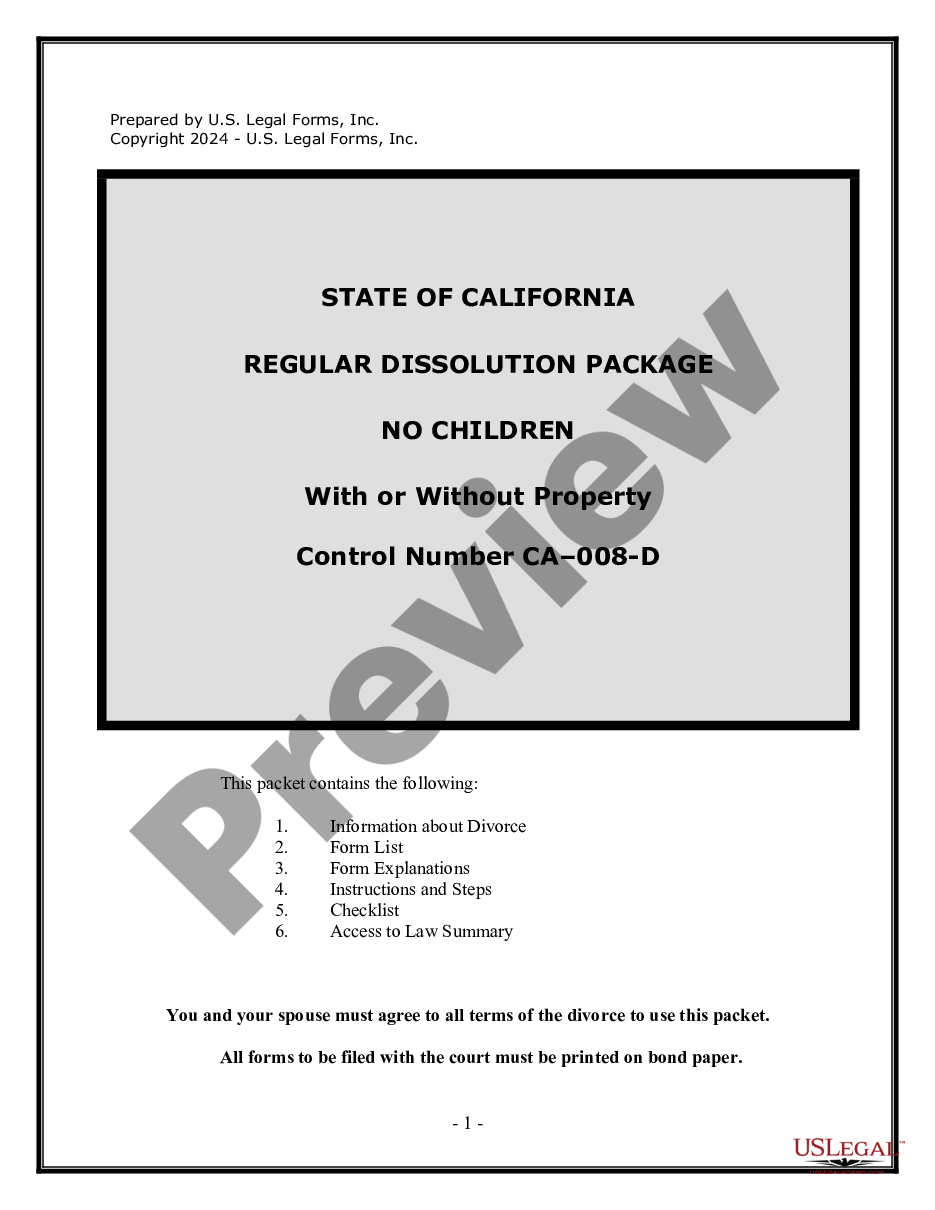
Uncontested Divorce Package - No Children
PopularAll court forms for a no-fault agreed divorce with no minor children - petition, waiver, final decree, and hearing documents.
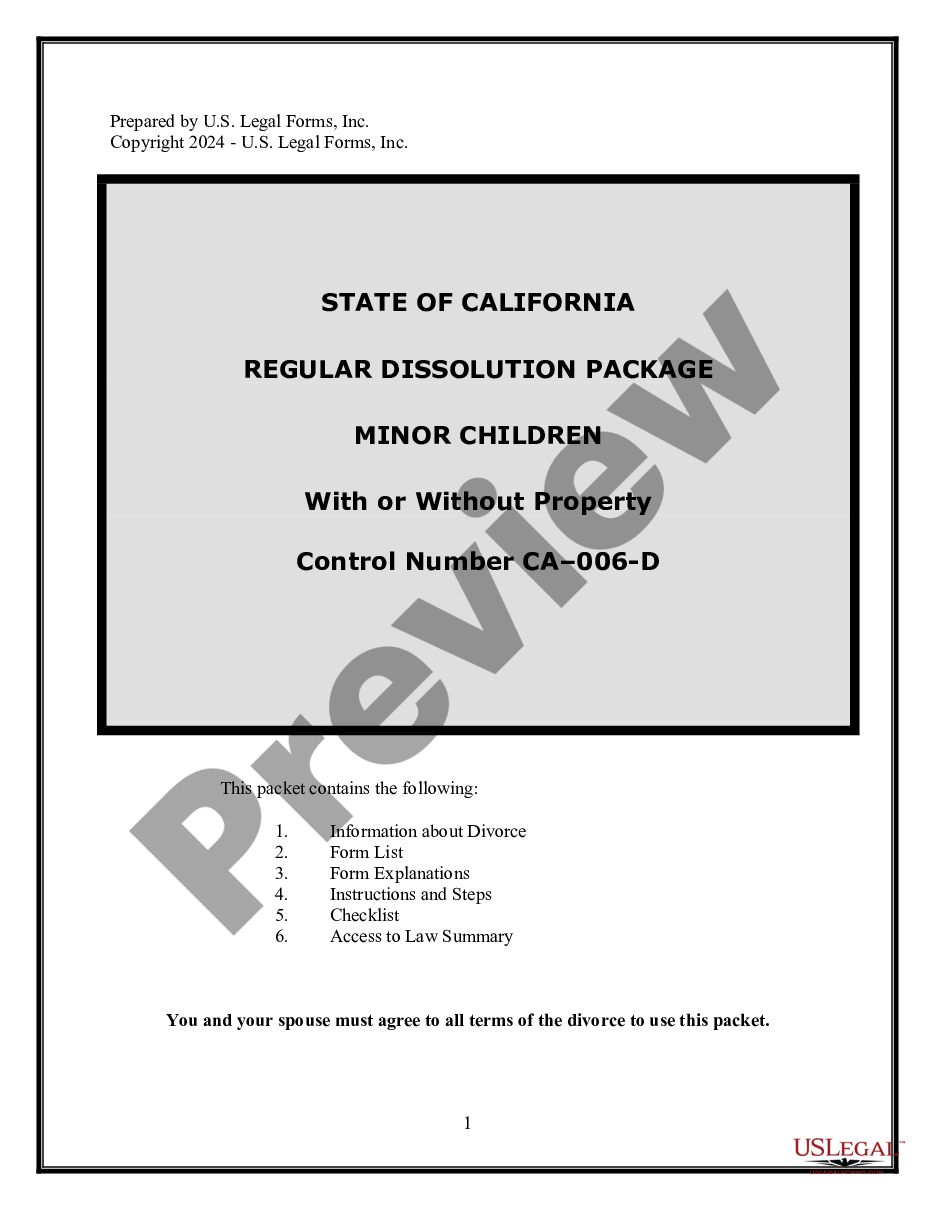
Uncontested Divorce Package - Minor Children
PopularComplete agreed divorce filing package for couples with children under 18 — all required court documents included.
Similar documents: key differences
- Divorce vs. Legal Separation — divorce ends the marriage; legal separation allows for living apart while remaining married.
- Uncontested Divorce vs. Contested Divorce — uncontested means both parties agree on terms; contested involves disputes.
- Marital Settlement Agreement vs. Divorce Decree — the former outlines agreements; the latter is the court's final ruling.
- Divorce Petition vs. Complaint for Divorce — both start the process, but terminology may vary by state.
- Separation Agreement vs. Marital Settlement Agreement — separation agreements are for couples not yet divorced; marital settlement agreements finalize divorce terms.
Search for more forms
Types of Divorce forms
Separation Agreement
Establish clear terms for separating partners, detailing property division and support obligations.
Separation + Support: Joint Custody & Mutual Support
Create a binding agreement for custody, visitation, and support of children after separation, ensuring both parents maintain shared responsibilities.
Petition — Marriage or Domestic Partnership (FL-100)
Use this form to initiate a legal separation, divorce, or nullification of marriage, ensuring proper court recognition of your relationship status.
Declaration for Default or Uncontested Dissolution (FL-170)
Use this declaration when responding to a default or uncontested dissolution or separation case, simplifying court proceedings without a hearing.
Request to Enter Default (FL-165)
Use this request to seek a court's acknowledgment of default when no response is submitted in a family law case.
Summons — Family Law (FL-110)
Act promptly to respond to court orders impacting marriage, property, and child custody. Missing deadlines can lead to unfavorable outcomes.
Response — Family Law (FL-120)
Respond to a marriage dissolution or legal separation petition by clarifying your position and requests regarding property and marital status.
Appearance, Stipulation and Waivers (FL-130)
Notice and Acknowledgment of Receipt (FL-117)
Ensure proper notification in family law cases by acknowledging receipt of essential documents like petitions and summons.
Proof of Service by Mail (FL-335)
Document delivery through mail requires proof that recipients received their copies. Use this form to confirm that service was completed correctly.
Proof of Service of Summons (FL-115)
Essential for serving legal documents, this form ensures parties involved in family law cases receive notice of the petition filed against them.
Stipulation Regarding Spousal Support
Use this form when both partners agree to waive spousal support during a divorce process, ensuring clarity on financial arrangements.
Family-Centered Case Resolution Order (FL-174)
Judgment (FL-180)
Finalize legal separation, dissolutions, or nullity with this essential judgment form, ensuring your marital status is officially recognized.
Judgment Checklist — Dissolution (FL-182)
Petition to Modify
Request to end child support due to visitation interference and child's adulthood status.
Notice of Entry of Judgment (FL-190)
Utilize this document to officially record a family law judgment regarding custody, support, and other parental issues.
Affidavit — Divorce
Use this document to request a court review of alimony after the remarriage of the other party, highlighting potential changes in financial circumstances.
Motion to Modify Decree — Restore Name
Easily request a court order to revert your name to your married name after a divorce, addressing difficulties you've faced with your maiden name.
Case Information — Family Law (FL-172)
Marital Settlement Agreement
Finalize your separation with a comprehensive agreement detailing property, custody, and support arrangements. Essential for amicable divorce settlements.
Separation Agreement (No Kids · No Joint Property · Immediate)
Use this agreement to settle financial and property matters during a separation without filing for divorce, effective immediately.
Separation Agreement (No Kids · Joint Property · Immediate)
Establish clear terms for property division and financial matters in a separation without children, ensuring mutual understanding and acceptance.
Separation Agreement (No Kids · Joint Property · Future Filing)
Use this agreement to settle property and debt issues when separating before divorce, ensuring both parties' rights are clear.
Separation Agreement (No Kids · No Joint Property · Future Filing)
Enter a separation agreement before or during divorce proceedings without children, joint property, or debts, streamlining the process for both parties.
Separation Agreement (Minor Kids · No Joint Property · Future Filing)
Ideal for spouses with minor children, no shared debts, and an impending divorce, this agreement outlines separation terms.
Separation Agreement (Minor Kids · Joint Property · Future Filing)
Enter a settlement agreement for separation before divorce, covering child custody, property division, and financial obligations.
Child Support Case Registry Form (FL-191)
Essential for documenting child support orders, ensuring all relevant parties are informed and registered.
UCCJEA Declaration (FL-105)
Essential for child custody cases, this declaration helps establish jurisdiction and ensures compliance with custody laws across states.
Separation Agreement (Minor Kids · Joint Property · Immediate)
Create a binding agreement for immediate separation and asset division when you have minor children and shared property or debts.
Separation Agreement (Minor Kids · No Joint Property · Immediate)
Use this agreement for immediate legal separation when there are minor children, but no joint property or debts involved.
Notice of Rights and Responsibilities (FL-192)
Notify the other parent about health-care costs and request reimbursement when insurance doesn't cover expenses.
Order — Income Withholding for Child Support (FL-195)
Use this notice to instruct employers to withhold income for child support, ensuring timely payments for obligations.
Separation Agreement (Adult Kids · Joint Property · Immediate)
Navigate separation with a clear agreement on property and debt responsibilities involving adult children.
Separation Agreement (Adult Kids · Joint Property · Future Filing)
Use this agreement to formalize a property settlement and terms of separation when planning for divorce, especially if you have adult children.
Divorce Worksheet and Law Summary for Contested
Prepare for your divorce consultation by gathering essential information on assets, children, and marital history, streamlining the process for you and your attorney.
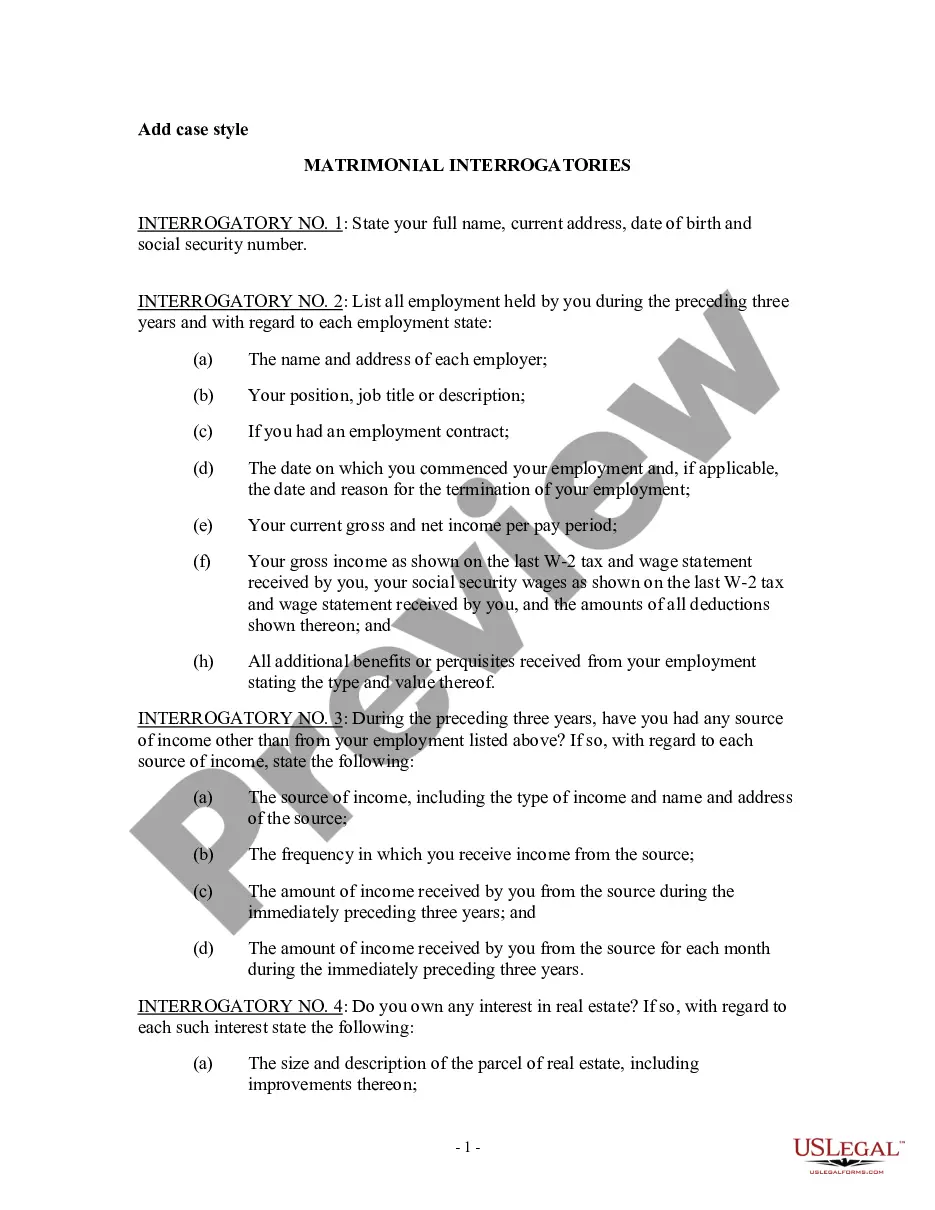
Discovery Interrogatories: Divorce (Either Party)
Use this form to gather detailed financial and personal information during a divorce proceeding, ensuring transparency between parties.
Continuation of Property Declaration (FL-161)
Necessary for detailing property division in family law cases, especially during divorce or separation proceedings.
Declaration Regarding Service of Disclosure (FL-141)
Provide proof of serving necessary financial disclosures in family law cases to ensure fair proceedings.
Declaration of Disclosure (FL-140)
Essential for family law cases, it ensures proper disclosure of assets and debts between parties during legal separation or dissolution.
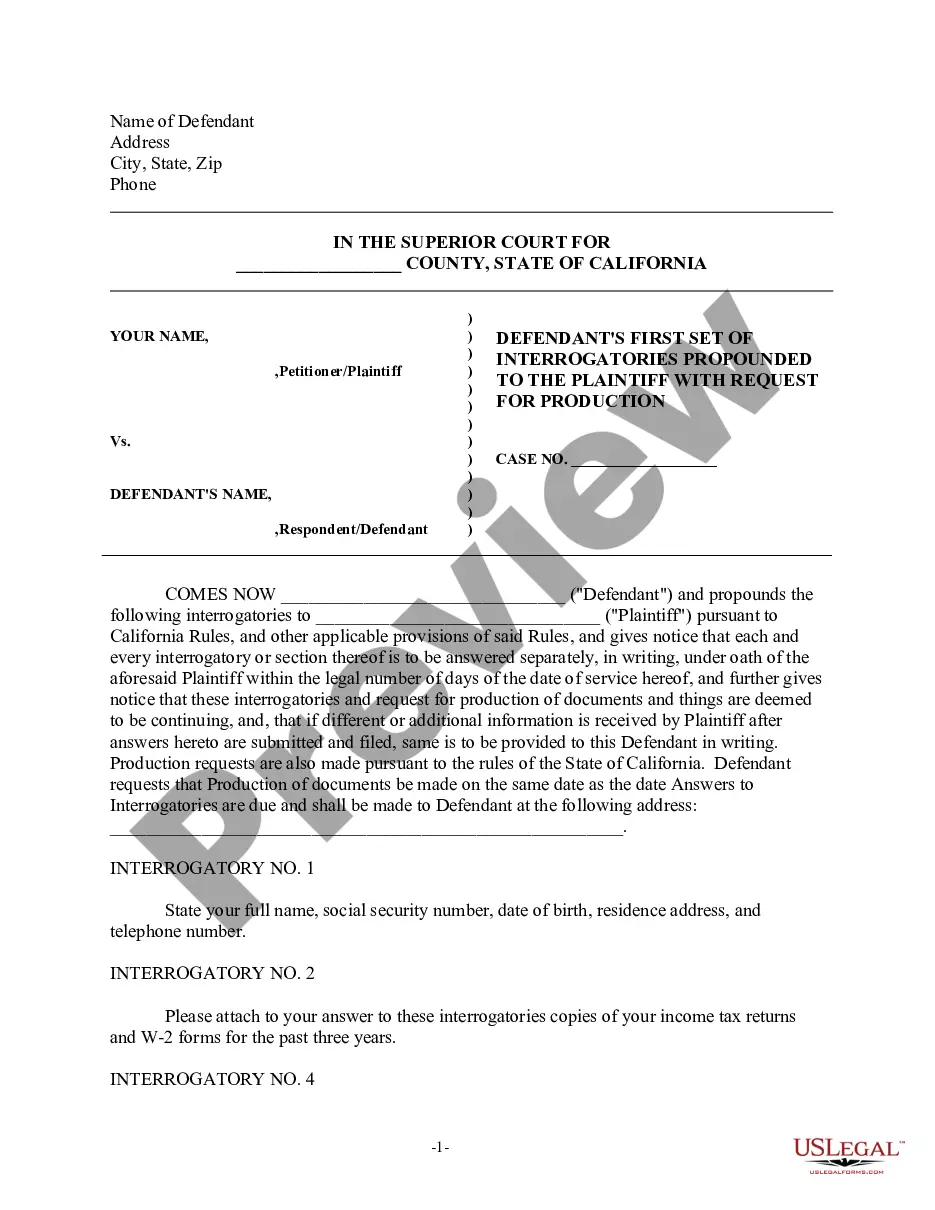
Discovery Interrogatories: Defendant → Plaintiff
Gather essential information from the plaintiff during discovery in a legal case, ensuring transparency and clarification of facts.
Discovery Interrogatories: Plaintiff → Defendant
Gather detailed responses and document requests from a defendant during civil litigation.
Income and Expense Declaration (FL-150)
Property Declaration (FL-160)
Clarify and propose the division of assets during family law proceedings with this essential declaration.
Schedule of Assets and Debts (FL-142)
Gather and list all your assets and debts to ensure fair division in family law matters.
Common California Divorce documents
- Divorce Petition — initiates the legal process to end a marriage.
- Divorce Decree — finalizes the divorce and outlines terms.
- Marital Settlement Agreement — details the division of assets and responsibilities.
- Complaint for Divorce — a formal statement requesting a divorce.
- Divorce Filing Forms — documents required to file for divorce.
- Separation Agreement — outlines terms for living apart before divorce.
- Divorce Judgment Forms — record the court's final decision on the divorce.
Complete California Divorce packages
Bundle every form you need for a complete situation — not just one document.

 16 forms
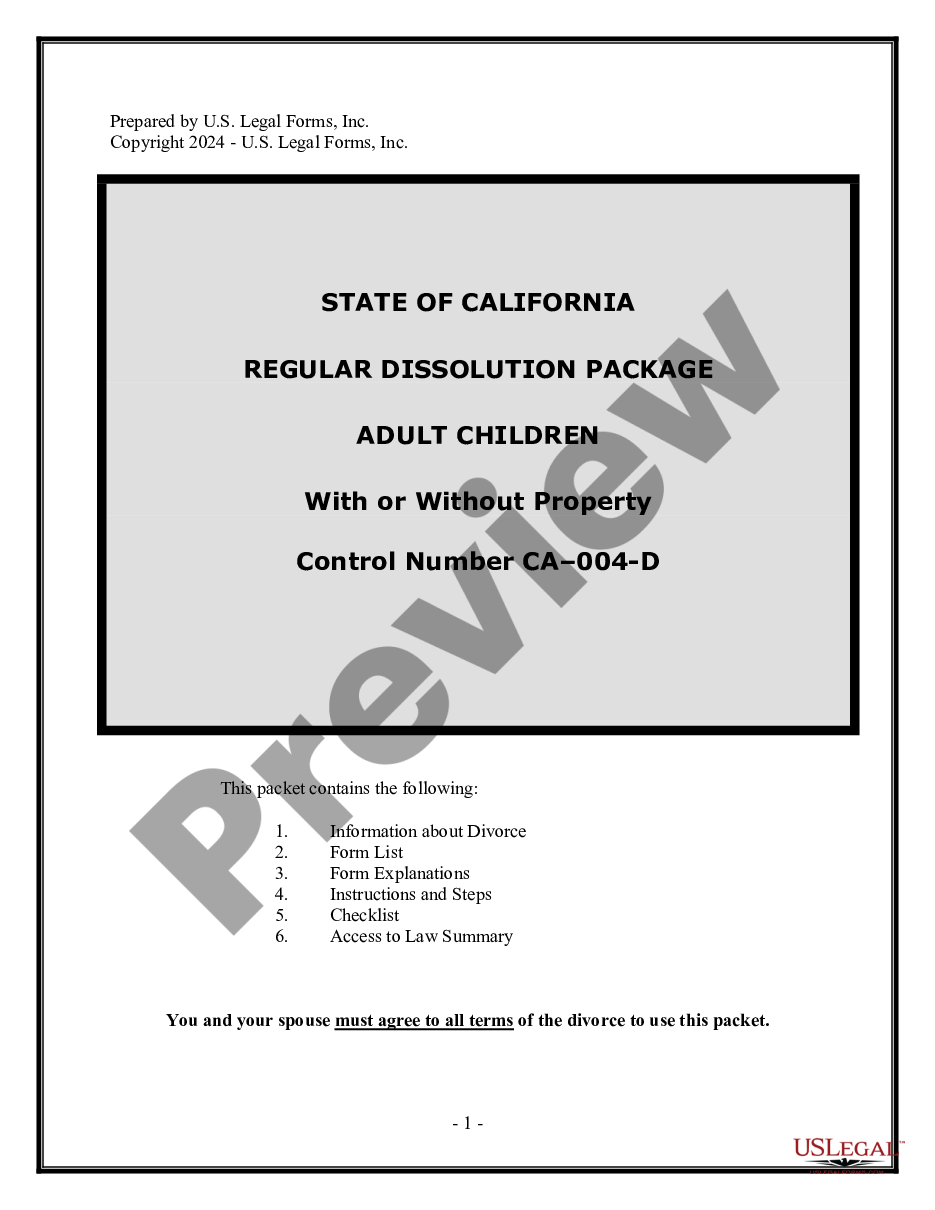
California No-Fault Uncontested Agreed Divorce Package for Dissolution of Marriage with Adult Children and with or without Property and Debts
Access all necessary legal forms for a straightforward divorce without children.
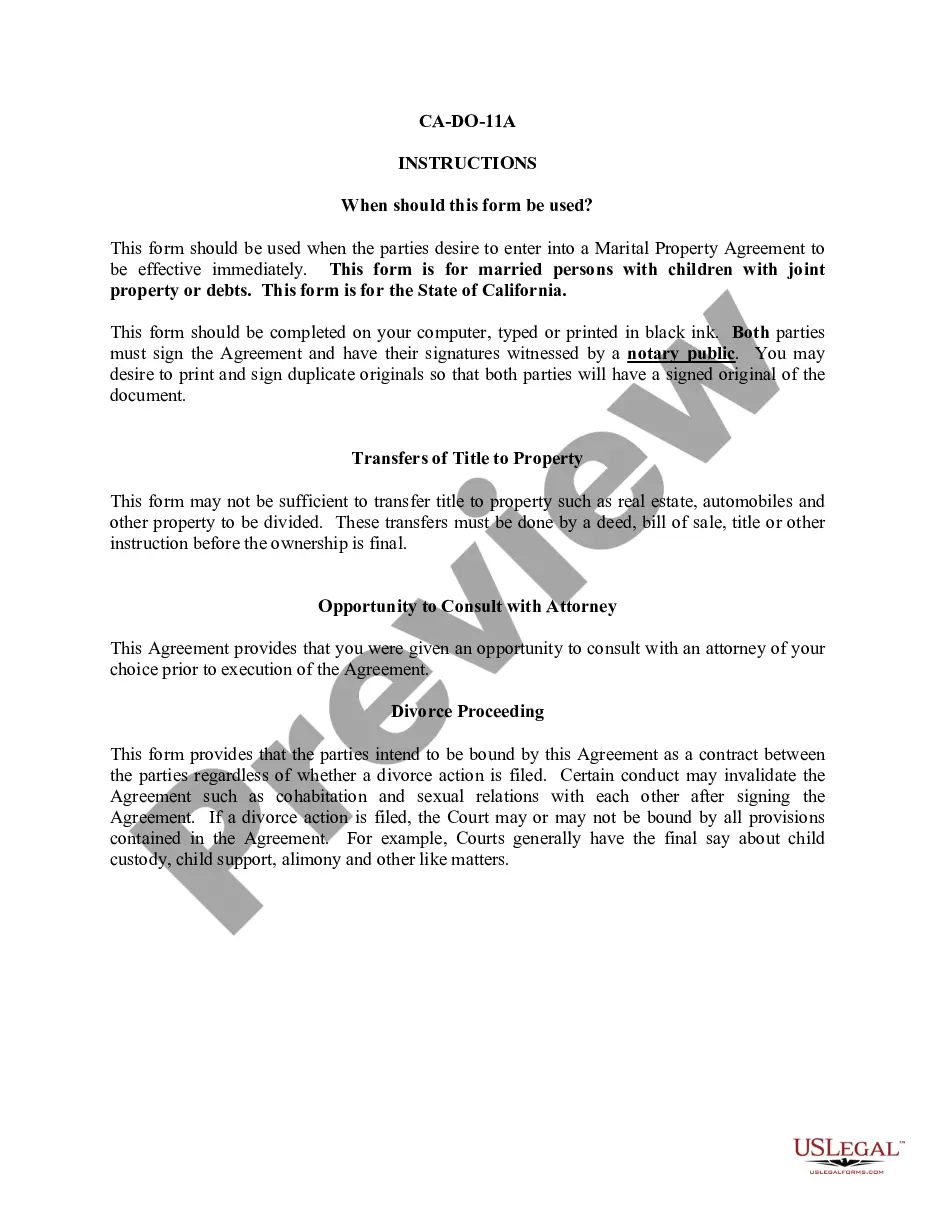
- California Legal Separation and Property Settlement Agreement with Adult Children - Marital - Domestic - Parties May have Joint Property or Debts - Effective Immediately
- California Petition - Marriage or Domestic Partnership
- California Summons - Family Law
- California Proof of Service of Summons
- California Notice and Acknowledgment of Receipt - Family Law
- California Response - Family Law
- California Declaration of Disclosure - Family Law
- California Declaration Regarding Service of Declaration of Disclosure and Income and Expense Declaration - Family Law
- California Schedule of Assets and Debts - Family Law
- California Income and Expense Declaration - Family Law
- California Property Declaration - Family Law
- California Request to Enter Default - Family Law - Uniform Parentage
- California Declaration for Default or Uncontested Dissolution or Legal Separation
- California Judgment
- California Notice of Entry of Judgment - Family Law - Uniform Parentage - Custody and Support
- California Proof Of Service By Mail
5 forms
California Newly Divorced Individuals Package
Get everything needed for your legal life after divorce in one package, with multiple related forms for peace of mind.
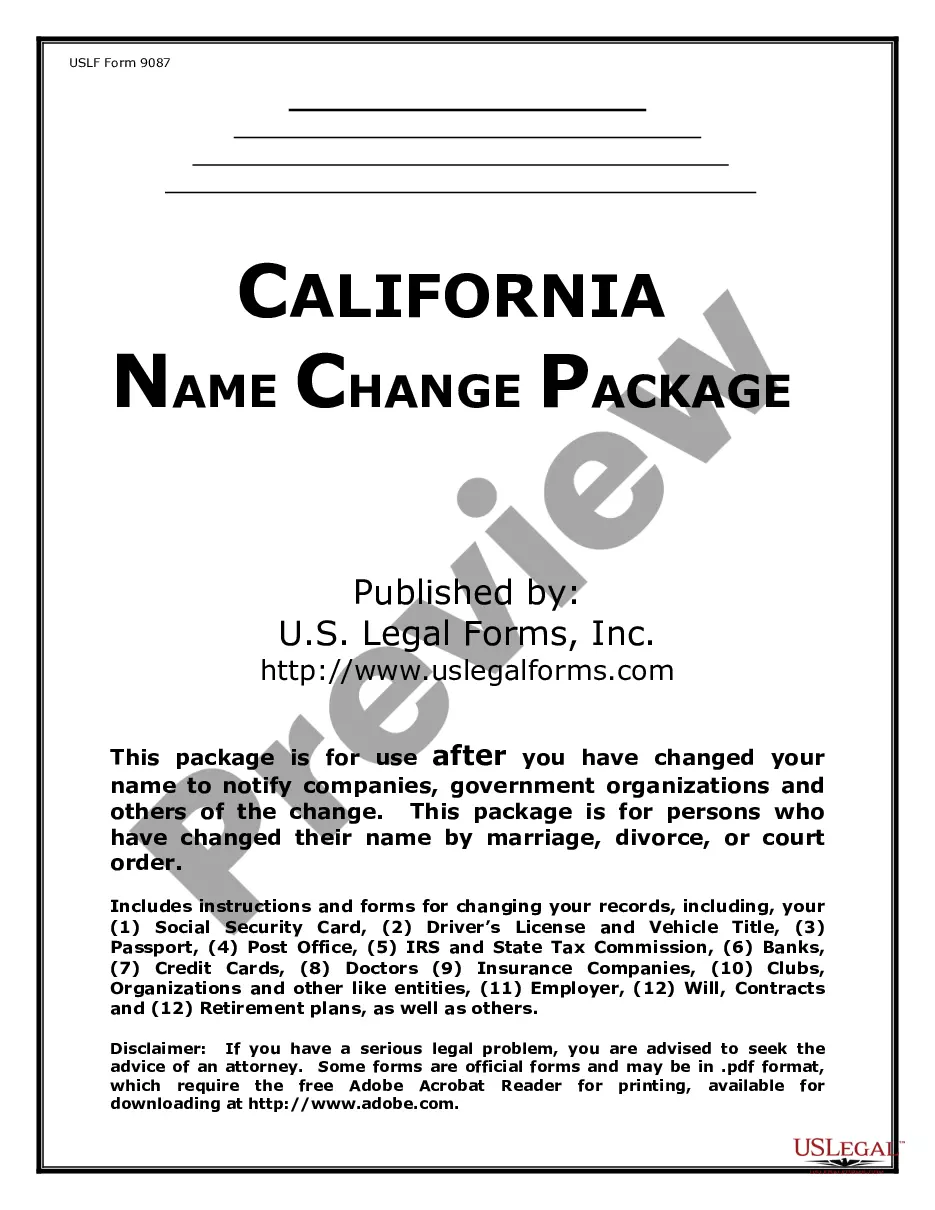
- California Name Change Notification Form
- California General Durable Power of Attorney for Property and Finances or Financial Effective upon Disability
- California Statutory Health Care Directive
- California Written Revocation of Will
- Personal Planning Information and Document Inventory Worksheets - A Legal Life Document
FAQs
Divorce permanently ends the marriage, while legal separation allows couples to live apart but remain married.
Separation does not legally end a marriage; filing for divorce is necessary to terminate it.
The timeline varies based on the complexity of the case and court schedules.
Yes, you can withdraw your petition, but it may involve additional paperwork.
California allows no-fault divorce, meaning no reason needs to be provided beyond irreconcilable differences.
Key legal points
- Divorce requires specific forms to be completed and filed.
- Many documents may need to be notarized or witnessed.
- Divorce can be unilateral or mutual, depending on circumstances.
- Filing fees are typically required when submitting documents.
- Parties can choose mediation to resolve disputes amicably.
- Timing for processing can vary based on court workload.
- All terms agreed upon should be clearly documented.
How to get started
Begin the process with these simple steps.
- Find a template or package that fits your situation.
- Review the description, preview, and signing requirements.
- Get full access with a subscription.
- Complete it in the online editor.
- Export or send: download, email, USPS mail, notarize online, or send for e-signature (Premium).
Practical tip
Consider discussing asset division early in the process to minimize conflict.