District of Columbia Letter from Tenant to Landlord containing Notice to landlord to withdraw retaliatory rent increase
About this form
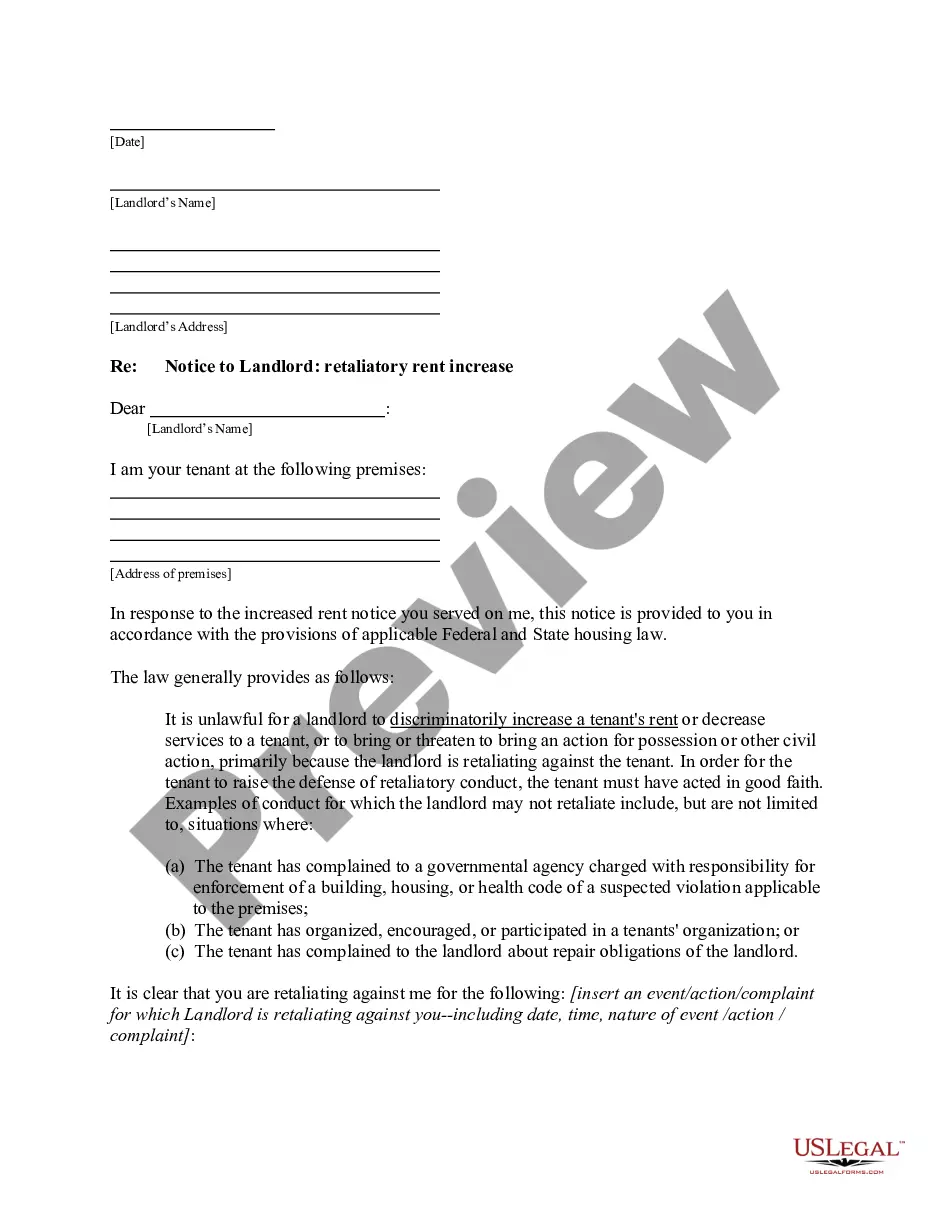
This form is a letter from the tenant to the landlord providing notice of a retaliatory rent increase. It serves to inform the landlord that increasing rent in retaliation for a tenant's protected actions is unlawful. This form is essential for tenants to assert their rights against discrimination and retaliation regarding rent adjustments or services in their rental agreement.
Key parts of this document
- Tenant's name and contact information.
- Landlord's name and contact information.
- Date of the notice.
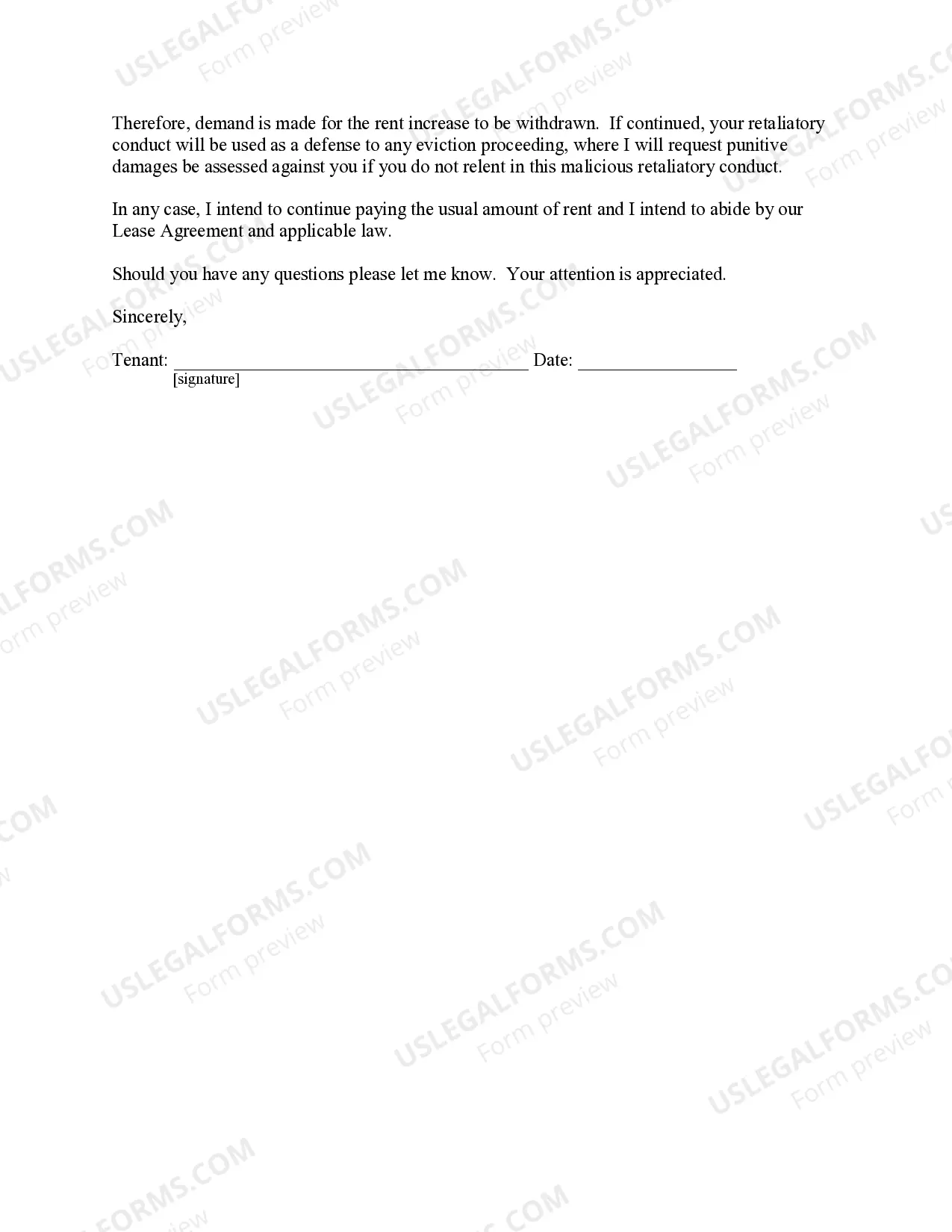
- Statement of intent to continue paying the usual rent.
- Reference to the specific actions that triggered retaliation.
- Tenant's signature and date.

Common use cases
This form should be used when a tenant suspects that their landlord is increasing rent in retaliation for actions that are legally protected. Examples include reporting unsafe living conditions, participating in tenant unions, or lodging complaints about the landlord's obligations to maintain the property. Using this letter can help establish a record of the tenantâs objection to the retaliatory rent increase.
Intended users of this form
- Tenants who have experienced a recent rent increase they believe is retaliatory.
- Individuals seeking to formally communicate their rights to their landlord.
- Those who have reported violations or participated in tenant advocacy efforts.
How to prepare this document
- Identify yourself as the tenant by entering your full name and contact information at the top of the letter.
- Include the landlord's full name and address.
- Fill in the current date at the beginning of the document.
- Clearly state your intention to continue paying your usual rent and outline the retaliatory actions you are addressing.
- Sign the letter and include the date of your signature to formalize the notice.
Does this document require notarization?
Notarization is generally not required for this form. However, certain states or situations might demand it. You can complete notarization online through US Legal Forms, powered by Notarize, using a verified video call available anytime.
Get your form ready online
Our built-in tools help you complete, sign, share, and store your documents in one place.
Make edits, fill in missing information, and update formatting in US Legal Forms—just like you would in MS Word.
Download a copy, print it, send it by email, or mail it via USPS—whatever works best for your next step.
Sign and collect signatures with our SignNow integration. Send to multiple recipients, set reminders, and more. Go Premium to unlock E-Sign.
If this form requires notarization, complete it online through a secure video call—no need to meet a notary in person or wait for an appointment.
We protect your documents and personal data by following strict security and privacy standards.

Make edits, fill in missing information, and update formatting in US Legal Forms—just like you would in MS Word.

Download a copy, print it, send it by email, or mail it via USPS—whatever works best for your next step.

Sign and collect signatures with our SignNow integration. Send to multiple recipients, set reminders, and more. Go Premium to unlock E-Sign.

If this form requires notarization, complete it online through a secure video call—no need to meet a notary in person or wait for an appointment.

We protect your documents and personal data by following strict security and privacy standards.
Common mistakes
- Failing to provide adequate details about the retaliatory action.
- Not keeping a copy of the letter for personal records.
- Sending the letter without verifying if there are local regulations to consider.
Why use this form online
- Convenient access to legal templates from anywhere.
- Editability allows for personalization to meet your specific situation.
- Reliability ensures the form complies with state laws and is up to date.
Legal use & context
- This form helps protect tenants from unlawful retaliatory practices by landlords.
- It empowers tenants to assert their rights in a clear and formal manner.
- Documenting your concerns may be essential if further legal actions are needed.
Main things to remember
- This form is essential for tenants experiencing retaliatory rent increases.
- It outlines protective actions tenants can take against unfair treatment.
- Use this form to formally communicate with your landlord and establish a written record.
Looking for another form?
Form popularity
FAQ
To inform a tenant of a rent increase, draft a letter that includes the new rental amount, effective date, and the reason for the increase. Maintain a professional tone throughout, ensuring clarity throughout the document. You might also consider mentioning the District of Columbia Letter from Tenant to Landlord containing Notice to landlord to withdraw retaliatory rent increase for complete transparency about tenant rights.
Tenants have several remedies if a landlord refuses to accept rent. They can place the rent in escrow while seeking legal advice, or they could file a complaint with the appropriate local agency. Leveraging a District of Columbia Letter from Tenant to Landlord containing Notice to landlord to withdraw retaliatory rent increase can also be an effective strategy to assert their rights.
If you encounter issues with your landlord, you can report them to the District of Columbia Department of Consumer and Regulatory Affairs. This agency handles complaints about landlord violations of rental laws. Be prepared to provide evidence and detailed information regarding your situation, including any correspondence like a District of Columbia Letter from Tenant to Landlord containing Notice to landlord to withdraw retaliatory rent increase.
Writing a formal letter to a tenant involves using a professional tone and clear language. Begin with the sender's address, followed by the date, then the tenant's address. Clearly state the purpose of the letter, such as a rent increase, and be sure to incorporate relevant details, including references to any District of Columbia regulations that may apply.
To write a letter explaining a rent increase to a tenant, start by clearly stating the amount of the increase and the effective date. Ensure you provide a brief explanation for the increase, emphasizing any improvements or changes in the market. Additionally, consider including a reference to the District of Columbia Letter from Tenant to Landlord containing Notice to landlord to withdraw retaliatory rent increase for context on tenant rights.
When writing a letter to your landlord about a rent increase, clearly state your concerns and reference specific lease terms or laws. It helps to be polite yet assertive, providing any relevant documentation that supports your position. Additionally, using a District of Columbia Letter from Tenant to Landlord containing Notice to landlord to withdraw retaliatory rent increase as a template can provide clarity and structure in your communication.
A letter from your landlord outlines specific information related to your lease or living situation. It may involve notifications about repairs, rent adjustments, or even requests for documentation. Understanding the context and content of these letters is vital for staying informed as a tenant. If your landlord has issued a retaliatory rent increase, look into a District of Columbia Letter from Tenant to Landlord containing Notice to landlord to withdraw retaliatory rent increase.
Your landlord may send you a letter to communicate essential details regarding your lease or property. This can include notices of rent increases, maintenance issues, or other tenancy matters. Receiving timely communication is crucial for maintaining a good landlord-tenant relationship. If the letter pertains to a rent increase you believe is retaliatory, consulting a District of Columbia Letter from Tenant to Landlord containing Notice to landlord to withdraw retaliatory rent increase is advisable.
To get a landlord letter, you should approach your current or previous landlord and request it formally. Ensure you explain the purpose for which you need the letter, such as applying for a new rental property. If you are dealing with retaliatory actions, you might need to employ a District of Columbia Letter from Tenant to Landlord containing Notice to landlord to withdraw retaliatory rent increase as part of your communication.
A letter from the landlord typically communicates important information about your tenancy. This could include changes to the rental agreement, notices to vacate, or information about upcoming repairs. Understanding these letters can help tenants respond appropriately. If you receive a letter regarding a retaliation notice, refer to a District of Columbia Letter from Tenant to Landlord containing Notice to landlord to withdraw retaliatory rent increase for guidance.