Connecticut Quitclaim Deed from Corporation to Corporation
What is this form?
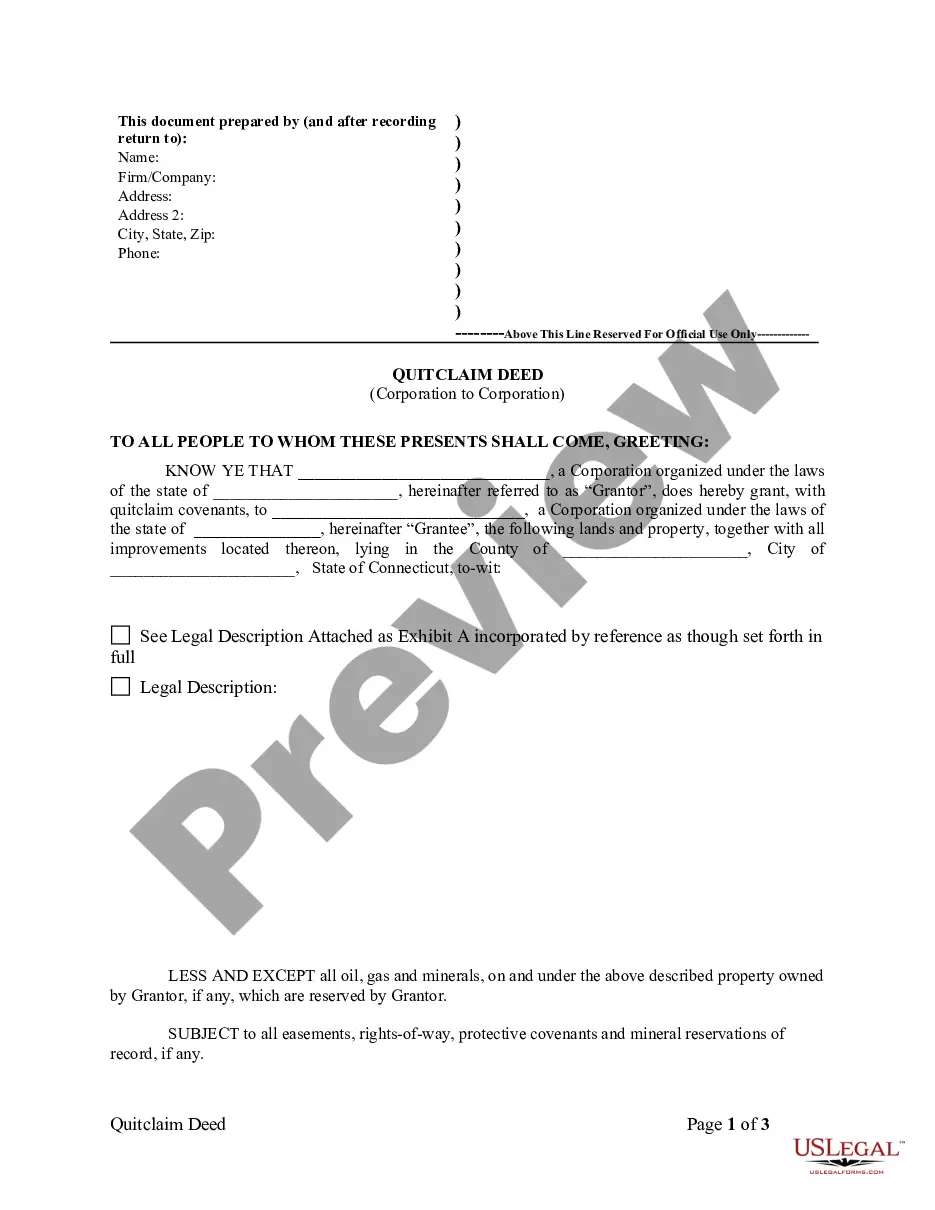
The Quitclaim Deed from Corporation to Corporation is a legal document that allows one corporation (the Grantor) to transfer ownership of a specific property to another corporation (the Grantee). Unlike other types of deeds, a quitclaim deed does not guarantee that the Grantor holds clear title to the property. Instead, it transfers whatever interest the Grantor has in the property, which might be limited. This deed is distinct in its use between corporations and complies with all state statutory laws, ensuring a legally recognized transfer of property ownership.
Key parts of this document
- Identification of the Grantor and Grantee corporations.
- Description of the property being transferred.
- Reservation of any oil, gas, and mineral rights by the Grantor.
- Specify any easements or rights affecting the property.
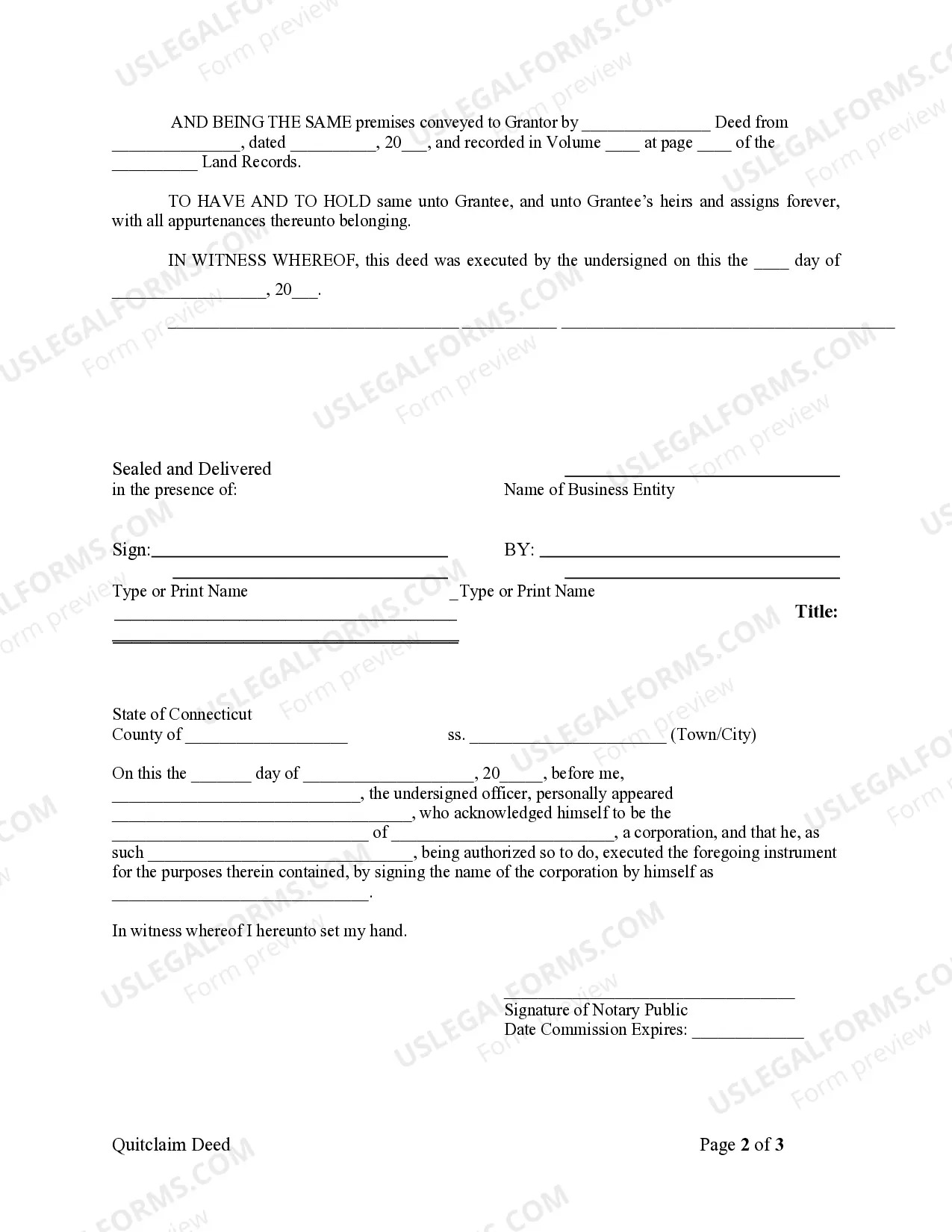
- Execution date of the deed.
- Signature lines for authorized representatives of both corporations.


When to use this form
This form is typically used when one corporation wishes to transfer property ownership to another corporation without providing warranties about the title. Situations may include corporate restructuring, selling or buying of corporate assets, or transferring properties within corporate subsidiaries.
Who this form is for
- Certainly, corporations involved in a real estate transaction.
- Business entities looking to formalize ownership transfers between corporate partners.
- Legal teams responsible for corporate governance and compliance.
- Real estate professionals assisting corporations in property transactions.
How to complete this form
- Identify and record the names of both corporations (Grantor and Grantee).
- Clearly describe the property being transferred, including any relevant identifiers.
- Include any reserved rights, such as oil, gas, and mineral interests.
- Have the authorized representatives of both corporations sign and date the form.
- Ensure the deed complies with any state-specific requirements before filing.
Notarization guidance
This form must be notarized to be legally valid. US Legal Forms provides secure online notarization powered by Notarize, allowing you to complete the process through a verified video call.
Get your form ready online
Our built-in tools help you complete, sign, share, and store your documents in one place.
Make edits, fill in missing information, and update formatting in US Legal Forms—just like you would in MS Word.
Download a copy, print it, send it by email, or mail it via USPS—whatever works best for your next step.
Sign and collect signatures with our SignNow integration. Send to multiple recipients, set reminders, and more. Go Premium to unlock E-Sign.
If this form requires notarization, complete it online through a secure video call—no need to meet a notary in person or wait for an appointment.
We protect your documents and personal data by following strict security and privacy standards.

Make edits, fill in missing information, and update formatting in US Legal Forms—just like you would in MS Word.

Download a copy, print it, send it by email, or mail it via USPS—whatever works best for your next step.

Sign and collect signatures with our SignNow integration. Send to multiple recipients, set reminders, and more. Go Premium to unlock E-Sign.

If this form requires notarization, complete it online through a secure video call—no need to meet a notary in person or wait for an appointment.

We protect your documents and personal data by following strict security and privacy standards.
Mistakes to watch out for
- Failing to properly identify the Grantor and Grantee corporations.
- Omitting the legal description of the property.
- Not addressing reserved rights or easements affecting the property.
- Incomplete signatures or lack of proper authority for signatories.
- Not complying with state-specific requirements for filing.
Benefits of using this form online
- Convenient digital access allows immediate download and completion of the form.
- Editable templates ensure you can customize the document easily.
- Reliability of attorney-drafted documents helps ensure compliance with legal standards.
Looking for another form?
Form popularity
FAQ
Filing a quitclaim deed in Connecticut involves completing the deed form correctly and ensuring it's signed by the grantor. Afterward, you need to file the deed with the town clerk in the municipality where the property is located. For assistance, you might consider using uslegalforms to make the process easier, ensuring you comply with all necessary requirements for a Connecticut Quitclaim Deed from Corporation to Corporation.
A corporation conveys real estate by formally executing a deed, typically done by a designated officer. In the case of a Connecticut Quitclaim Deed from Corporation to Corporation, the deed must specify the granting corporation and the receiving corporation. It’s important to follow the legal requirements, including proper authorization and recording the deed, to ensure a valid transfer.
The transfer of property without the owner's consent is referred to as adverse possession. However, in the context of corporate transactions such as a Connecticut Quitclaim Deed from Corporation to Corporation, this normally does not occur, since both parties must agree to the deed's terms. It's essential to have consent from both corporations during property transfers to ensure legality and clarity.
To ensure a deed is valid, it must be in writing, identify the parties involved, and outline a clear description of the property. Additionally, the deed needs to be signed by the grantor, which in the case of a Connecticut Quitclaim Deed from Corporation to Corporation, means an authorized representative of the corporation must sign. Remember, proper execution and witnessing may also be necessary, depending on state laws.
People commonly use a Connecticut Quitclaim Deed from Corporation to Corporation to transfer property rights without guarantees. This method is straightforward and efficient, making it ideal for corporate transactions where trust exists between parties. Corporations often utilize this type of deed to streamline the transfer process, especially during mergers or property consolidations. By using a quitclaim deed, companies can quickly change property ownership while minimizing the complexities of traditional deeds.
Yes, when a corporation transfers ownership using a Connecticut Quitclaim Deed from Corporation to Corporation, the deed must be signed. It must be signed by an authorized officer representing the corporation, ensuring that the transfer is legally binding. This signature verifies consent and allows for the proper documentation of the transaction in public records.
In Connecticut, a Quitclaim Deed from Corporation to Corporation must meet specific requirements. It should include the names of the grantor and grantee, a clear description of the property, and should be signed by an authorized officer of the corporation transferring the property. Additionally, the deed needs to be acknowledged before a notary public and filed with the appropriate town clerk.
The process for a Connecticut Quitclaim Deed from Corporation to Corporation begins with drafting the deed document. This deed must clearly outline the properties being transferred and be signed by the authorized representatives of both corporations. After signing, the deed should be filed with the local town clerk's office to make the transfer official and to ensure public records are updated.