California Residential Lease Renewal Agreement
Understanding this form
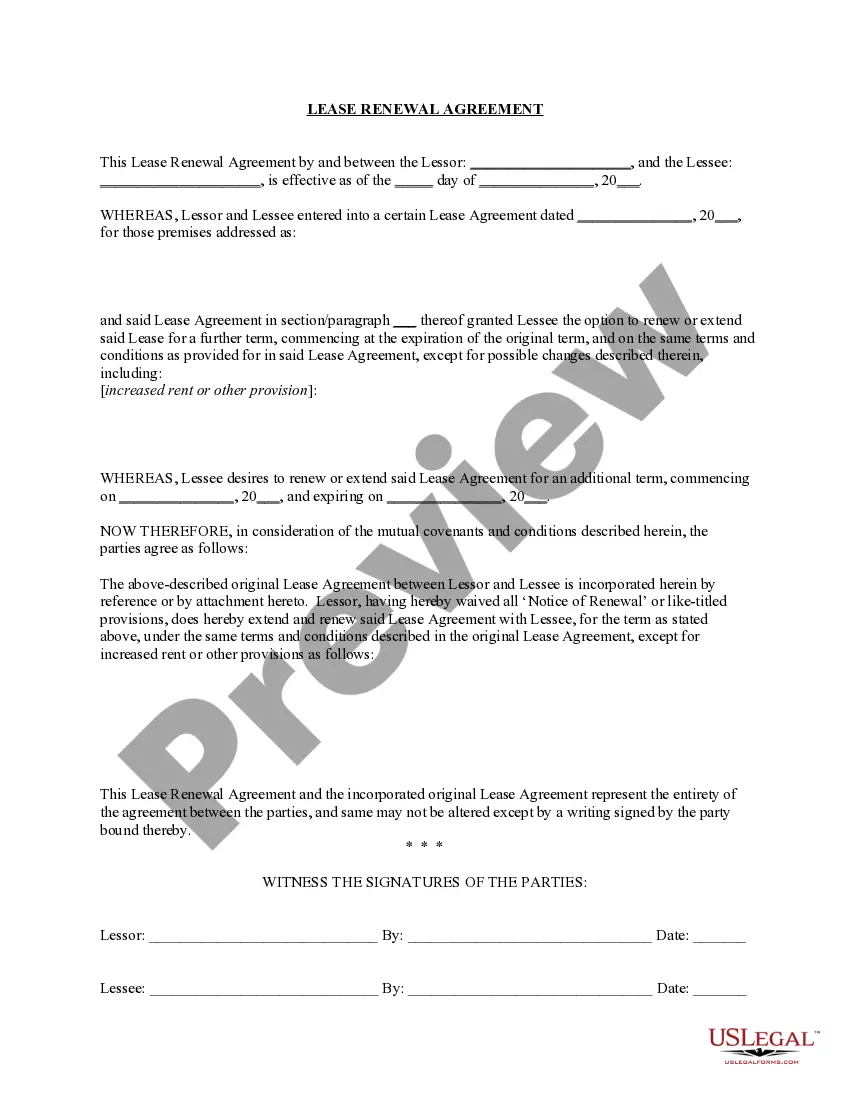
The Residential Lease Renewal Agreement is a legal document that allows tenants and landlords to extend an existing lease for an additional term. This agreement may also include modifications to the original lease terms. Creating a renewal agreement is crucial for maintaining clear expectations and responsibilities, distinguishing it from a new lease, which could entail entirely new terms and conditions.
What’s included in this form
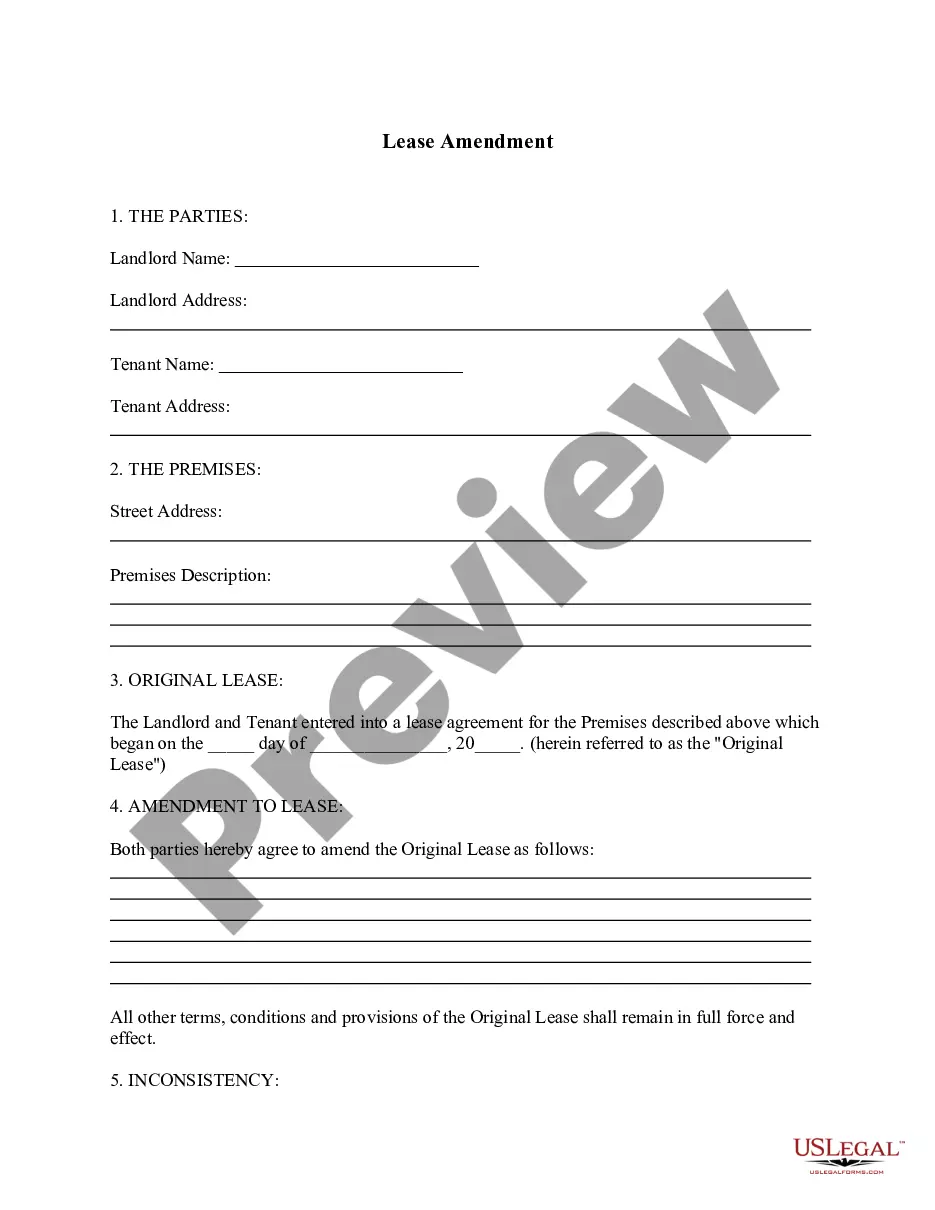
- Identification of the Lessor (landlord) and Lessee (tenant).
- Effective date of the renewal agreement.
- Reference to the original lease agreement with dates.
- Property address details.
- Signature lines for both Lessor and Lessee along with dates.
When this form is needed
This form is useful when a tenant wishes to renew their lease after the initial term has ended. It is typically used when both parties agree to continue the tenancy without entirely renegotiating the lease. This document helps to formalize the extension and any changes to the existing lease terms.
Who can use this document
- Landlords who want to renew a lease with an existing tenant.
- Tenants looking to extend their current lease term.
- Property managers overseeing rental agreements for residential properties.
How to complete this form
- Identify the parties: Fill in the names of the Lessor and Lessee.
- Specify the effective date: Enter the date when the renewal takes effect.
- Reference the original lease: Indicate the date of the original lease agreement.
- Provide property details: Enter the address of the rental property.
- Gather signatures: Both parties should sign and date the document to validate the renewal.
Is notarization required?
This form does not typically require notarization unless specified by local law. It's always advisable to check local regulations to ensure compliance.
Get your form ready online
Our built-in tools help you complete, sign, share, and store your documents in one place.
Make edits, fill in missing information, and update formatting in US Legal Forms—just like you would in MS Word.
Download a copy, print it, send it by email, or mail it via USPS—whatever works best for your next step.
Sign and collect signatures with our SignNow integration. Send to multiple recipients, set reminders, and more. Go Premium to unlock E-Sign.
If this form requires notarization, complete it online through a secure video call—no need to meet a notary in person or wait for an appointment.
We protect your documents and personal data by following strict security and privacy standards.

Make edits, fill in missing information, and update formatting in US Legal Forms—just like you would in MS Word.

Download a copy, print it, send it by email, or mail it via USPS—whatever works best for your next step.

Sign and collect signatures with our SignNow integration. Send to multiple recipients, set reminders, and more. Go Premium to unlock E-Sign.

If this form requires notarization, complete it online through a secure video call—no need to meet a notary in person or wait for an appointment.

We protect your documents and personal data by following strict security and privacy standards.
Avoid these common issues
- Failing to reference the original lease agreement accurately.
- Not obtaining signatures from both parties.
- Leaving out effective dates or property details.
- Assuming that a verbal agreement is sufficient for renewal.
Benefits of completing this form online
- Convenient access to legally compliant forms at any time.
- Editable templates that allow for quick modifications.
- Reliable and professional drafting from licensed attorneys.
Legal use & context
- The form serves to legally extend an existing lease and create a binding agreement between the parties.
- Failure to properly execute this form may lead to misunderstandings or disputes regarding lease terms.
- Using this form protects the rights and obligations established in the previous lease agreement.
Main things to remember
- The Residential Lease Renewal Agreement is essential for extending lease terms legally.
- Complete all required sections accurately to avoid disputes.
- Both parties should retain a signed copy of the agreement for their records.
Looking for another form?
Form popularity
FAQ
After a lease expires in California, tenants maintain certain rights, including the right to remain in the property under a month-to-month arrangement, unless otherwise stipulated. Landlords must follow legal procedures for eviction if they wish to terminate the tenancy. A well-crafted California Residential Lease Renewal Agreement can clarify these rights and provide essential protection to tenants.
The regulations for lease renewal in California require landlords to comply with any local laws and contractual agreements. Key elements include providing proper notice and ensuring that any changes to terms are mutually agreed upon and documented. A comprehensive California Residential Lease Renewal Agreement can safeguard both parties by clearly outlining these rules.
In California, if a landlord decides not to renew a lease, they must typically provide written notice to the tenant 30 or 60 days in advance, depending on the length of the tenancy. The notice period ensures that the tenant has enough time to find a new residence. Utilizing a clear California Residential Lease Renewal Agreement can simplify this process and enhance communication.
After a lease expires in California, tenants may either move out or enter into a new rental agreement with the landlord. If no action is taken, the lease might convert to a month-to-month rental arrangement under certain conditions. Having a proactive California Residential Lease Renewal Agreement can eliminate confusion and provide clarity on the next steps for both parties.
In California, lease renewal typically involves an agreement between the landlord and tenant to extend the current lease terms. Both parties should discuss and confirm any changes, ensuring the California Residential Lease Renewal Agreement reflects their mutual understanding. This approach helps to maintain a positive relationship and clarifies expectations for the duration of the new lease.
An addendum to a lease renewal in California serves as an official document that outlines modifications to the original lease agreement. This might include changes in rent, terms, or conditions for the upcoming rental period. It is crucial to have a well-drafted California Residential Lease Renewal Agreement that incorporates any new clauses to protect both the landlord and the tenant.
In California, a landlord typically must provide a written notice of non-renewal at least 30 days before the lease expires for rentals under one year. For leases longer than one year, the notice period extends to 60 days. It's important to read the original California Residential Lease Renewal Agreement carefully as it may contain specific timelines or requirements. Staying informed helps you prepare for any transitions.
To express your desire to renew, communicate directly with your landlord in writing, which leaves a clear record. Be polite and clear about your intention to continue your tenancy under the terms of the California Residential Lease Renewal Agreement. Additionally, you might want to ask if there are any changes to the terms or rental rate. Open communication can create a positive experience for both you and your landlord.
Renewing a lease generally involves reviewing the original agreement and negotiating any changes with your landlord. You should initiate this process well before the expiration of your current lease to ensure all parties are on the same page. The California Residential Lease Renewal Agreement may require you to sign a new document or amend the existing one. Consider consulting resources or professionals to clarify any terms.
Yes, a landlord can refuse to renew your lease in California, but they must comply with state laws. Typically, a landlord must provide a legitimate reason for not renewing a lease, such as requiring the unit for personal use or significant renovations. Understanding your rights regarding the California Residential Lease Renewal Agreement is essential. It's best to communicate openly with your landlord about your concerns.