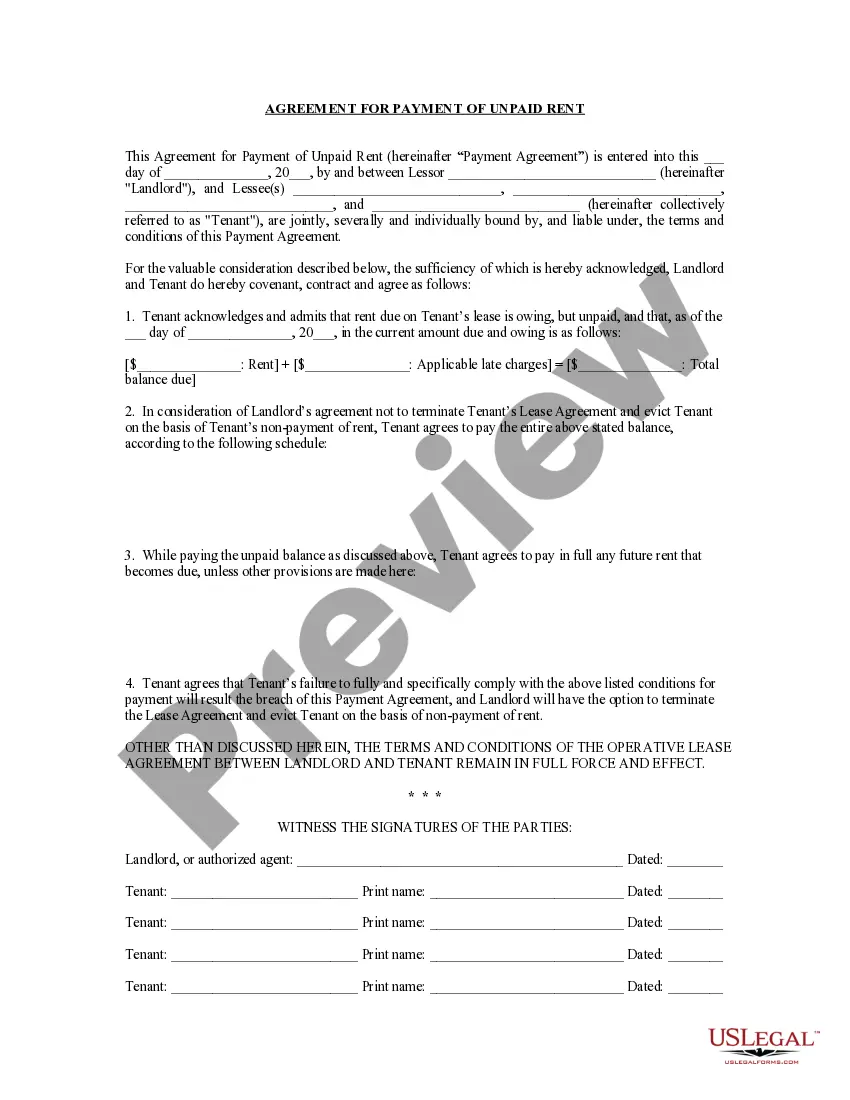
Alabama Agreement for Payment of Unpaid Rent
What is this form?
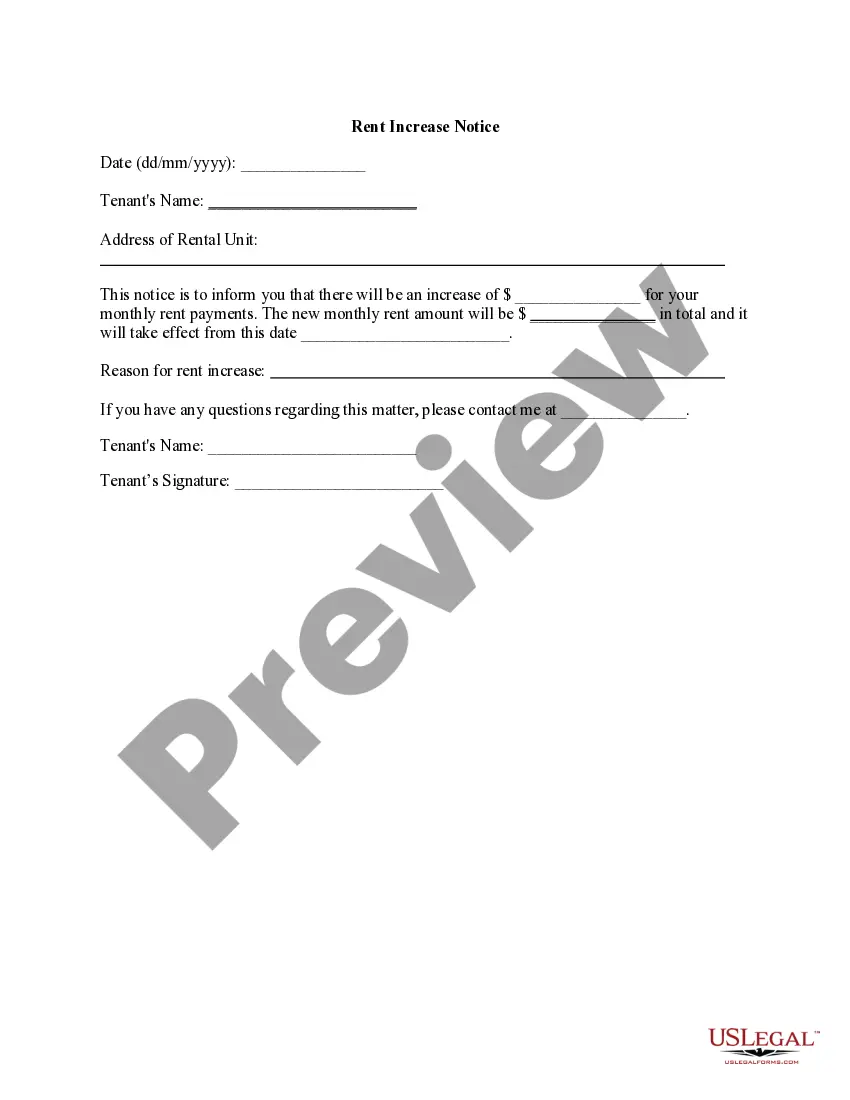
The Agreement for Payment of Unpaid Rent is a legal document that formalizes an arrangement between a landlord and tenant regarding overdue rental payments. This agreement outlines the repayment terms and deadlines, while allowing the tenant to avoid eviction during the repayment period. Unlike a standard lease agreement, this form specifically addresses the circumstances of unpaid rent and offers a structured solution to financial challenges within the rental relationship.
Key parts of this document
- Identification of the landlord and tenant(s)
- Statement of the outstanding rent amount and any applicable late charges
- Terms of the repayment agreement, including deadlines
- Confirmation that other lease terms remain effective
- Signatures of all parties involved, including dates

When this form is needed
This form should be used when a tenant is unable to pay their rent on time and wishes to formalize a repayment plan with their landlord. It can help prevent eviction and provide a clear framework for the tenant to catch up on missed payments while maintaining their housing situation. Situations that might necessitate this form include temporary financial difficulties, job loss, or unexpected expenses that hinder timely rent payment.
Who can use this document
- Landlords who wish to provide an opportunity for tenants to repay overdue rent.
- Tenants facing temporary financial hardships and needing to establish a payment agreement.
- Individuals seeking to formalize verbal agreements regarding unpaid rent with legal backing.
- Real estate professionals managing rental agreements in multi-tenant properties.
Completing this form step by step
- Identify the parties: Fill in the names of the landlord and all tenants involved in the agreement.
- Specify the property: Clearly mention the property for which the rent is due.
- Enter the overdue rent details: List the amount of overdue rent and any late charges incurred.
- Outline the repayment terms: Agree on and document how and when the tenant will repay the overdue rent.
- Sign and date the agreement: Ensure all parties sign and date the document to make it legally binding.
Does this form need to be notarized?
This form does not typically require notarization unless specified by local law. However, having the document notarized can further strengthen its legal standing and provide added protection for both parties.
Get your form ready online
Our built-in tools help you complete, sign, share, and store your documents in one place.
Make edits, fill in missing information, and update formatting in US Legal Forms—just like you would in MS Word.
Download a copy, print it, send it by email, or mail it via USPS—whatever works best for your next step.
Sign and collect signatures with our SignNow integration. Send to multiple recipients, set reminders, and more. Go Premium to unlock E-Sign.
If this form requires notarization, complete it online through a secure video call—no need to meet a notary in person or wait for an appointment.
We protect your documents and personal data by following strict security and privacy standards.

Make edits, fill in missing information, and update formatting in US Legal Forms—just like you would in MS Word.

Download a copy, print it, send it by email, or mail it via USPS—whatever works best for your next step.

Sign and collect signatures with our SignNow integration. Send to multiple recipients, set reminders, and more. Go Premium to unlock E-Sign.

If this form requires notarization, complete it online through a secure video call—no need to meet a notary in person or wait for an appointment.

We protect your documents and personal data by following strict security and privacy standards.
Mistakes to watch out for
- Failing to include all tenants in the agreement, which could lead to legal issues later.
- Not specifying clear repayment terms and deadlines, leading to misunderstandings.
- Omitting signatures or dates, making the document unenforceable.
- Not keeping a copy of the signed agreement for future reference.
Why use this form online
- Convenience of accessing and downloading the form from anywhere, at any time.
- Editability to customize the agreement to suit individual circumstances quickly.
- Structured format ensures all necessary legal components are included.
- Reliability of a form drafted by licensed attorneys, meeting state specifications.
Legal use & context
- This Agreement for Payment of Unpaid Rent serves as a binding commitment between parties to comply with the agreed-upon payment plan.
- Failure to adhere to the terms outlined may still result in eviction actions by the landlord.
What to keep in mind
- The Agreement for Payment of Unpaid Rent offers a structured approach to handling overdue rent while preventing eviction.
- It involves clear acknowledgment of debt and repayment terms.
- Proper completion and signing of the agreement are crucial for it to be legally enforceable.
Looking for another form?







Form popularity
FAQ
Renters law in Alabama outlines rights and responsibilities for both landlords and tenants. This law covers aspects such as security deposits, maintenance responsibilities, and notice periods for eviction. Understanding these laws helps you navigate your rental situation effectively. To protect your interests, especially regarding unpaid rent, consider creating an Alabama Agreement for Payment of Unpaid Rent.
Yes, you can sue for unpaid rent even without a formal lease in Alabama. If you have evidence of an agreement or your tenant status, you can pursue legal action. This is where the Alabama Agreement for Payment of Unpaid Rent can serve as a crucial document to support your claim. It provides a clear outline of the payment terms, making enforcement easier in court.
In Alabama, you can stay in a rental property without being on the lease for a temporary period, typically up to 30 days. However, after this period, you may need a verbal or written agreement with the landlord. It's important to clarify your status with your landlord to avoid legal issues. If unpaid rent becomes a concern, an Alabama Agreement for Payment of Unpaid Rent can help resolve outstanding balances.
A proof of rent payment letter should include the tenant's name, the payment amount, and a reference to the rental period covered. Additionally, it should include your signature as the landlord for verification. You can reference the Alabama Agreement for Payment of Unpaid Rent to confirm that the payment aligns with the stated conditions in your agreement.
To write a legally binding rental agreement, include the names of all parties, the rental property's address, the lease terms, and the payment details. Always specify your rights and obligations as landlords and tenants. Using an Alabama Agreement for Payment of Unpaid Rent assists in ensuring that your rental agreement covers all necessary legal aspects.
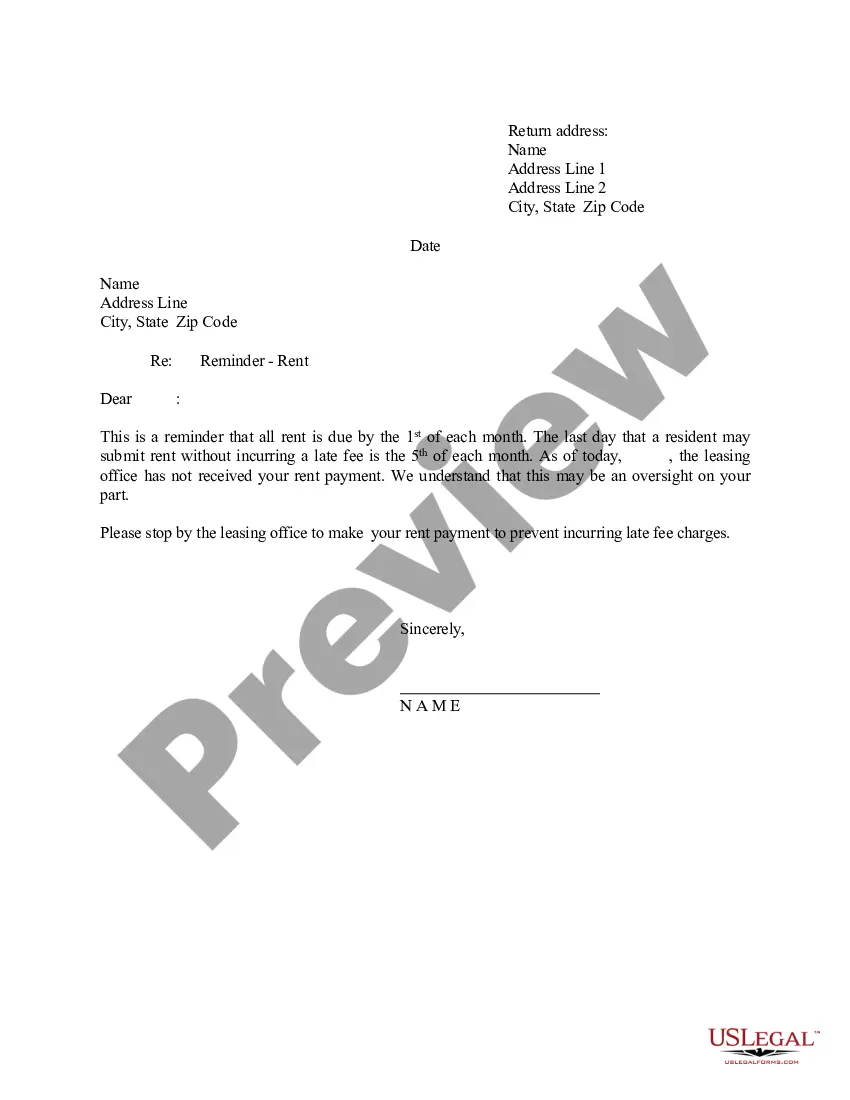
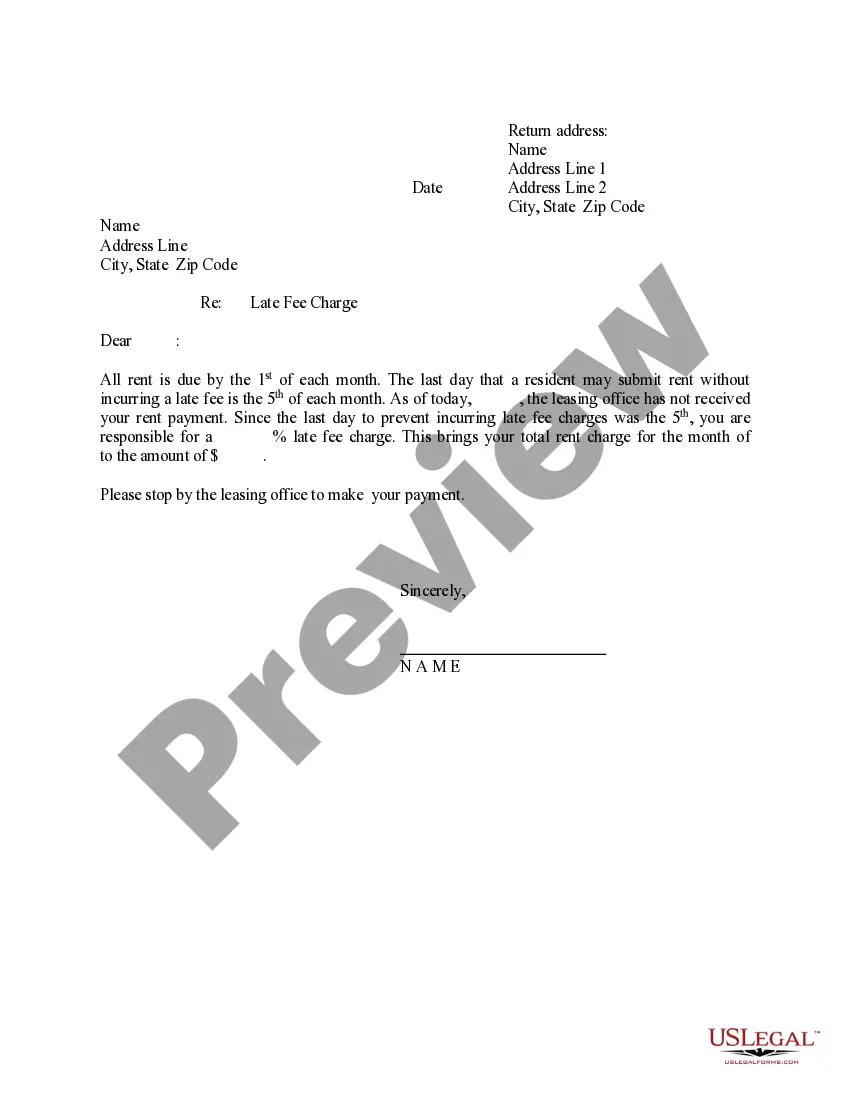
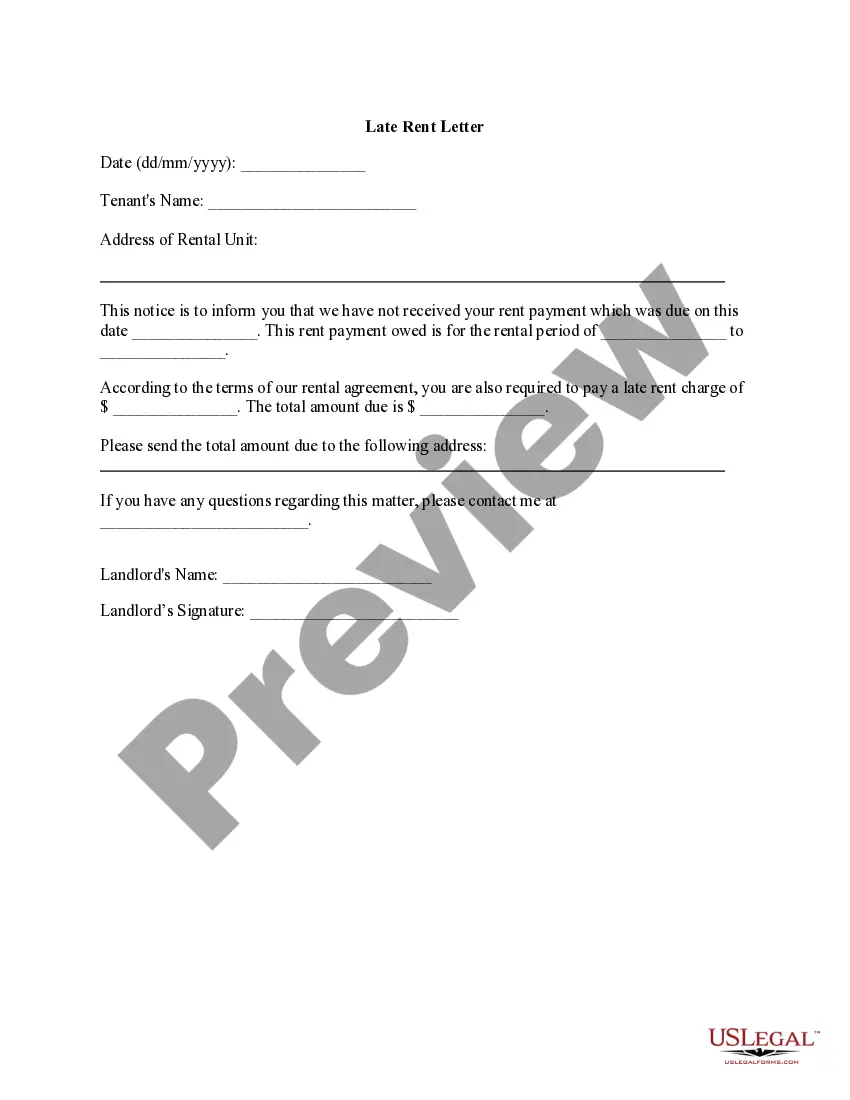
When writing a demand letter for rent payment, clearly outline the missing payment amount and specify the payment due date. Include a line about the actions you may take if the payment is not received, such as initiating eviction procedures. An Alabama Agreement for Payment of Unpaid Rent can guide you in crafting this letter to comply with relevant laws.
To write a demand letter for unpaid rent, start by clearly stating the tenant's name, address, and the specific amount of rent due. Make sure to include a deadline for payment and mention any late fees that may apply. Utilizing an Alabama Agreement for Payment of Unpaid Rent ensures your letter meets local requirements and increases its effectiveness.
If your landlord never provided you with a lease, you can still assert your rights as a tenant. Start by gathering any documentation, like rent receipts and communications, to establish an informal agreement. You might find an Alabama Agreement for Payment of Unpaid Rent helpful to clarify rental terms moving forward. For comprehensive support and resources, you can rely on platforms like US Legal Forms to ensure you understand your rights and options.
Code 35 9A 421 A in Alabama pertains to the obligations of landlords and tenants regarding rent payments. Specifically, it outlines the legal procedures landlords must follow when dealing with unpaid rent. By understanding this code, tenants can better navigate situations of unpaid rent, often leading to an Alabama Agreement for Payment of Unpaid Rent as a potential resolution. For detailed guidance, consider consulting legal resources like US Legal Forms.
Yes, you can sue for rent even if you do not have a written lease. In Alabama, however, it's essential to show evidence of the rental agreement, such as rent payments or communications with your landlord. You can utilize an Alabama Agreement for Payment of Unpaid Rent to formalize the payment terms and increase your chances of a favorable outcome. Many tenants find it beneficial to consult legal resources or platforms like US Legal Forms to navigate their options.