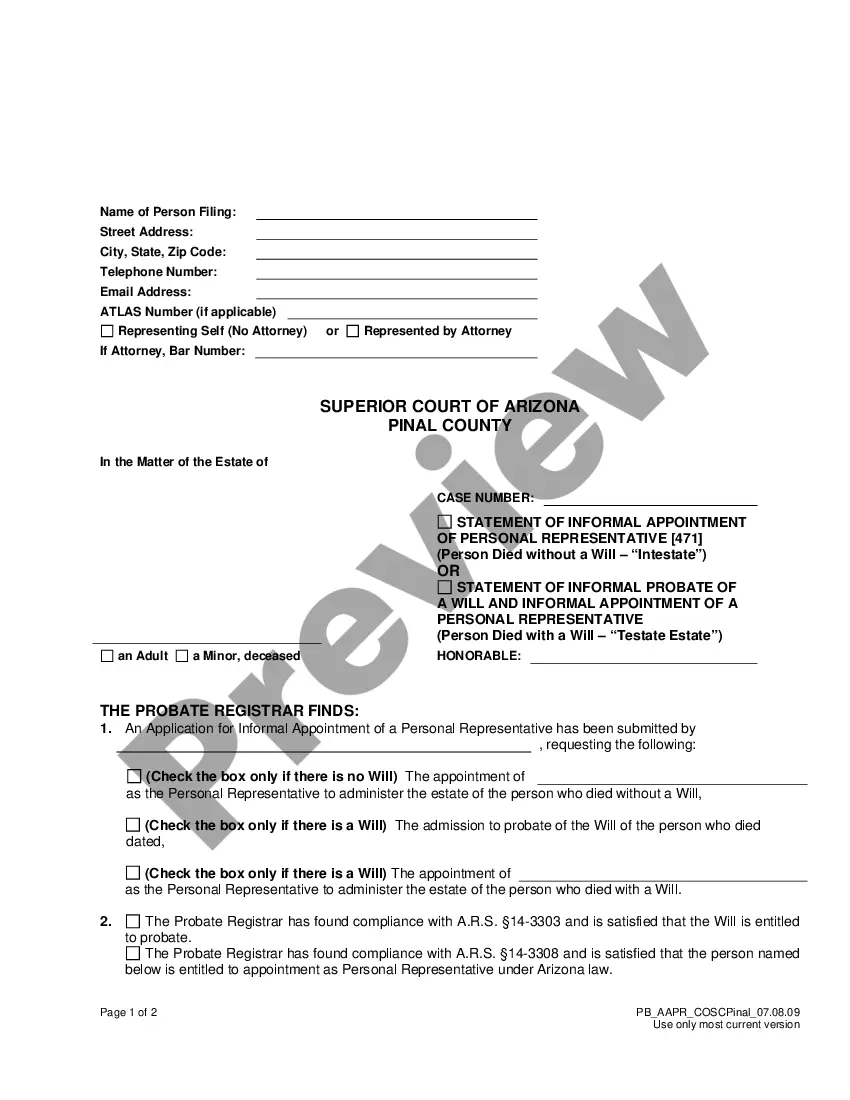
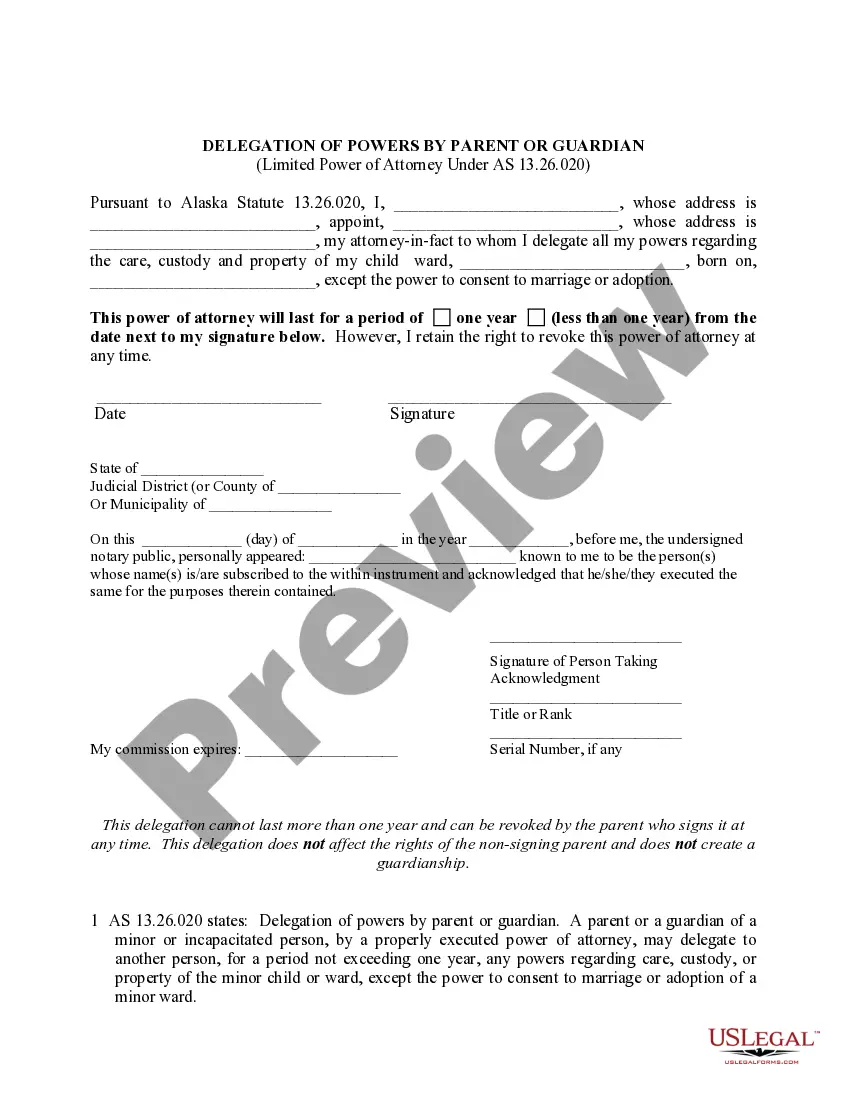
Alaska General Power of Attorney for Care and Custody of Child or Children
Understanding this form
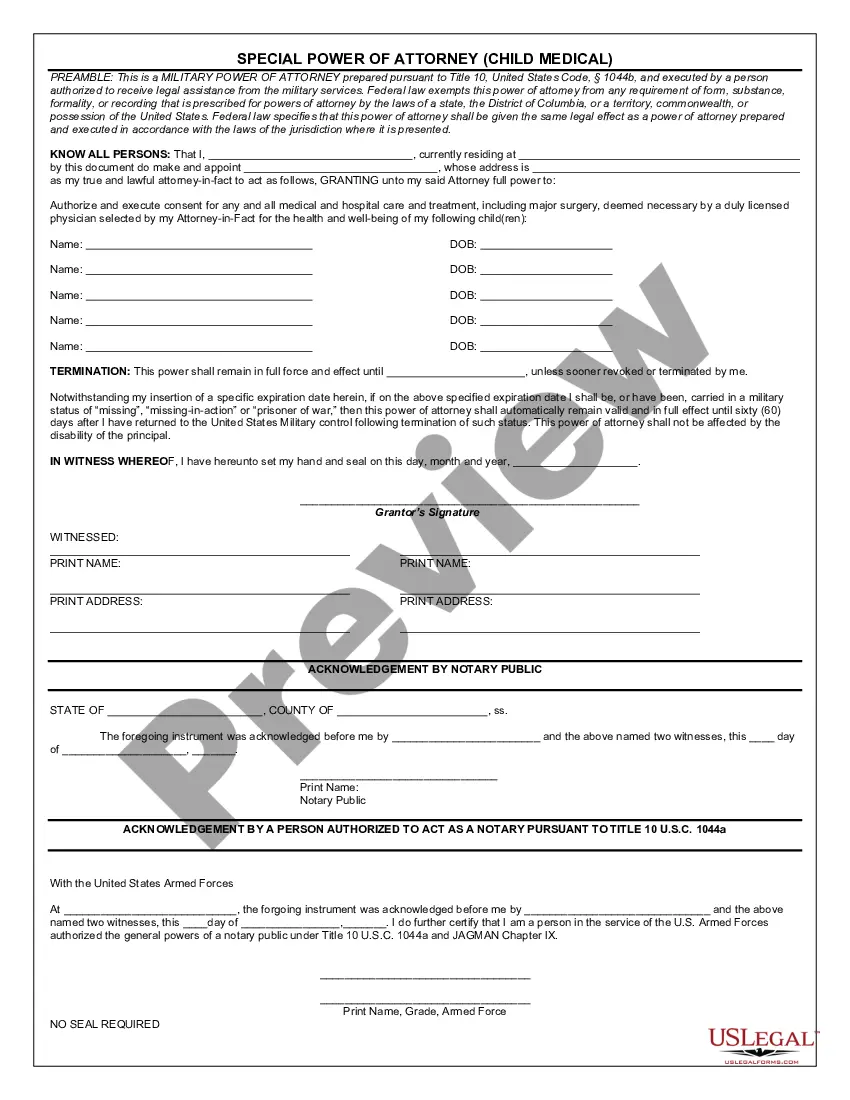
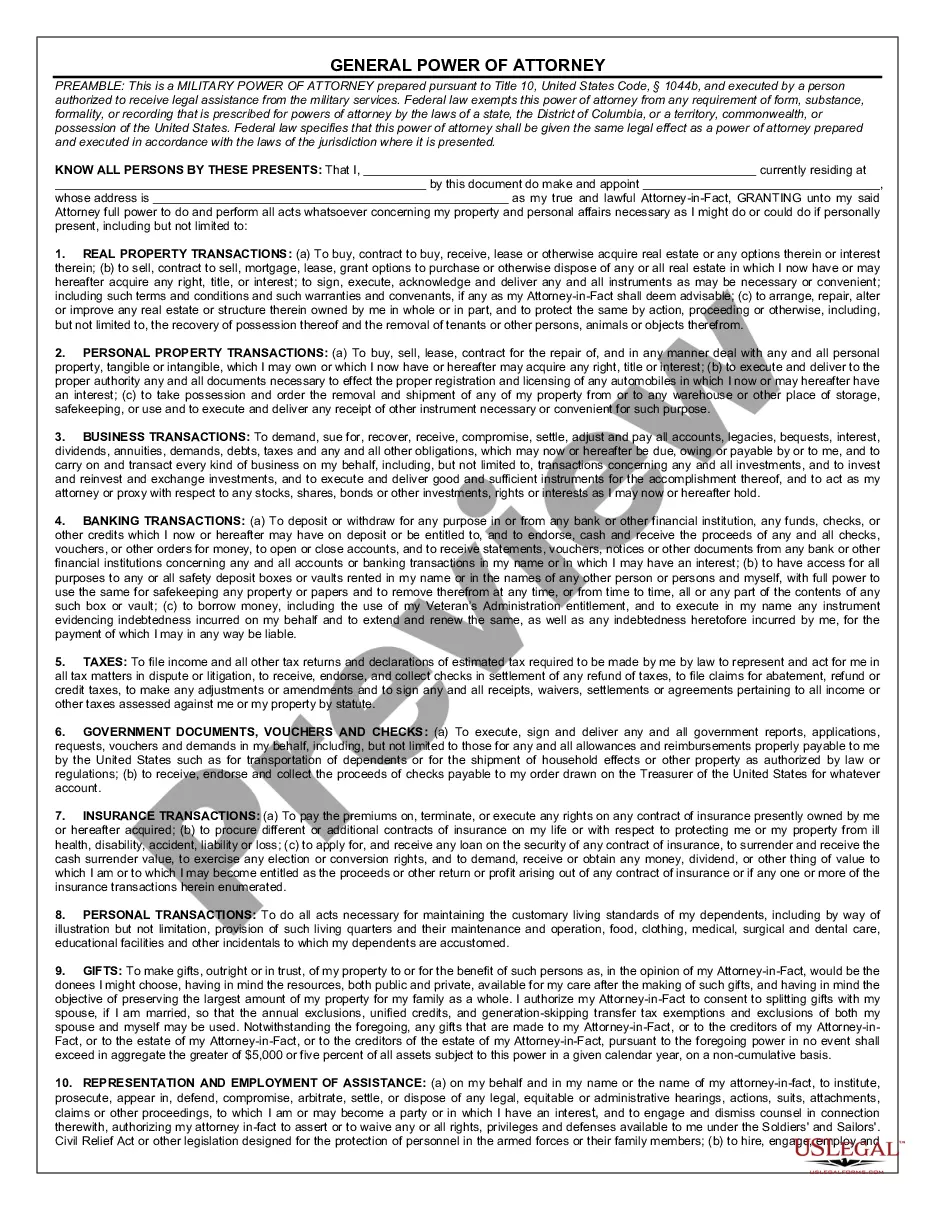
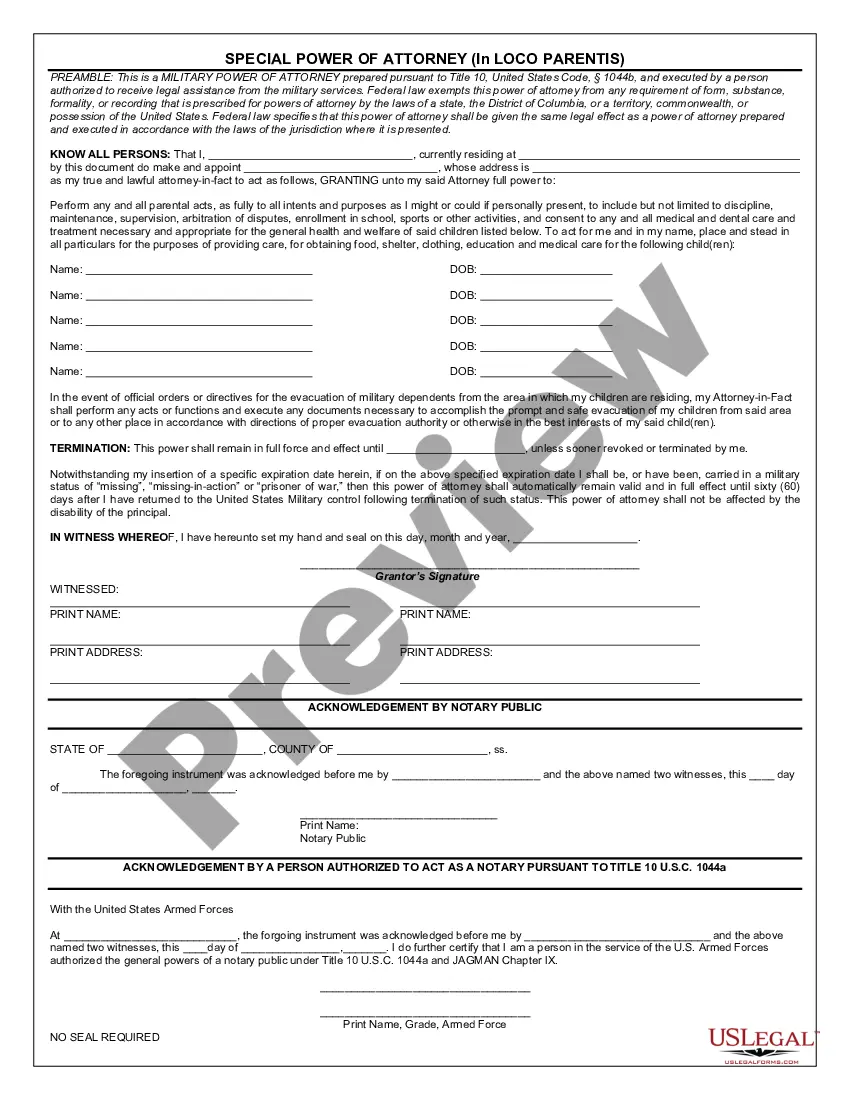
The General Power of Attorney for Care and Custody of Child or Children allows a parent or guardian to appoint an attorney-in-fact to manage the care and custody of their minor child or children. Unlike standard Power of Attorney forms, this document specifically focuses on child care, including aspects related to health care. It requires notarization to ensure its legal validity, making it a secure option for delegating parental responsibilities temporarily.
Key parts of this document
- Delegation of powers from parent or guardian to an attorney-in-fact.
- Identification of the child or children involved, including their date of birth.
- Specification of a time limit for the Power of Attorney, not exceeding one year.
- Signature of the parent or guardian, which must be notarized.
- Acknowledgment section for the notary public.
When this form is needed
This form is useful in scenarios where a parent needs to temporarily transfer their caregiving responsibilities to another trusted adult. Examples include when a parent must travel for work, undergo medical treatment, or is unable to care for their child due to unforeseen circumstances. It ensures that the appointed person has the legal authority to make decisions on behalf of the child during the specified period.
Intended users of this form
This form is intended for:
- Parents or legal guardians of minor children who need assistance in caregiving.
- Individuals preparing for temporary absences from their caregiving roles.
- Trusted relatives or friends who are designated to take care of a child.
Steps to complete this form
- Identify the parent or guardian granting the authority by filling in their name and address.
- Include the name and address of the appointed attorney-in-fact.
- Clearly state the name of the child or children and their date of birth.
- Specify the duration of the Power of Attorney, ensuring it does not exceed one year.
- Sign the document in the presence of a notary public, who will acknowledge the signature.
Is notarization required?
Notarization is required for this form to take effect. Our online notarization service, powered by Notarize, lets you verify and sign documents remotely through an encrypted video session, available 24/7.
Get your form ready online
Our built-in tools help you complete, sign, share, and store your documents in one place.
Make edits, fill in missing information, and update formatting in US Legal Forms—just like you would in MS Word.
Download a copy, print it, send it by email, or mail it via USPS—whatever works best for your next step.
Sign and collect signatures with our SignNow integration. Send to multiple recipients, set reminders, and more. Go Premium to unlock E-Sign.
If this form requires notarization, complete it online through a secure video call—no need to meet a notary in person or wait for an appointment.
We protect your documents and personal data by following strict security and privacy standards.

Make edits, fill in missing information, and update formatting in US Legal Forms—just like you would in MS Word.

Download a copy, print it, send it by email, or mail it via USPS—whatever works best for your next step.

Sign and collect signatures with our SignNow integration. Send to multiple recipients, set reminders, and more. Go Premium to unlock E-Sign.

If this form requires notarization, complete it online through a secure video call—no need to meet a notary in person or wait for an appointment.

We protect your documents and personal data by following strict security and privacy standards.
Common mistakes
- Failing to have the form notarized, which is required for legal validity.
- Not clearly specifying the scope of authority granted to the attorney-in-fact.
- Leaving out the child's date of birth or any other crucial information.
- Failing to specify the expiration date or leaving it open-ended.
Why complete this form online
- Convenient access to legal documents without visiting a lawyer's office.
- Easy customization to fit specific needs regarding child care and custody.
- Reliable templates drafted by licensed attorneys to ensure compliance with legal standards.
Legal use & context
- This Power of Attorney is enforceable for a defined period and can be revoked at any time by the granting parent or guardian.
- It cannot transfer the right to consent to marriage or adoption for the child.
- This form does not establish a guardianship; it is a temporary delegation of authority.
Quick recap
- The General Power of Attorney for Care and Custody of Child or Children allows a parent to delegate authority for no more than one year.
- The form requires notarization to ensure legal validity.
- It is essential for parents who need to appoint a temporary caretaker for their children.
Looking for another form?


Form popularity
FAQ
Non-Durable Power of Attorney. Durable Power of Attorney. Special or Limited Power of Attorney. Medical Power of Attorney. Springing Power of Attorney. Create Your Power of Attorney Now.
In order for your parent to grant you Power of Attorney, they must be of sound mind.If the parent is of sound mind, they may sign over Power of Attorney. If your parent is already mentally incapacitated, they may have already granted you (or another person) Power of Attorney in a Living Will.
Designating someone to act on your behalf using a power of attorney (POA) document is a serious decision. While POA can be given to anyone, individuals usually choose a trusted family member to handle the responsibly of making health and/or financial decisions for them.
No. Wife cannot "override" valid POA executed by spouse.
A power of attorney and a guardianship are tools that help someone act in your stead if you become incapacitated. With a power of attorney, you choose who you want to act for you. In a guardianship proceeding, the court chooses who will act as guardian.
A power of attorney is a legal document that allows a principal to appoint an agent to act for them should they become incapacitated. The agent is expected to place the principal's interests ahead of his or her own, which is why it is important for you and your loved one to pick a trusted individual.
A power of attorney over a child is a document signed and notarized by a parent giving a non- parent authority to make decisions for a minor child.It can be used to authorize the person to obtain medical treatment for a child or sign up a child for an activity or for other significant decisions.
Once a parent is no longer competent, he or she cannot revoke the power of attorney. If the agent is acting improperly, family members can file a petition in court challenging the agent.
Power of attorney gives someone other than a legal parent or guardian the right to make decisions about a child's welfare, but it does not establish legal custody. You can only modify legal custody through court proceedings.