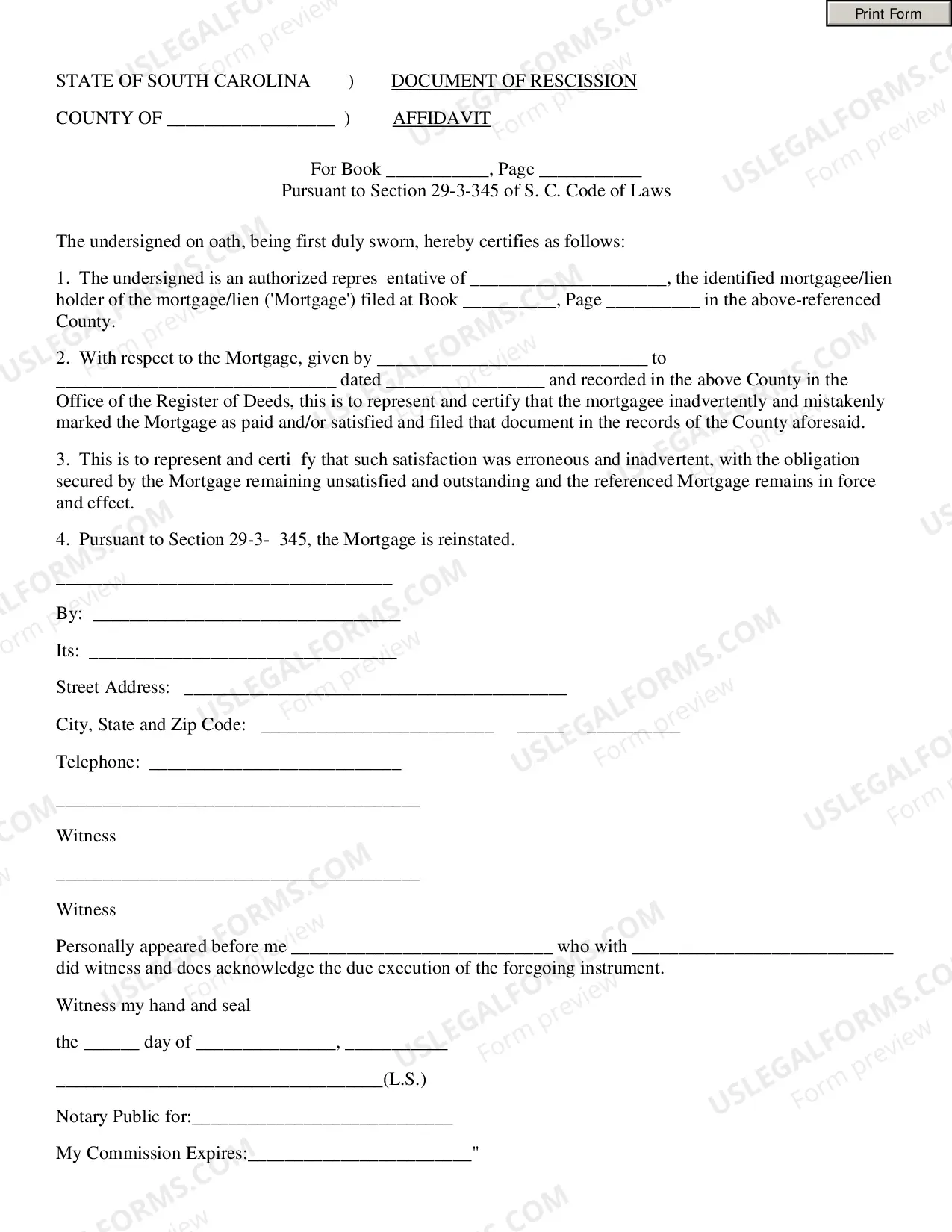
New Mexico Renunciation And Disclaimer of Real Property Interest
Overview of this form
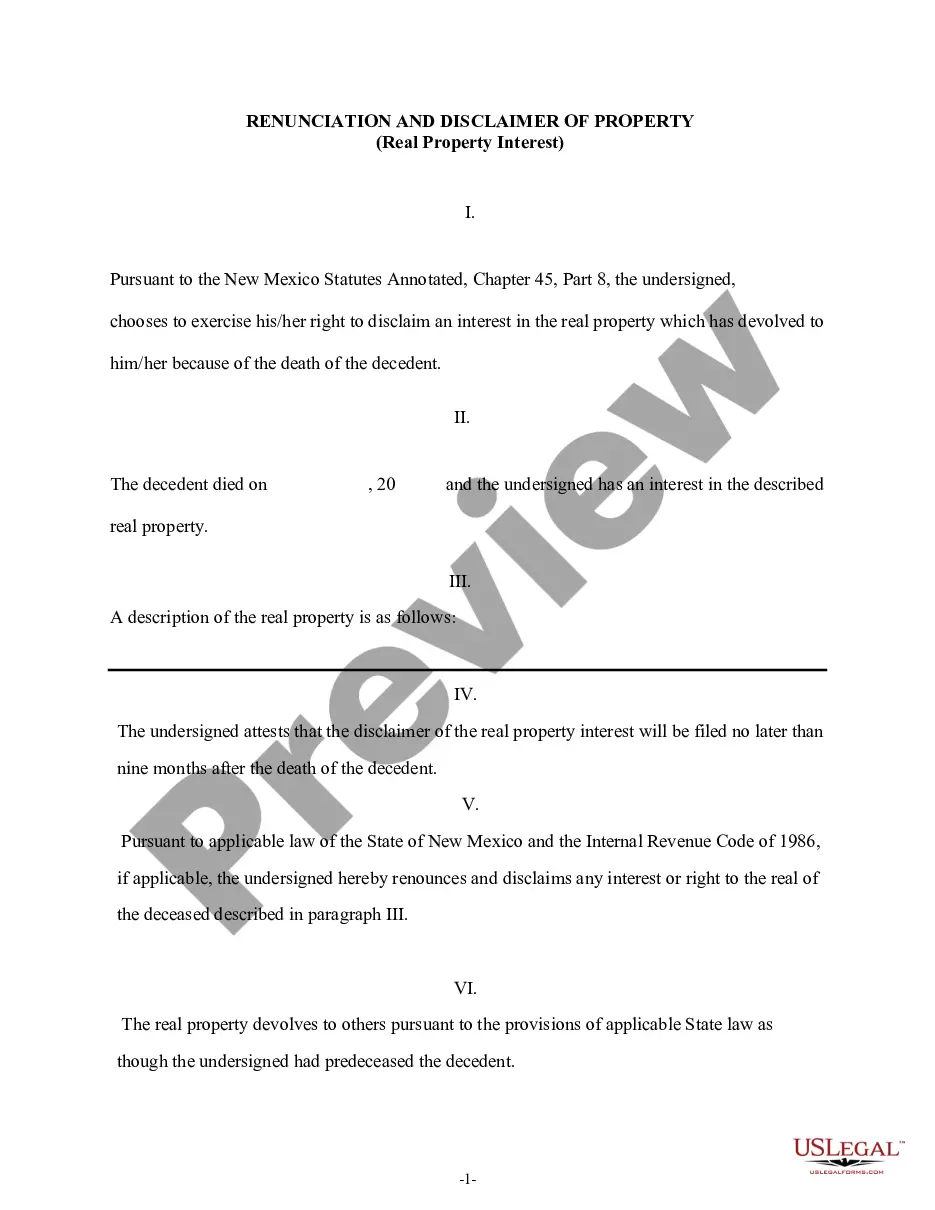
The Renunciation and Disclaimer of Real Property Interest is a legal document that allows a beneficiary to formally refuse their interest in a property received upon a decedent's death. This form is specifically designed for beneficiaries in New Mexico who choose to disclaim their rights to property, ensuring that property transfers according to state law as if they had predeceased the decedent. Unlike similar forms, this document secures the validity of the disclaimer by requiring filing within nine months of the decedent's death.
Key components of this form
- Identification of the beneficiary and decedent.
- Clear statement of renunciation of property interest.
- Certification of intent to file the disclaimer within nine months.
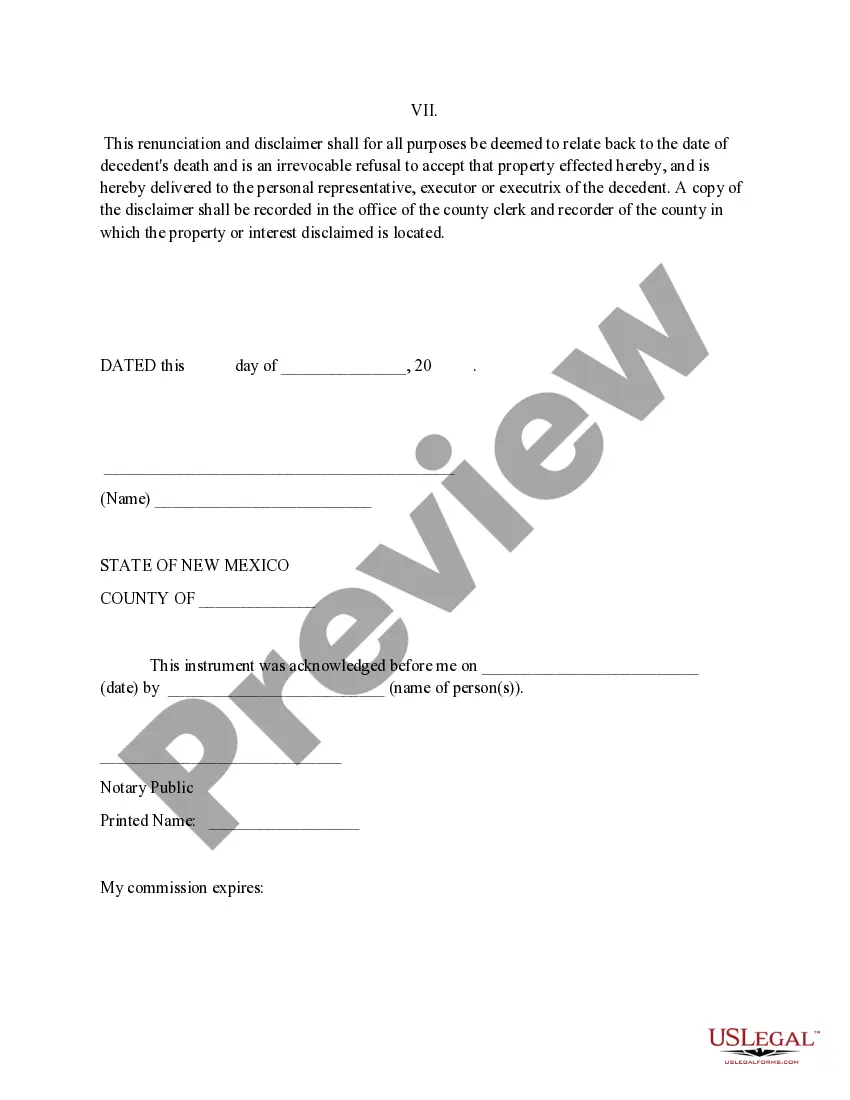
- Clause stipulating the disclaimer's relation back to the date of the decedent's death.
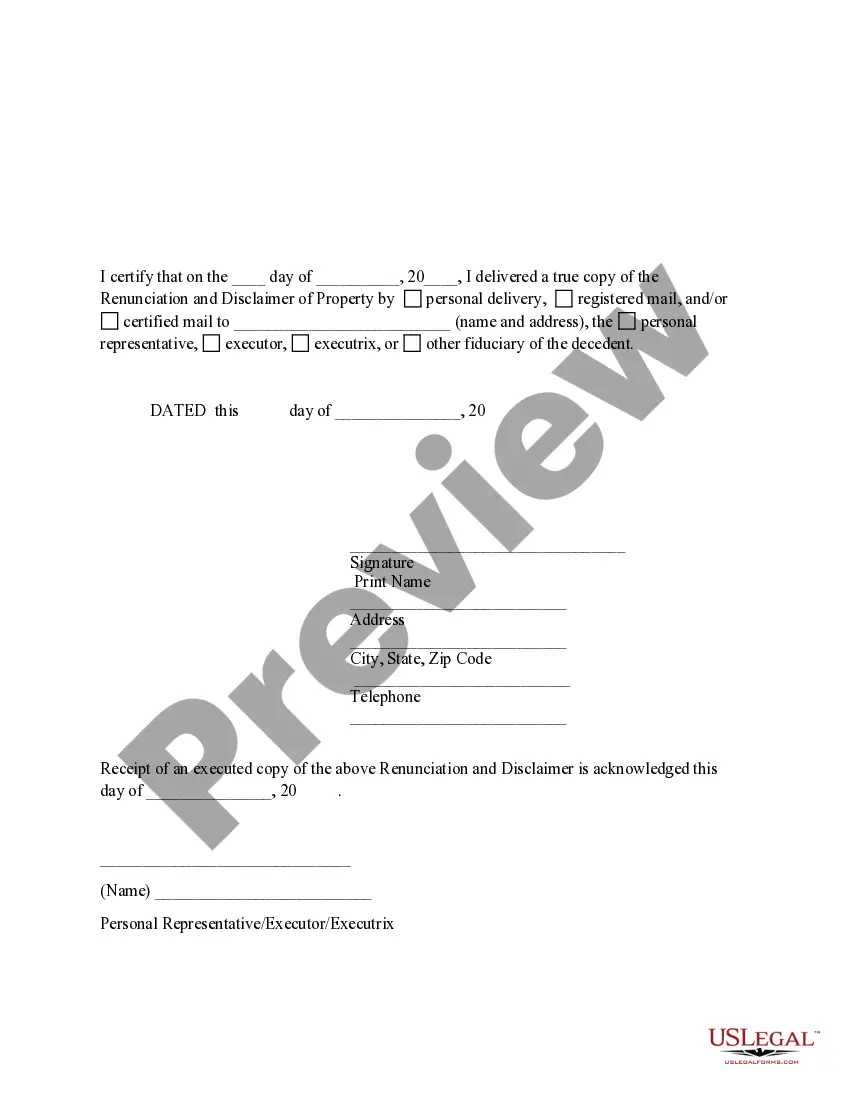
- Section for acknowledgment and certification of delivery.



When to use this form
This form is necessary when a beneficiary inherits a property from a decedent but chooses to renounce their interest. It is particularly useful in situations where accepting the property may result in unwanted tax implications or legal responsibilities. Completing this form ensures that the property will devolve to other intended beneficiaries under New Mexico law.
Who should use this form
- Beneficiaries who have inherited real property but wish to disclaim that interest.
- Individuals acting as personal representatives, executors, or executrixes of a decedent's estate.
- Anyone involved in the estate settlement process in New Mexico who needs to clarify ownership interests.
How to complete this form
- Identify the parties involved, including the beneficiary and the decedent.
- Clearly state your intention to renounce any interest in the property.
- Specify the property details that are being disclaimed.
- Sign and date the form, ensuring that it is completed within the nine-month time frame.
- Submit the disclaimer to the personal representative and file a copy with the county clerk's office where the property is located.
Notarization requirements for this form
This form does not typically require notarization unless specified by local law. It is advisable to check local regulations to ensure compliance with any additional requirements.
Get your form ready online
Our built-in tools help you complete, sign, share, and store your documents in one place.
Make edits, fill in missing information, and update formatting in US Legal Forms—just like you would in MS Word.
Download a copy, print it, send it by email, or mail it via USPS—whatever works best for your next step.
Sign and collect signatures with our SignNow integration. Send to multiple recipients, set reminders, and more. Go Premium to unlock E-Sign.
If this form requires notarization, complete it online through a secure video call—no need to meet a notary in person or wait for an appointment.
We protect your documents and personal data by following strict security and privacy standards.

Make edits, fill in missing information, and update formatting in US Legal Forms—just like you would in MS Word.

Download a copy, print it, send it by email, or mail it via USPS—whatever works best for your next step.

Sign and collect signatures with our SignNow integration. Send to multiple recipients, set reminders, and more. Go Premium to unlock E-Sign.

If this form requires notarization, complete it online through a secure video call—no need to meet a notary in person or wait for an appointment.

We protect your documents and personal data by following strict security and privacy standards.
Mistakes to watch out for
- Failing to file the disclaimer within nine months of the decedent's death.
- Not providing complete property details in the form.
- Neglecting to sign and date the form, which can invalidate it.
- Not delivering the form to the required parties or the county clerk's office.
Advantages of online completion
- Convenience of downloading and completing the form at your own pace.
- Editability allows for easy corrections and updates.
- Access to professionally drafted templates ensures reliability and adherence to legal standards.
Legal use & context
- The renunciation and disclaimer of real property interest is legally enforceable in New Mexico when filed correctly.
- This action allows the property to pass directly to other heirs, avoiding complications of probate concerning that particular interest.
- It is crucial to adhere to state statutes to maintain the legal validity of the disclaimer.
Quick recap
- The Renunciation and Disclaimer of Real Property Interest allows beneficiaries to refuse property inheritance.
- It must be filed within nine months of the decedent's death to be valid.
- This form specifically caters to New Mexico's legal framework for property disclaimers.
Looking for another form?
Form popularity
FAQ
Put the disclaimer in writing. Deliver the disclaimer to the person in control of the estate usually the executor or trustee. Complete the disclaimer within nine months of the death of the person leaving the property. Do not accept any benefit from the property you're disclaiming.
By filing a properly drafted petition with the circuit court, which includes the consent of the trustee and the trust beneficiaries, an Order can be obtained directing the collapse of the ILIT and the distribution of its assets in any way the parties agree.
A marital disclaimer trust has provisions (usually contained in a will) that allow a surviving spouse to put assets in a trust by disclaiming ownership of a portion of the estate that they would have inherited after the death of the first spouse.
Yes, a fiduciary can disclaim an interest in property if the will, trust or power of attorney gives the fiduciary that authority or if the appropriate probate court authorizes the disclaimer.The primary reason an executor or trustee might disclaim property passing to an estate or trust is to save death taxes.
Property owned in joint tenancy automatically passes, without probate, to the surviving owner(s) when one owner dies. Setting up a joint tenancy is easy, and it doesn't cost a penny.
The disclaimer must be in writing: A signed letter by the person doing the disclaiming, identifying the decedent, describing the asset to be disclaimed, and the extent and amount, percentage or dollar amount, to be disclaimed, must be delivered to the person in control of the estate or asset, such as an executor,
Disclaimer of interest, in the law of inheritance, wills and trusts, is a term that describes an attempt by a person to renounce their legal right to benefit from an inheritance (either under a will or through intestacy) or through a trust. A disclaimer of interest is irrevocable.
Jointly owned property is treated as consisting of a both present and a future interest in the jointly owned property. Thus, a surviving spouse may disclaim the future interest in jointly owned property on the death of their spouse, including assets that were held by the spouses as tenants by the entirety.
Any disclaimer of an interest in a trust by a trust beneficiary must be made to the trustee of that trust. For a disclaimer to be valid, it must be supported by some evidence that the beneficiary is disclaiming their interest. Silence or otherwise passive behaviour will not suffice.