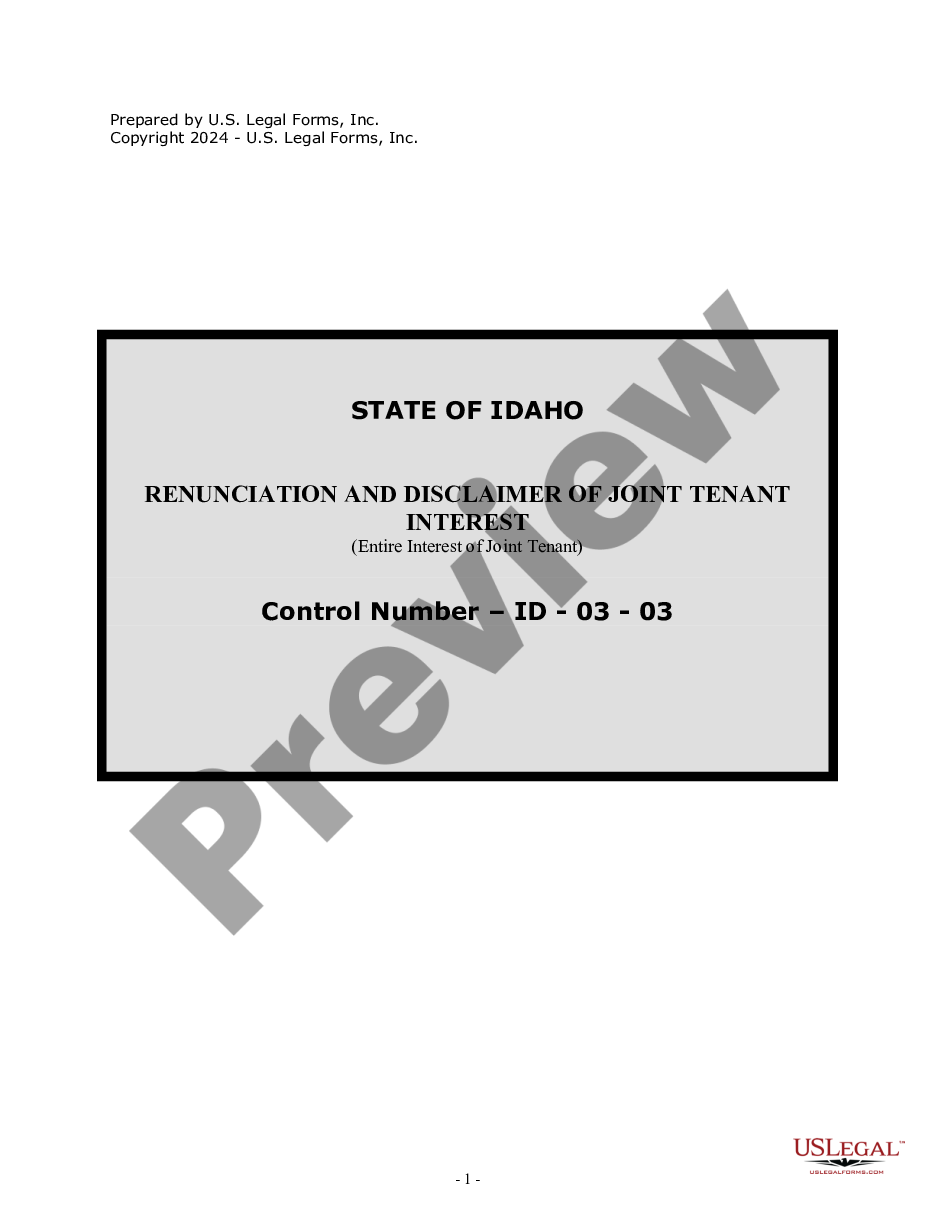
Idaho Renunciation and Disclaimer of Joint Tenant or Tenancy Interest
What this document covers
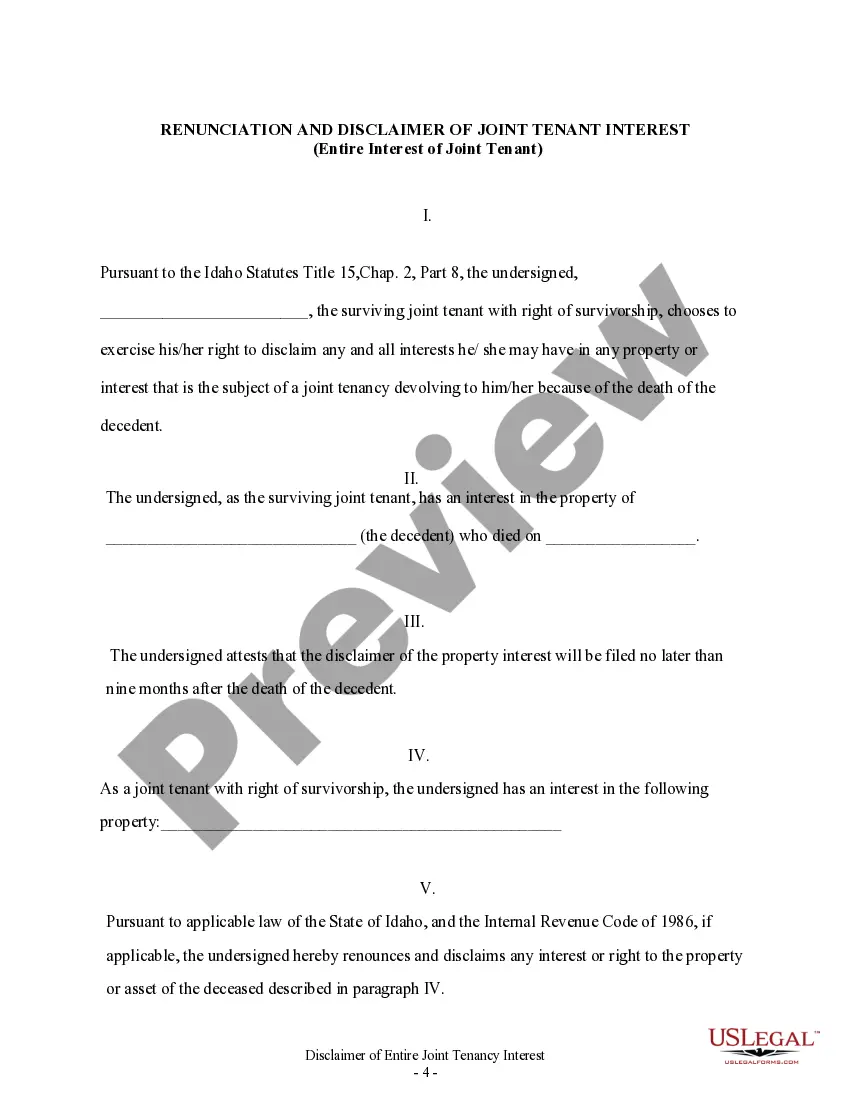
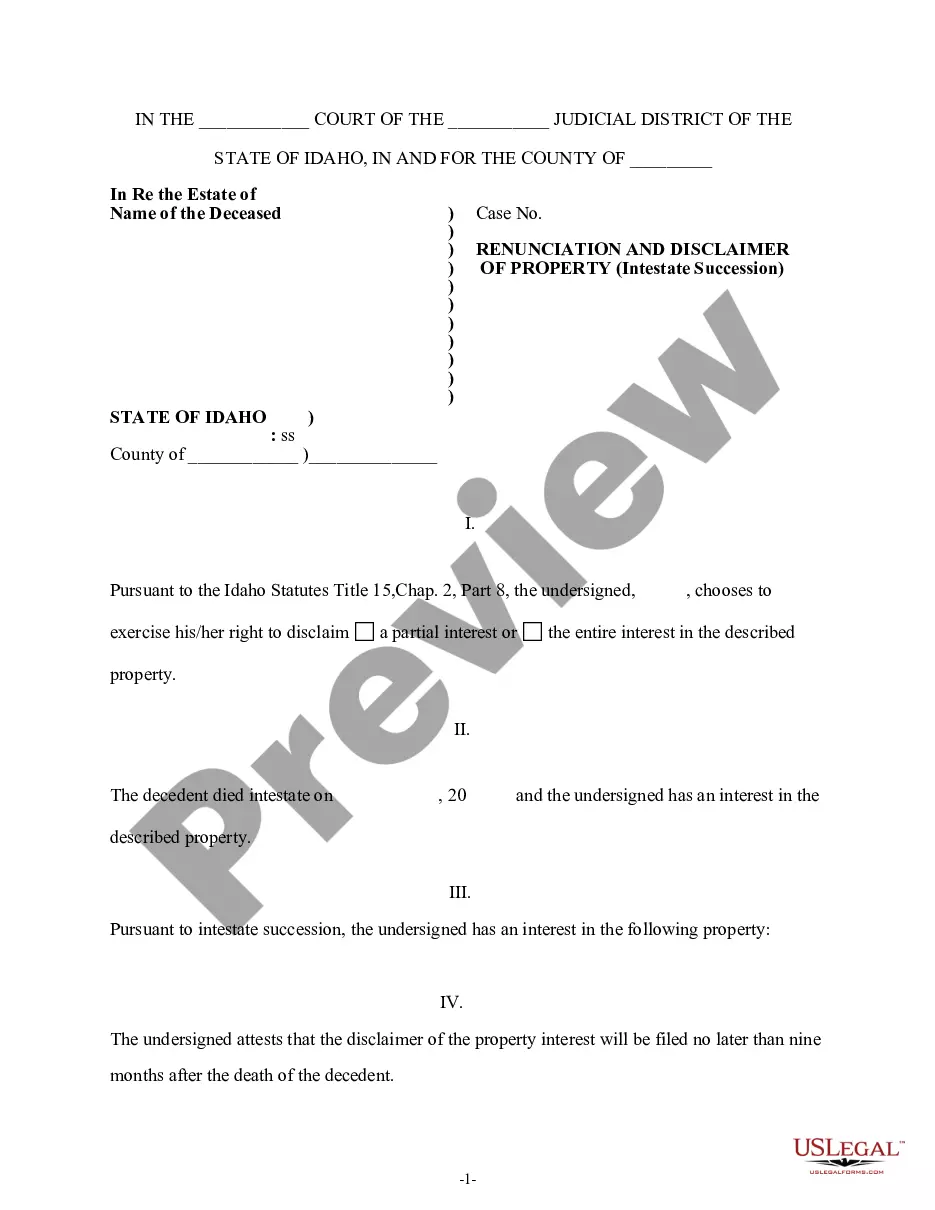
The Idaho Renunciation and Disclaimer of Joint Tenant or Tenancy Interest is a legal document used by the surviving joint tenant of a property to formally disclaim their interest in the property following the death of the co-tenant. This form allows the surviving tenant to relinquish their rights to the property, ensuring it passes to other heirs or beneficiaries as determined by state law. Unlike other forms of property transfer, this document specifically addresses the rights of joint tenants under Idaho law, requiring timely filing to be valid.
Form components explained
- Surviving joint tenant's details and acknowledgment of the decedent's death.
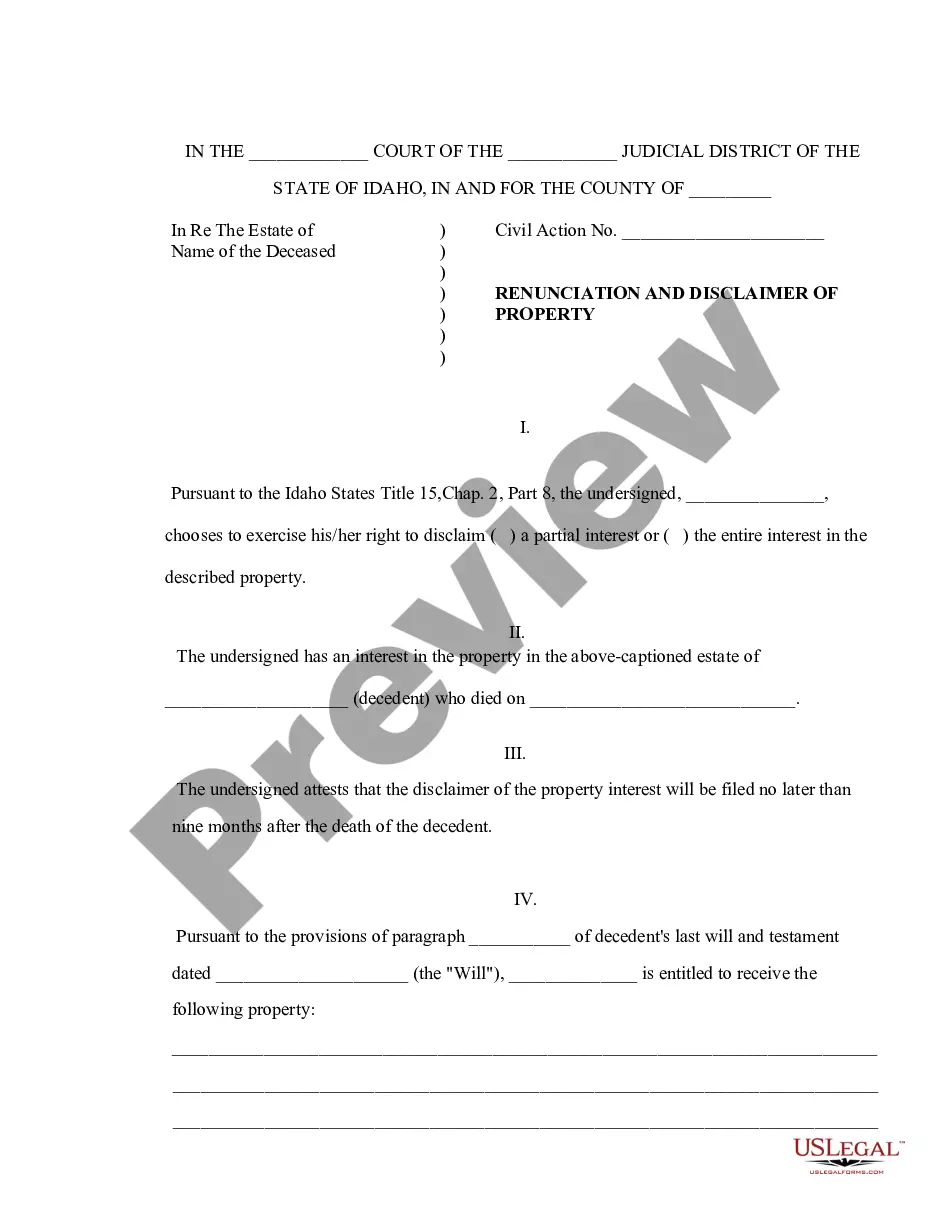
- Affirmation of the disclaimer and its filing within nine months of death.
- Description of the property subject to the disclaimer.
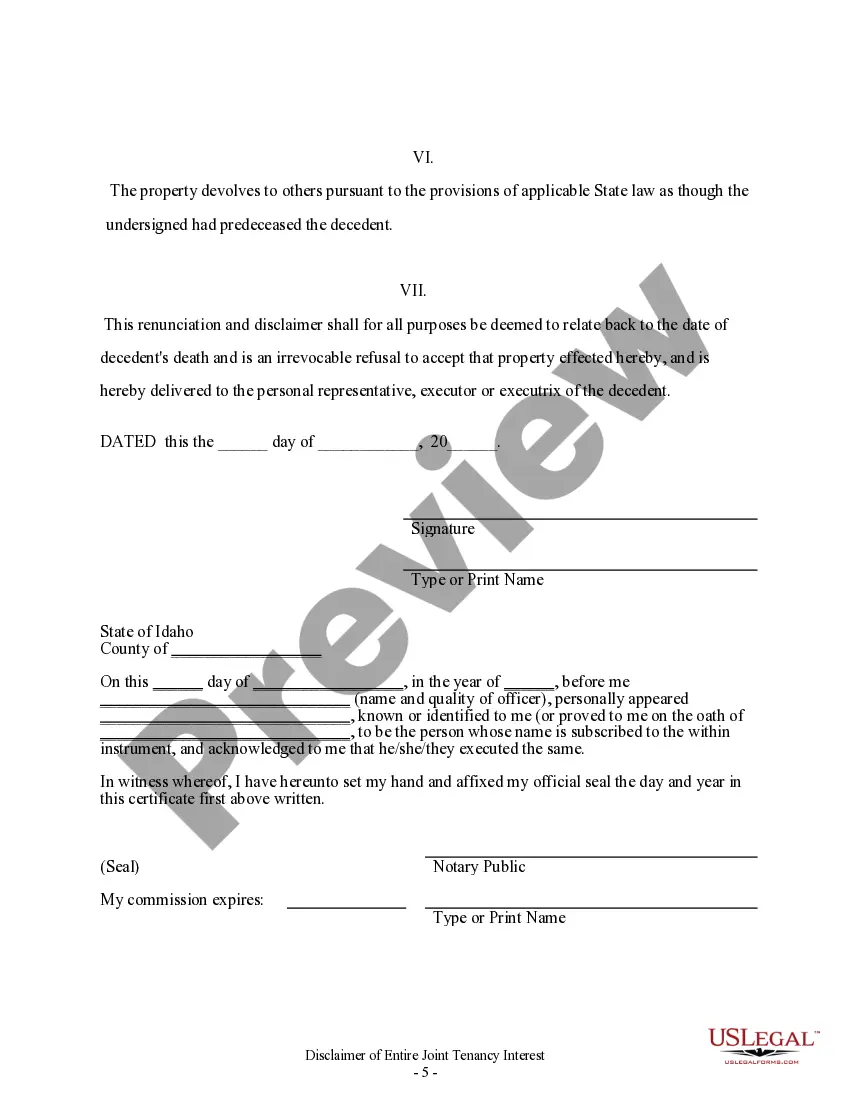
- Legal language confirming the renunciation and its effects.
- Date of signing and acknowledgment of the disclaiming party's signature.
When to use this document
This form should be used when a joint tenant wishes to renounce their interest in a property due to the death of the other joint tenant. It is essential for situations where the surviving tenant does not want to inherit the property and wishes for it to pass to the decedent's other heirs or beneficiaries. If the disclaimer is not filed within nine months of the decedent's death, the right to disclaim may be lost.
Intended users of this form
- Surviving joint tenants who are considering disclaiming their interest in a property.
- Individuals seeking to ensure property is distributed according to the decedent's wishes.
- Heirs or beneficiaries of the decedent who may be affected by the decision of the surviving joint tenant.
How to prepare this document
- Identify the property and the relevant parties involved, including the decedent and the surviving joint tenant.
- Fill in the date of the decedent's death accurately.
- Complete the section describing the property that is subject to the disclaimer.
- Sign and date the form, ensuring all required information is included.
- File the completed form with the appropriate authority within nine months of the decedent's death.
Does this document require notarization?
This form needs to be notarized to ensure legal validity. US Legal Forms provides secure online notarization powered by Notarize, allowing you to complete the process through a verified video call, available anytime.
Get your form ready online
Our built-in tools help you complete, sign, share, and store your documents in one place.
Make edits, fill in missing information, and update formatting in US Legal Forms—just like you would in MS Word.
Download a copy, print it, send it by email, or mail it via USPS—whatever works best for your next step.
Sign and collect signatures with our SignNow integration. Send to multiple recipients, set reminders, and more. Go Premium to unlock E-Sign.
If this form requires notarization, complete it online through a secure video call—no need to meet a notary in person or wait for an appointment.
We protect your documents and personal data by following strict security and privacy standards.

Make edits, fill in missing information, and update formatting in US Legal Forms—just like you would in MS Word.

Download a copy, print it, send it by email, or mail it via USPS—whatever works best for your next step.

Sign and collect signatures with our SignNow integration. Send to multiple recipients, set reminders, and more. Go Premium to unlock E-Sign.

If this form requires notarization, complete it online through a secure video call—no need to meet a notary in person or wait for an appointment.

We protect your documents and personal data by following strict security and privacy standards.
Typical mistakes to avoid
- Failing to file the disclaimer within nine months of the death.
- Not including detailed information about the property in question.
- Neglecting to sign and date the form, which may invalidate the disclaimer.
- Forgetting to inform other heirs or beneficiaries of the disclaimer process.
Why complete this form online
- Convenience of filling out the form from home or anywhere with internet access.
- Editable fields allow for easy adjustments and corrections before printing.
- Access to templates drafted by licensed attorneys ensures compliance with legal standards.
- Instant download for immediate use, speeding up the legal process.
Looking for another form?
Form popularity
FAQ
Disclaim, in a legal sense, refers to the renunciation of an interest in, or an acceptance of, inherited assets, such as property, by way of a legal instrument. A person disclaiming an interest, right, or obligation is known as a disclaimant.
In the law of inheritance, wills and trusts, a disclaimer of interest (also called a renunciation) is an attempt by a person to renounce their legal right to benefit from an inheritance (either under a will or through intestacy) or through a trust.A disclaimer of interest is irrevocable.
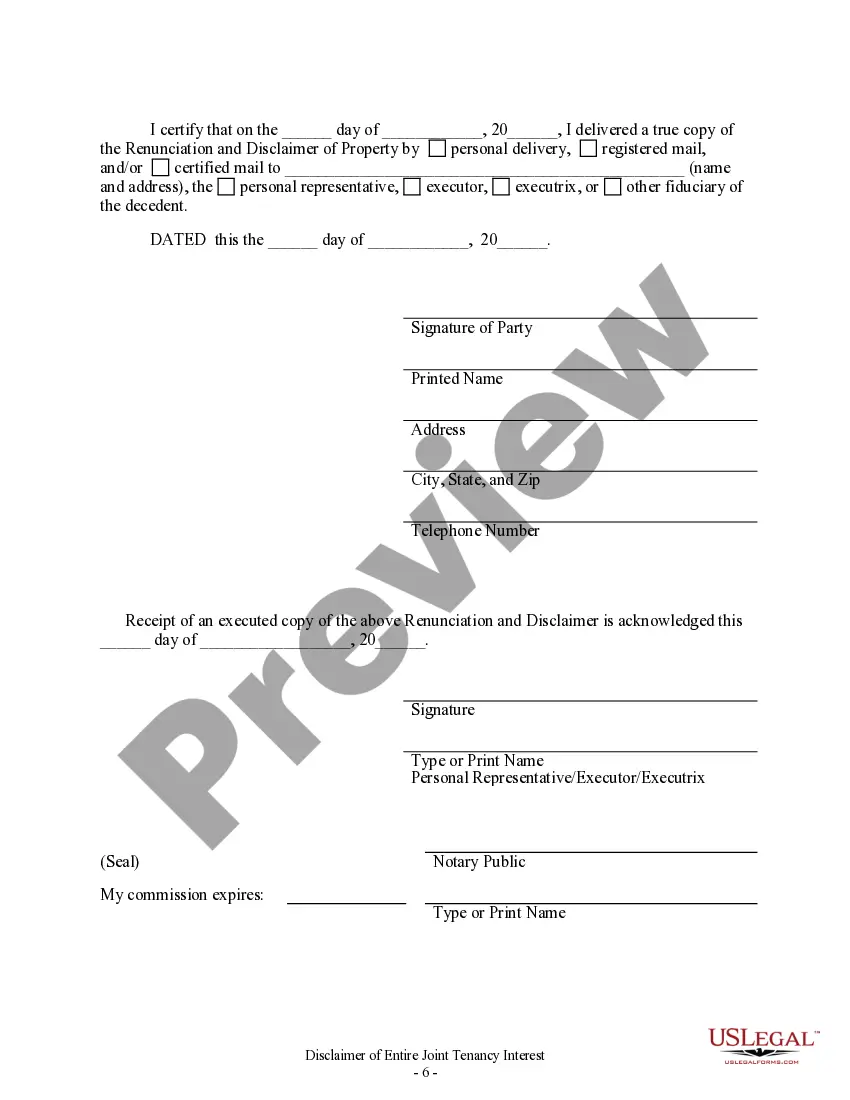
Put the disclaimer in writing. Deliver the disclaimer to the person in control of the estate usually the executor or trustee. Complete the disclaimer within nine months of the death of the person leaving the property. Do not accept any benefit from the property you're disclaiming.
Disclaim Inheritance, Definition In a nutshell, it means you're refusing any assets that you stand to inherit under the terms of someone's will, a trust or, in the case of a person who dies intestate, the inheritance laws of your state.
If you refuse to accept an inheritance, you will not be responsible for inheritance taxes, but you'll have no say in who receives the assets in your place. The bequest passes either to the contingent beneficiary listed in the will or, if that person died without a will, according to your state's laws of intestacy.
Disclaiming means that you give up your rights to receive the inheritance. If you choose to do so, whatever assets you were meant to receive would be passed along to the next beneficiary in line.
The disclaimer must be in writing: A signed letter by the person doing the disclaiming, identifying the decedent, describing the asset to be disclaimed, and the extent and amount, percentage or dollar amount, to be disclaimed, must be delivered to the person in control of the estate or asset, such as an executor,
A beneficiary of an estate, whether by Will or the laws of intestacy is perfectly within their rights to reject their inheritance. Beneficiaries may wish to vary dispositions of property following death in order to redirect benefits to other family members who are more in need or less well provided for and to save tax.
When you relinquish property, you don't get any say in who inherits in your place. If you want to control who gets the inheritance, you must accept it and give it to that person. If you relinquish the property and the deceased didn't name a back-up heir, the court will apply state law to decide who inherits.