7.01 JURY DELIBERATIONS
About this form
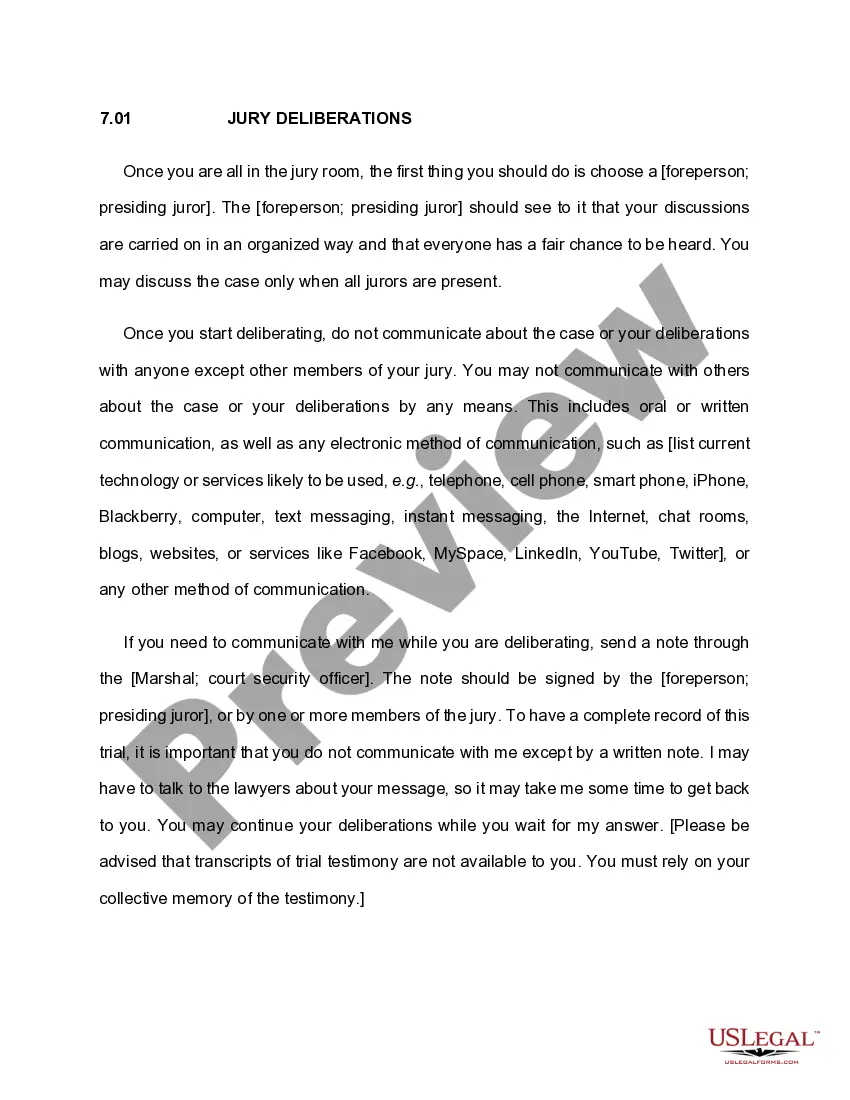
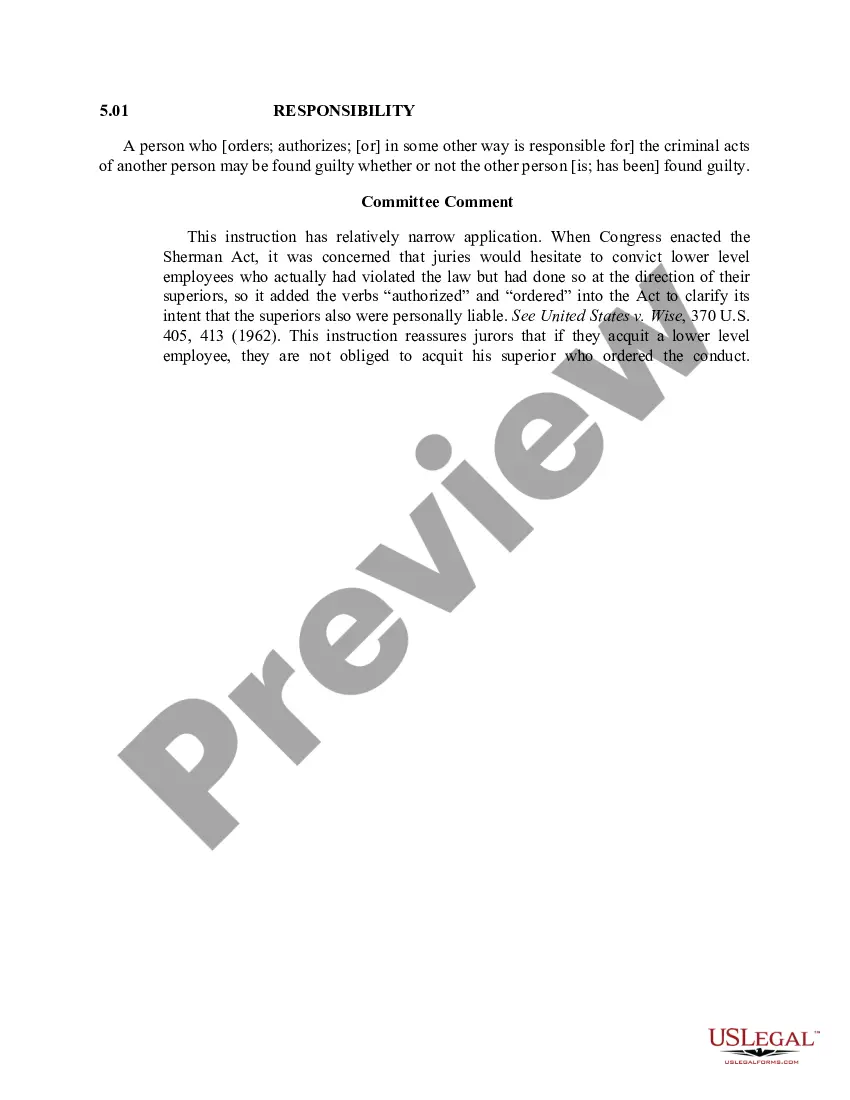
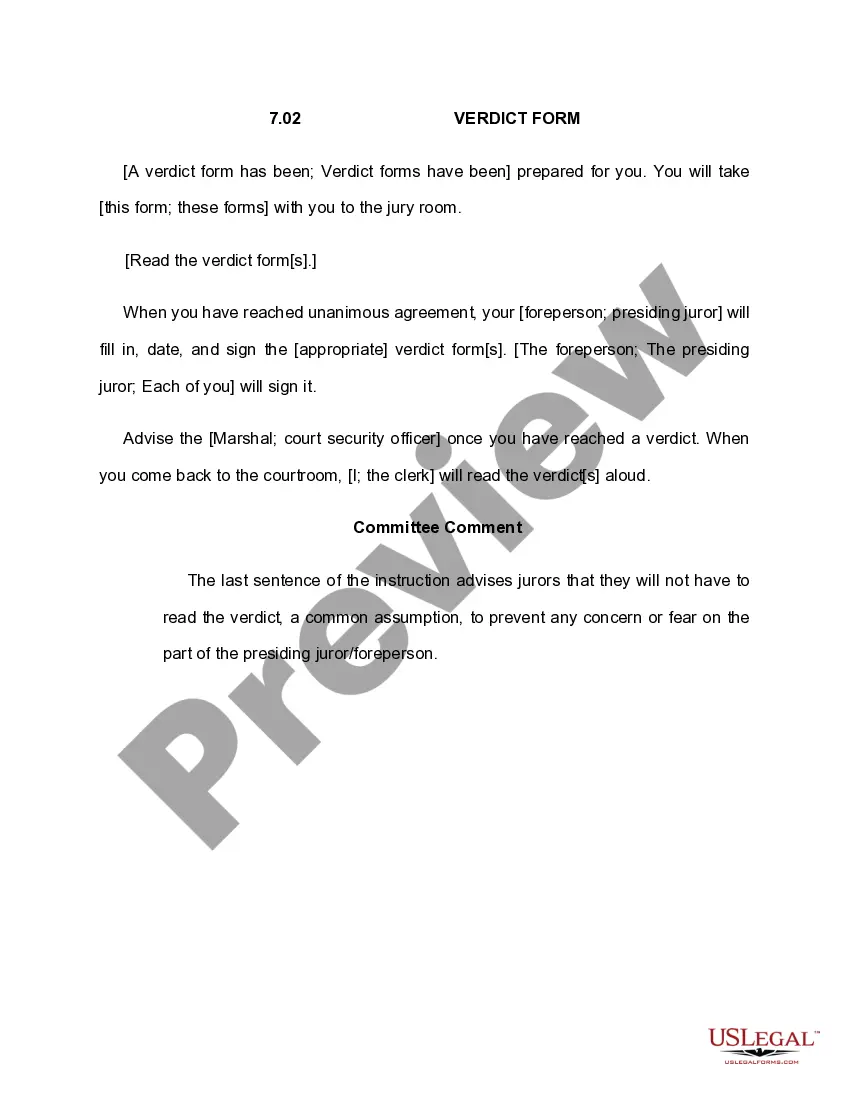
The 7.01 Jury Deliberations form provides official instructions for jurors on how to conduct their deliberations in a trial. This form offers guidance on the process, ensuring discussions are orderly and confidential. It is tailored for use in federal court settings, specifically adopted by the Federal 7th Circuit Court, making it distinct from similar forms used in other jurisdictions.
Key parts of this document
- Selection of a foreperson or presiding juror to facilitate discussions.
- Requirement for all jurors to be present for deliberations.
- Emphasis on confidentiality during discussions, prohibiting communication with outsiders.
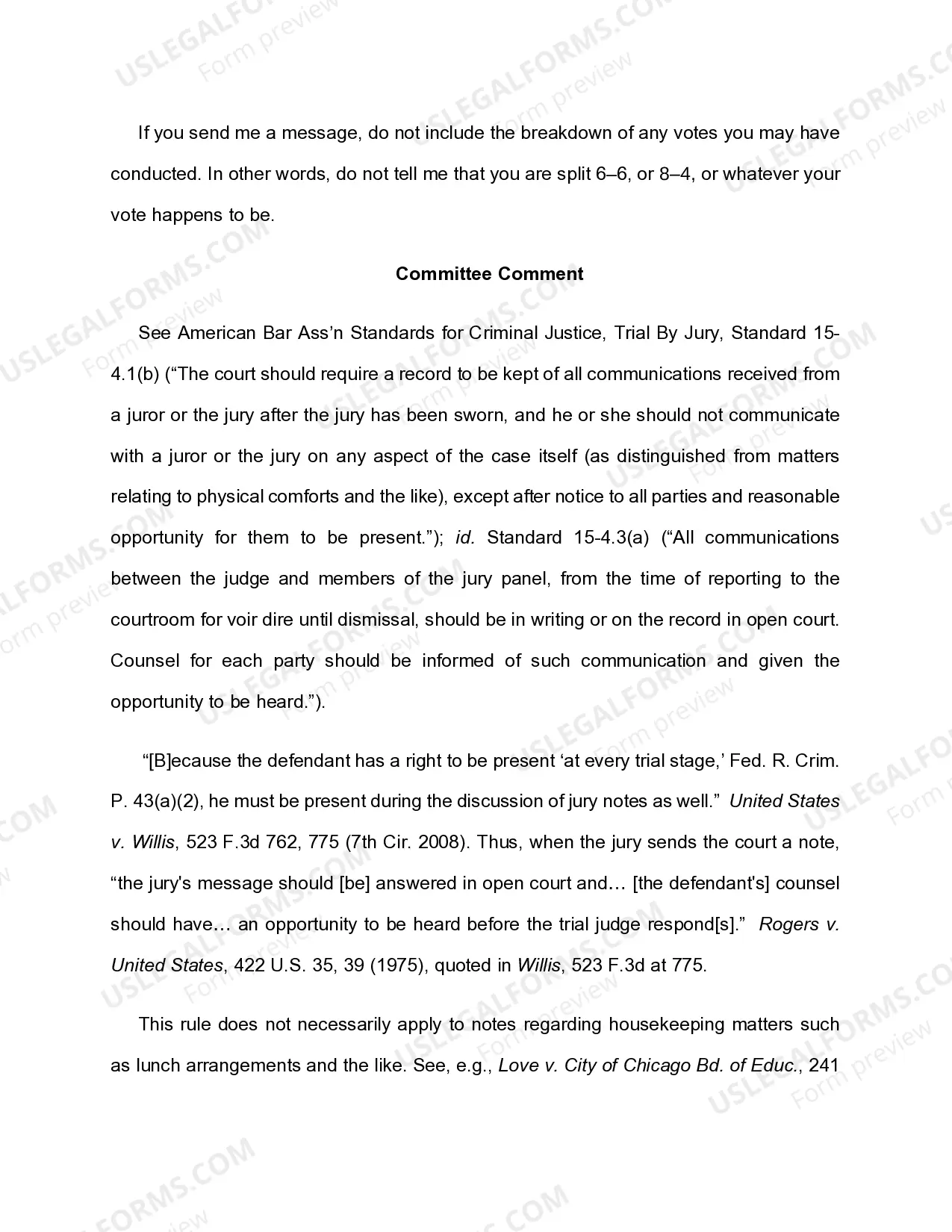
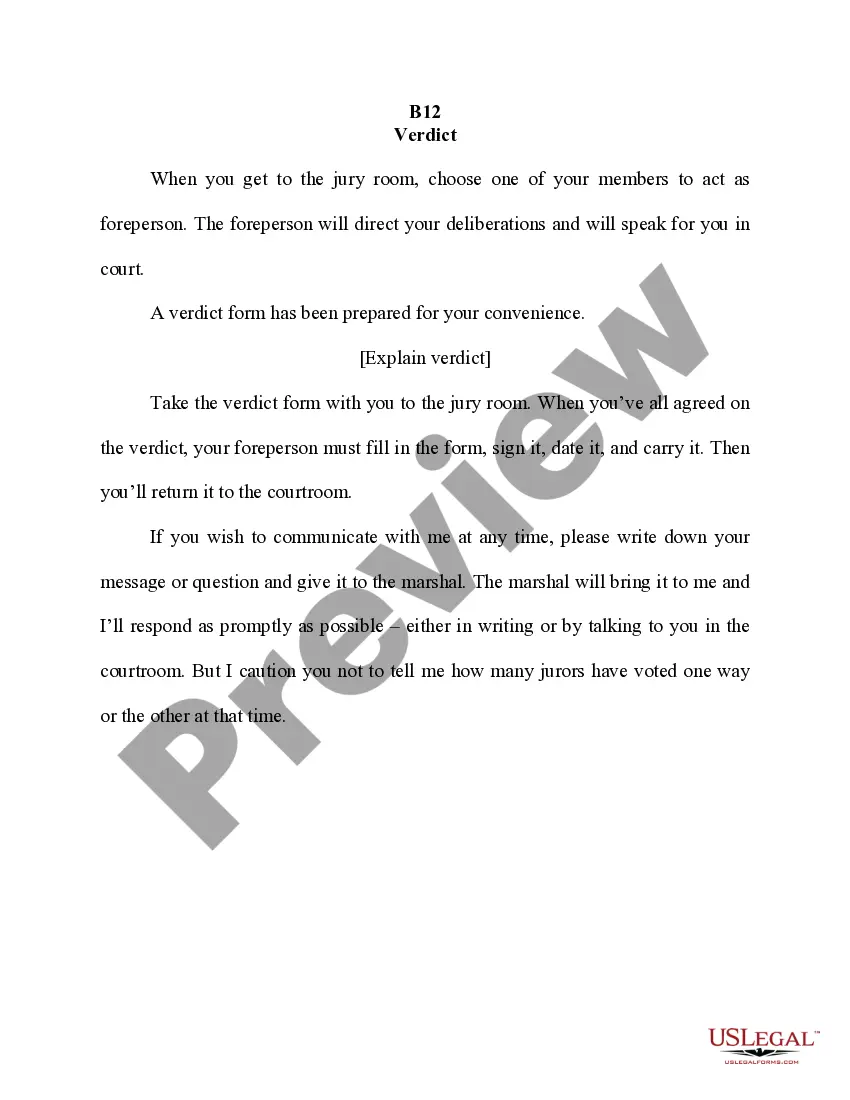
- Instructions for communicating with the court via written notes only.
- Guidelines on not revealing the breakdown of juror votes to the court.
When this form is needed
This form should be used when a jury is tasked with deliberating on a case. It outlines the essential procedures that jurors must follow once they are sequestered to decide on a case's verdict. This includes how to manage discussions, maintain confidentiality, and communicate any messages to the judge during the deliberation process.
Intended users of this form
This form is intended for:
- Members of juries selected for federal trials in the 7th Circuit jurisdiction.
- Judges and court officials overseeing jury deliberations.
- Legal professionals who need to understand jury processes and protocols.
Instructions for completing this form
- Begin by selecting a foreperson or presiding juror from your group.
- Ensure that all jurors are present before discussing the case.
- Maintain strict confidentiality and avoid any outside communication regarding the case.
- If necessary, send written notes to the court through the designated officer.
- Do not disclose vote counts or breakdowns in any communications to the court.
Does this document require notarization?
This form does not typically require notarization to be legally valid. However, some jurisdictions or document types may still require it. US Legal Forms provides secure online notarization powered by Notarize, available 24/7 for added convenience.
Get your form ready online
Our built-in tools help you complete, sign, share, and store your documents in one place.
Make edits, fill in missing information, and update formatting in US Legal Forms—just like you would in MS Word.
Download a copy, print it, send it by email, or mail it via USPS—whatever works best for your next step.
Sign and collect signatures with our SignNow integration. Send to multiple recipients, set reminders, and more. Go Premium to unlock E-Sign.
If this form requires notarization, complete it online through a secure video call—no need to meet a notary in person or wait for an appointment.
We protect your documents and personal data by following strict security and privacy standards.

Make edits, fill in missing information, and update formatting in US Legal Forms—just like you would in MS Word.

Download a copy, print it, send it by email, or mail it via USPS—whatever works best for your next step.

Sign and collect signatures with our SignNow integration. Send to multiple recipients, set reminders, and more. Go Premium to unlock E-Sign.

If this form requires notarization, complete it online through a secure video call—no need to meet a notary in person or wait for an appointment.

We protect your documents and personal data by following strict security and privacy standards.
Common mistakes to avoid
- Failing to select a foreperson before deliberations begin.
- Discussing the case outside the jury room or with non-jurors.
- Submitting notes to the court without proper signatures from jurors.
- Revealing vote counts in communications with the court.
Benefits of completing this form online
- Easy access to the most up-to-date jury deliberation instructions.
- Conveniently downloadable in Word format, allowing for easy editing and printing.
- Designed by licensed attorneys to ensure compliance with legal standards.
Legal use & context
- The instructions are designed to uphold the integrity of jury deliberations in federal cases.
- Strict adherence to these guidelines is essential for legal compliance and procedural fairness.
What to keep in mind
- Understand the role of the foreperson in jury deliberations.
- Maintain confidentiality and avoid external communication about the case.
- Communicate with the court through written notes to ensure an accurate record.
Looking for another form?
Form popularity
FAQ
In a 1992 lawsuit in Long Beach, California, USA, which took 11 years and 6 months to get to trial, Shirley and Jason McClure accused city officials of violating the US Fair Housing Act by conspiring to prevent them from opening a chain of residential homes.
In other words, in criminal cases, faster deliberations favor the prosecution, while in civil cases, faster deliberations favor the defendants.
Question 1: What was the shortest time taken by a jury to make its decision? Unbelievably, one minute! ing to Guinness World Records, on 22 July 2004 Nicholas McAllister was acquitted in New Zealand's Greymouth District Court of growing cannabis plants.
Jury deliberations have traditionally been secret only insofar as no juror could be compelled to talk about what happened. Every state and the federal government have variations on a ?no impeachment? rule, which prevents jurors from testifying about their deliberations after a verdict has been reached.
The jury's decision is "the verdict." To return a verdict in a civil case, three-fourths of jurors must agree on the verdict. In a criminal case, the verdict must be unanimous.
In a 1992 lawsuit in Long Beach, California, USA, which took 11 years and 6 months to get to trial, Shirley and Jason McClure accused city officials of violating the US Fair Housing Act by conspiring to prevent them from opening a chain of residential homes.
The goal of jury deliberation is agreement on a verdict, but no juror should try to force another to adopt his/her position. Courteous and reasonable discussion will usually make it possible to reach agreement.
Social science research has consistently found that larger groups perform better than smaller groups on various metrics. Larger juries spend more time deliberating and examining the evidence more carefully and thoroughly. Twelve-person juries are more likely to focus on probative rather than non-probative evidence.