Postal Customer Counsel One-Way Non-Disclosure Agreement
What this document covers
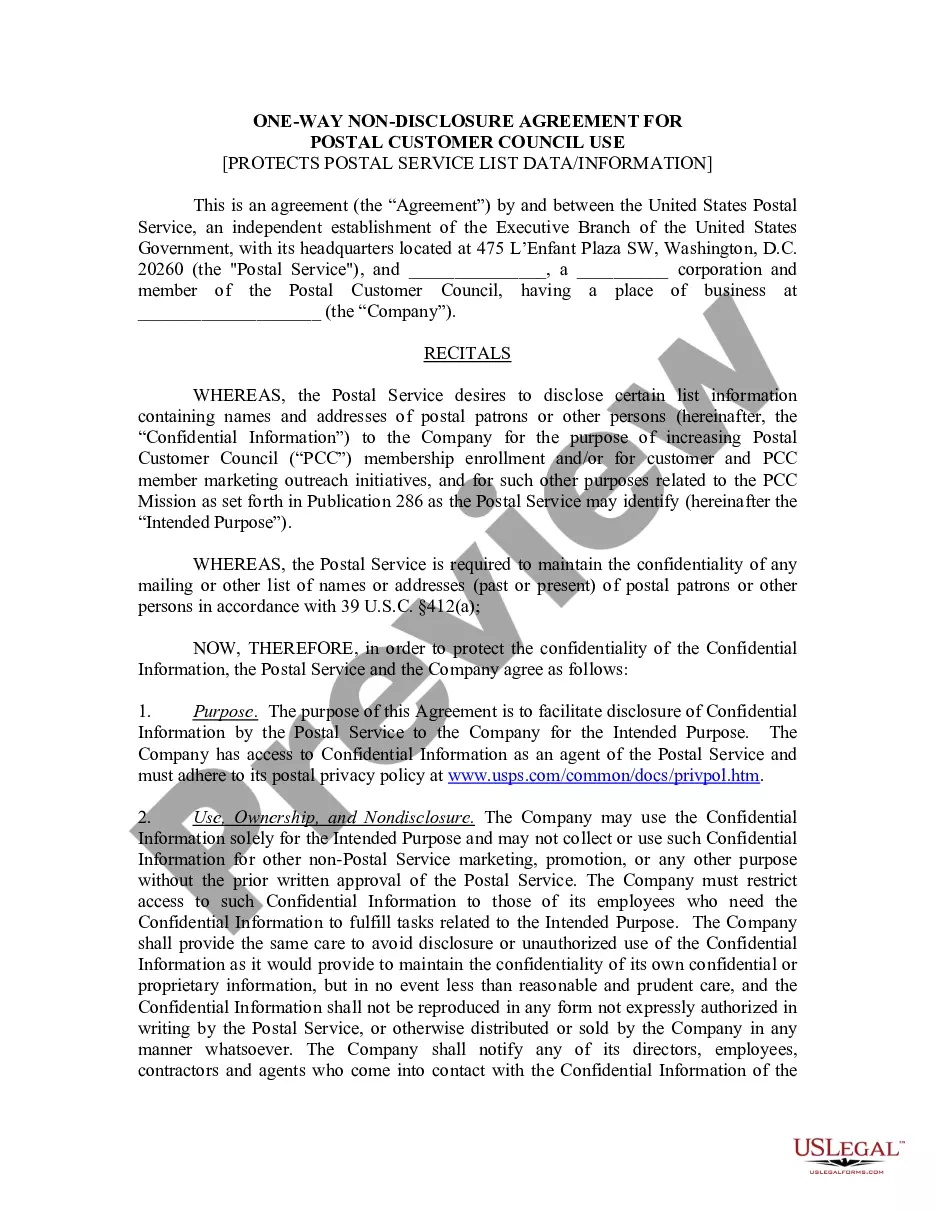
The Postal Customer Counsel One-Way Non-Disclosure Agreement is a legal document designed to protect confidential postal service list data and information when shared with a Postal Customer Council (PCC) member. This form is exclusively intended for corporations or businesses that are members of the PCC, enabling them to access sensitive customer information for specific marketing and outreach purposes while ensuring the confidentiality and security of that data. Unlike other nondisclosure agreements, this form is tailored specifically for use within the context of Postal Customer Council operations and obligations.
What’s included in this form
- Purpose: Facilitates disclosure of confidential postal service information for PCC marketing initiatives.
- Use, Ownership, and Nondisclosure: Outlines how the information can be used and ensures it is kept secure.
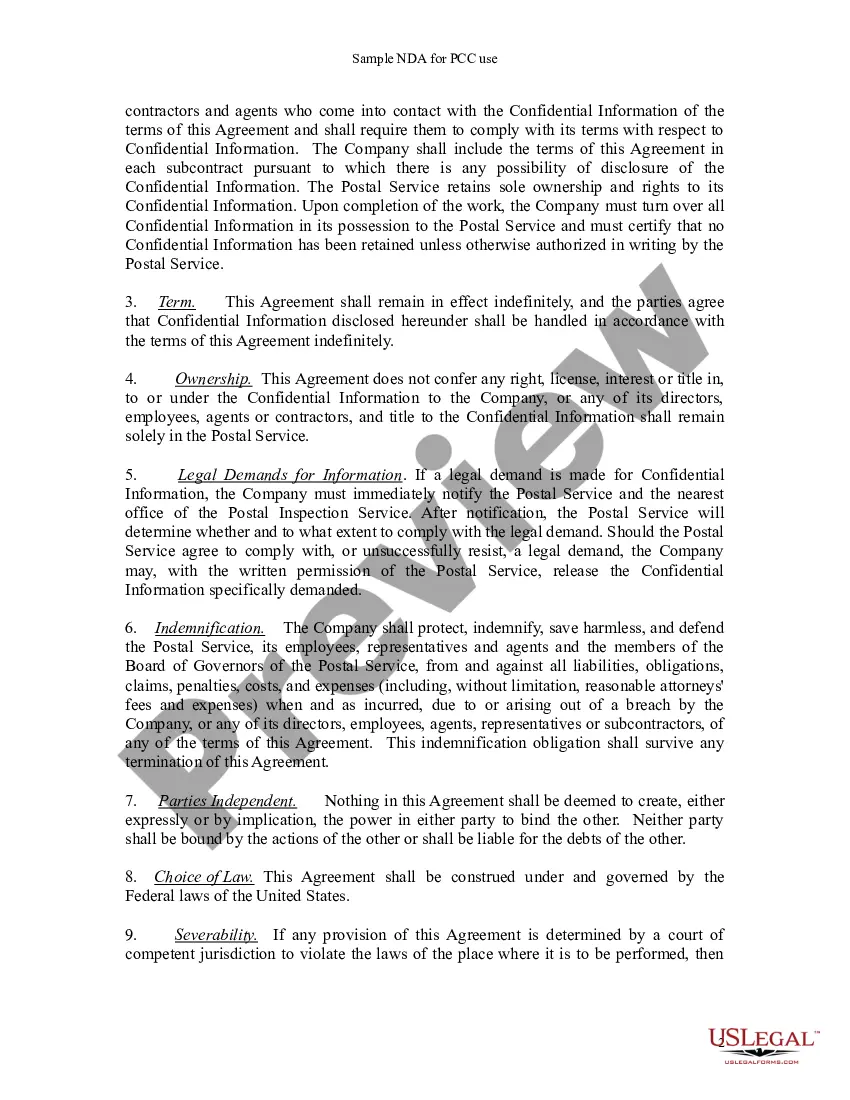
- Term: States that the agreement is effective indefinitely.
- Legal Demands: Details the obligations of the Company if a legal demand for information is made.
- Indemnification: The Company agrees to protect the Postal Service from any liabilities arising from breaches of the agreement.
When to use this form
This form should be used when a corporation or business that is a member of the Postal Customer Council requires access to confidential postal service customer information. It is particularly important for businesses engaged in marketing outreach initiatives aimed at increasing PCC membership enrollment and connecting with postal patrons. If you are looking to securely share or receive sensitive information from the United States Postal Service, this agreement is essential to ensure proper legal protections are in place.
Who this form is for
- PCC member corporations or businesses.
- Businesses seeking to engage in marketing outreach efforts involving Postal Service data.
- Entities that handle or access customer information provided by the USPS under confidentiality obligations.
Steps to complete this form
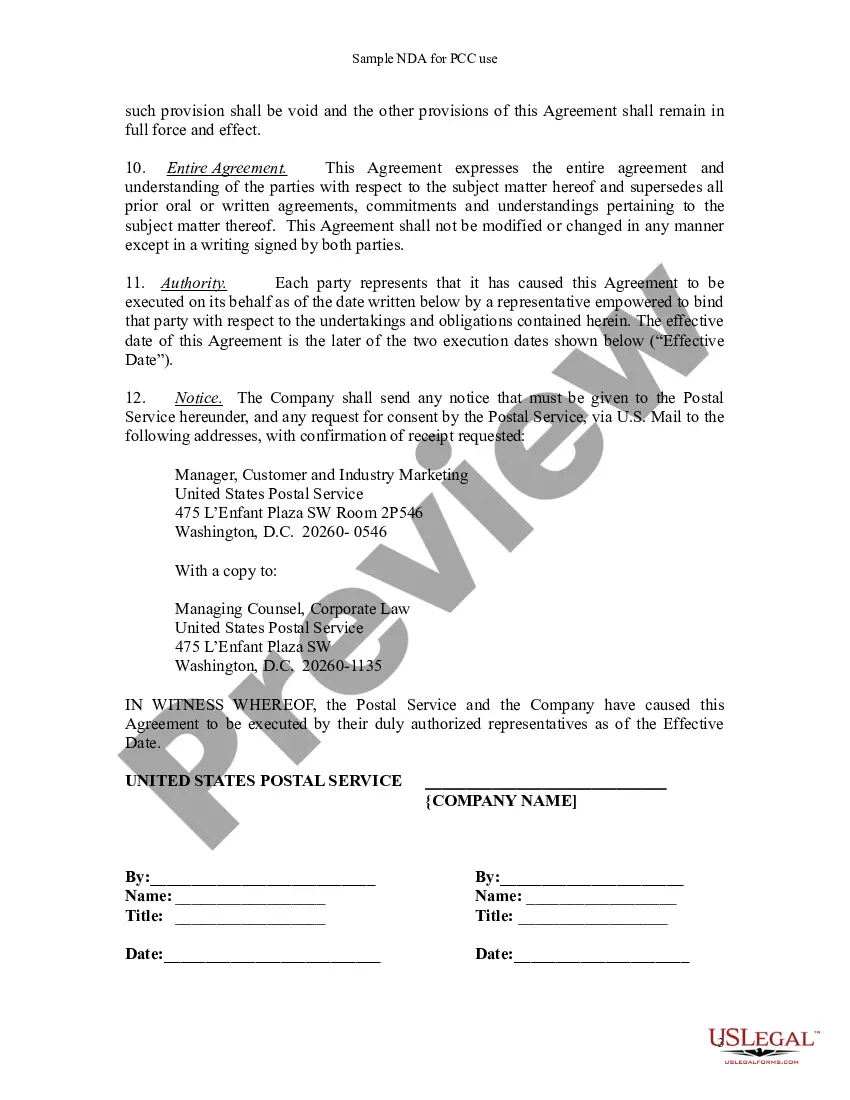
- Identify and enter the parties involved: the United States Postal Service and your corporation's name.
- Specify the business address of your corporation.
- Clearly state the intended purpose for which the confidential information will be used.
- Both parties should sign and date the agreement, ensuring authorized representatives sign on behalf of their respective organizations.
- Ensure that all terms of the agreement are understood by both parties before execution.
Does this form need to be notarized?
This form does not typically require notarization unless specified by local law. It is advisable to check your specific state's regulations or consult a legal professional for any additional requirements.
Get your form ready online
Our built-in tools help you complete, sign, share, and store your documents in one place.
Make edits, fill in missing information, and update formatting in US Legal Forms—just like you would in MS Word.
Download a copy, print it, send it by email, or mail it via USPS—whatever works best for your next step.
Sign and collect signatures with our SignNow integration. Send to multiple recipients, set reminders, and more. Go Premium to unlock E-Sign.
If this form requires notarization, complete it online through a secure video call—no need to meet a notary in person or wait for an appointment.
We protect your documents and personal data by following strict security and privacy standards.

Make edits, fill in missing information, and update formatting in US Legal Forms—just like you would in MS Word.

Download a copy, print it, send it by email, or mail it via USPS—whatever works best for your next step.

Sign and collect signatures with our SignNow integration. Send to multiple recipients, set reminders, and more. Go Premium to unlock E-Sign.

If this form requires notarization, complete it online through a secure video call—no need to meet a notary in person or wait for an appointment.

We protect your documents and personal data by following strict security and privacy standards.
Mistakes to watch out for
- Failing to specify the intended use of the confidential information.
- Not obtaining necessary signatures from authorized representatives.
- Neglecting to review the confidentiality obligations thoroughly before signing.
Advantages of online completion
- Quick and efficient access to an authorized legal document.
- Easy editing to tailor the agreement to specific needs.
- Secure storage options available for your signed forms.
Legal use & context
- This agreement is legally binding, provided it is executed properly by both parties.
- It is essential for protecting sensitive information shared between the Postal Service and PCC members.
Looking for another form?
Form popularity
FAQ
Here are the two types of NDAs to choose from: Unilateral (NDA) Unilateral nondisclosure agreements are the most common NDAs available.Mutual (MNDA) Mutual nondisclosure agreements (MNDA), also known as bilateral agreements, are used when two parties disclose confidential information to each other.
NDAs, or non-disclosure agreements, are legally enforceable contracts that create a confidential relationship between a person who has sensitive information and a person who will gain access to that information. A confidential relationship means one or both parties has a duty not to share that information.
You can identify a non-disclosure agreement by other names like: Confidential Agreement (CA) Confidential Disclosure Agreement (CDA) Secrecy Agreement (SA) Proprietary Information Agreement (PIA)
When an NDA has only one disclosing and one receiving party, it's called a one-way NDA. A one-way NDA is the simplest NDA type. It prohibits the receiver from sharing confidential business information with third parties and determines the consequences of doing so.
When drafting an NDA, it is critical to be as specific as possible. A contract can be declared null and void if the language is unduly broad, irrational, or onerous. Agreements that are overly broad, oppressive, or attempt to contain non-confidential information will also be challenged or invalidated by the courts.
NDAs can be either mutual or one way. A mutual NDA requires each party to protect the confidential information to the other party. A one-way NDA contemplates that only one party will be disclosing confidential information. If you won't be disclosing any confidential information, then you may not need a mutual NDA.
In a unilateral NDA, One party promises to keep confidential material belonging to the other party privately. In an MNDA, both parties agree not to reveal the confidential information of the other.
Besides naming all parties to the NDA, five essential elements every NDA should include are: Description Of The Confidential Information.Requirements And Obligations Of The Parties.Exclusions To The Confidentiality Agreement.Term Of The Non-Disclosure Agreement.Consequences Of Breach Of The NDA.