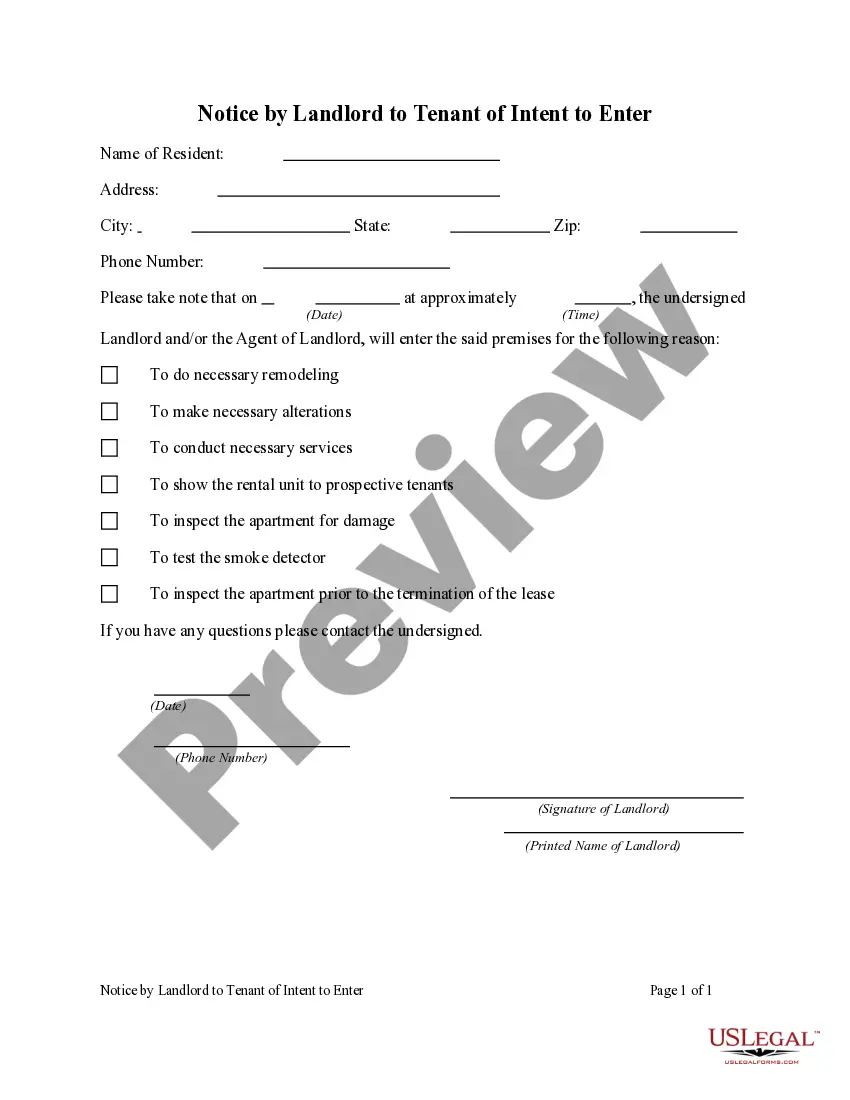
Notice by Landlord to Tenant of Intent to Enter

State:
Multi-State
Control #:
US-0316BG
Format:
Word; 
Rich Text
Instant download

What is this form?

The Notice by Landlord to Tenant of Intent to Enter is a legal document that informs tenants of a landlord's or property manager's planned entry into a rental unit. This form is typically used when the landlord needs to make minor repairs, conduct inspections, or show the property to potential tenants. It is essential for maintaining clear communication between landlords and tenants, ensuring that all parties are aware of when the rental unit will be accessed.

Form components explained

  • Identification of the landlord and tenant involved.
  • Specific reasons for entering the rental property.
  • Date and time for the intended entry.
  • Signature of the landlord or property manager.
  • Notice period to be provided to the tenant.

Situations where this form applies

This form should be used when a landlord intends to enter a rental property for various reasons, such as performing necessary repairs, showing the unit to prospective tenants, conducting safety inspections, or checking for damages. It ensures that tenants are adequately notified in advance, promoting transparency and cooperation.

Who can use this document

  • Landlords who manage rental properties.
  • Property managers operating on behalf of landlords.
  • Real estate agents showing rental units to potential tenants.

Steps to complete this form

  • Identify the landlord and tenant by entering their names and addresses.
  • Specify the reasons for the entry, ensuring they comply with legal guidelines.
  • Provide the date and time when the entry will take place.
  • Sign the document to validate your intent.
  • Ensure the tenant receives a copy of the notice within the legally required time frame.

Notarization requirements for this form

Notarization is generally not required for this form. However, certain states or situations might demand it. You can complete notarization online through US Legal Forms, powered by Notarize, using a verified video call available anytime.

Get your form ready online

Our built-in tools help you complete, sign, share, and store your documents in one place.

Built-in online Word editor

Make edits, fill in missing information, and update formatting in US Legal Forms—just like you would in MS Word.

Export easily

Download a copy, print it, send it by email, or mail it via USPS—whatever works best for your next step.

E-sign your document

Sign and collect signatures with our SignNow integration. Send to multiple recipients, set reminders, and more. Go Premium to unlock E-Sign.

Notarize online 24/7

If this form requires notarization, complete it online through a secure video call—no need to meet a notary in person or wait for an appointment.

Store your document securely

We protect your documents and personal data by following strict security and privacy standards.

Form selector

Make edits, fill in missing information, and update formatting in US Legal Forms—just like you would in MS Word.

Form selector

Download a copy, print it, send it by email, or mail it via USPS—whatever works best for your next step.

Form selector

Sign and collect signatures with our SignNow integration. Send to multiple recipients, set reminders, and more. Go Premium to unlock E-Sign.

Form selector

If this form requires notarization, complete it online through a secure video call—no need to meet a notary in person or wait for an appointment.

Form selector

We protect your documents and personal data by following strict security and privacy standards.

Typical mistakes to avoid

  • Failing to provide sufficient notice according to state regulations.
  • Not including the specific reasons for the entry.
  • Omitting the date and time of entry or providing vague information.
  • Forget to sign the form before delivering it to the tenant.

Advantages of online completion

  • Quick and easy access to a legally compliant document.
  • Editable templates allow landlords to customize the notice as needed.
  • Reliability ensures that you are using a form drafted by licensed attorneys.

Summary of main points

  • The Notice by Landlord to Tenant of Intent to Enter is crucial for notifying tenants prior to property access.
  • Landlords must follow state regulations regarding notice periods and reasons for entry.
  • Completing this form accurately helps prevent misunderstandings and fosters good landlord-tenant relationships.

Looking for another form?

This field is required
Virginia
Select state

Form popularity

FAQ

Let's be clear, other than in emergency it's illegal for a landlord or agent to enter a property without agreement from the tenant. The golden rule to abide by is always to provide your tenants with written notice at least 24 hours before any planned visits.

Step 1: Mention the Reason for Giving a Notice. Step 2: Use Formal Language. Step 3: Mention the Date for Vacating. Step 4: Address the Formalities to Be Taken Care Of. Step 5: Proofread the Letter.

Be in writing, Say the full name of the tenant or tenants, Have the address the notice is about, Say everything that the tenant did to break the lease or deserve a 3 day notice to leave, and include details and dates, Say clearly that the tenant has to move out as soon as the 3 days are up, and.

Dear (Name of landlord or manager), This letter constitutes my written (number of days' notice that you need to give based on your lease agreement)-day notice that I will be moving out of my apartment on (date), the end of my current lease. I am leaving because (new job, rent increase, etc.)

When you rent a property from a landlord it becomes your home. They should only enter the property without you being present, if you have given permission for them to do so, or in a genuine emergency.

Dear (Name of landlord or manager), This letter constitutes my written (number of days' notice that you need to give based on your lease agreement)-day notice that I will be moving out of my apartment on (date), the end of my current lease. I am leaving because (new job, rent increase, etc.)

1 month's notice if your tenancy runs from month to month. 4 weeks' notice if your tenancy runs from week to week. If you live with your landlord. You don't have to give a set amount of notice (unless your tenancy agreement says otherwise).

Trusted and secure by over 3 million people of the world’s leading companies

Notice by Landlord to Tenant of Intent to Enter