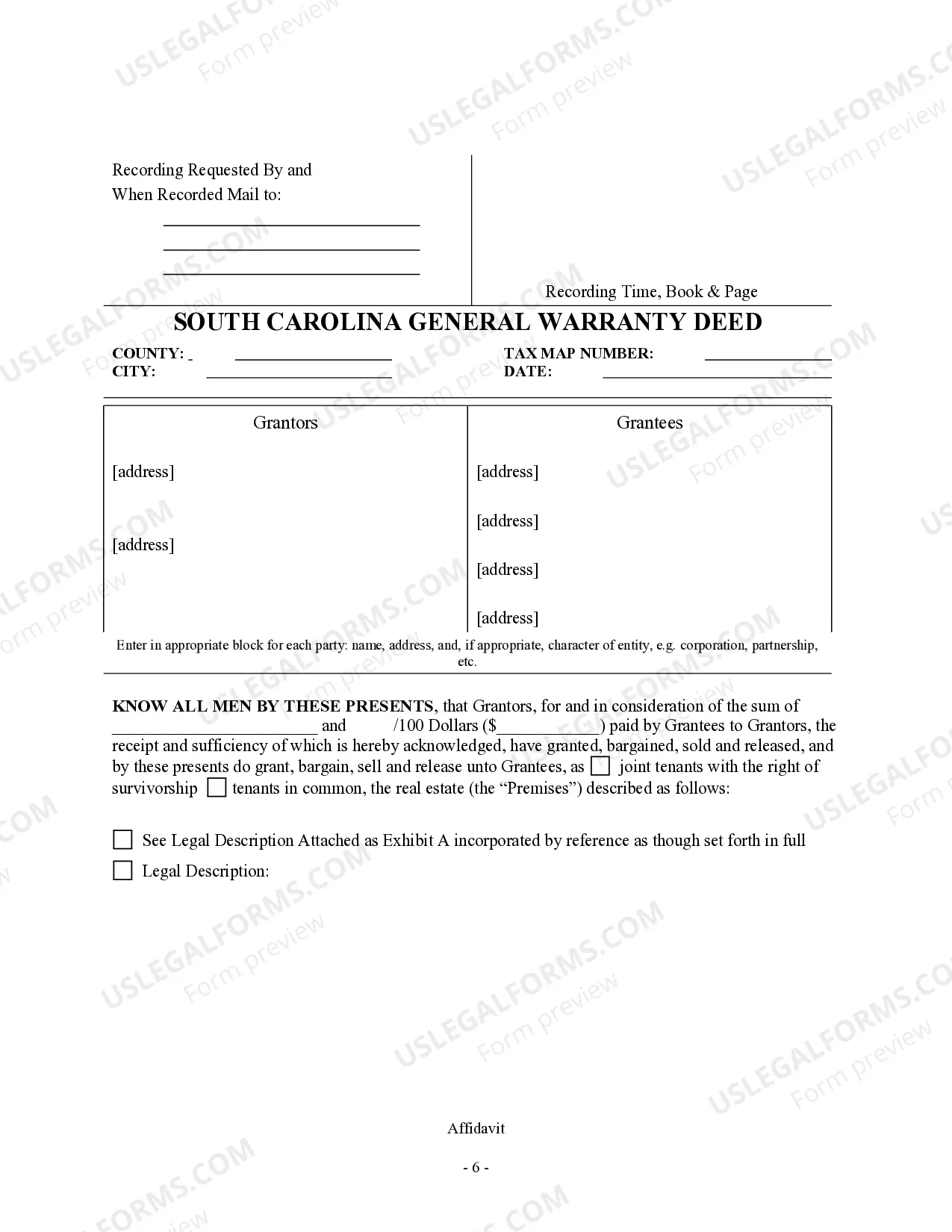
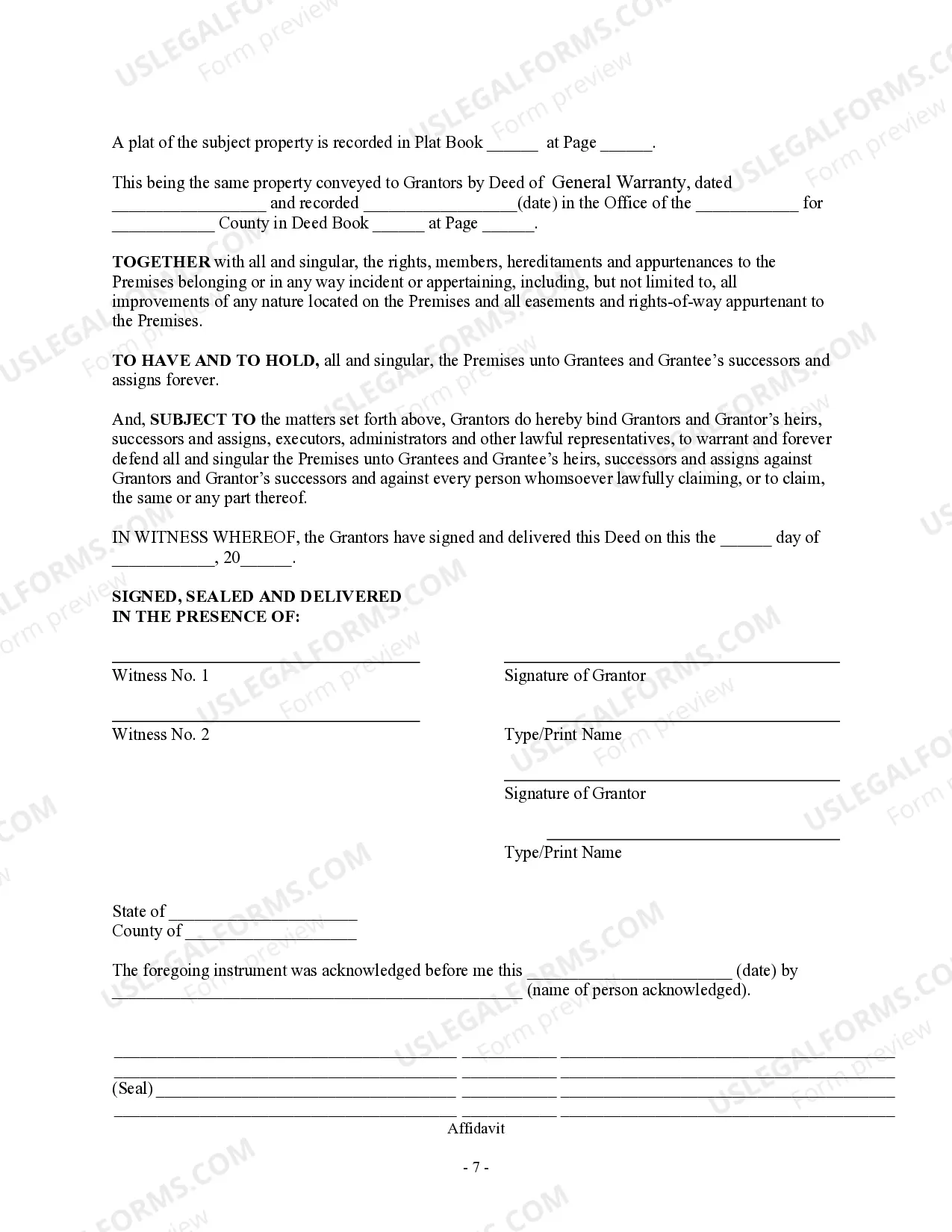
This form is a General Warranty Deed where the Grantors are husband and wife and the Grantees are four individuals. Grantors convey and generally warrant the described property to the Grantees. This deed complies with all state statutory laws.
Creating documents isn't the most uncomplicated task, especially for people who almost never deal with legal papers. That's why we advise using correct South Carolina General Warranty Deed - Husband and Wife to Four Individuals samples created by professional attorneys. It gives you the ability to stay away from troubles when in court or working with formal organizations. Find the templates you want on our site for top-quality forms and exact information.
If you’re a user having a US Legal Forms subscription, just log in your account. As soon as you’re in, the Download button will automatically appear on the file web page. Right after accessing the sample, it will be stored in the My Forms menu.
Customers with no a subscription can quickly create an account. Follow this simple step-by-step help guide to get the South Carolina General Warranty Deed - Husband and Wife to Four Individuals:
After doing these straightforward steps, you are able to complete the sample in an appropriate editor. Check the filled in info and consider asking a lawyer to review your South Carolina General Warranty Deed - Husband and Wife to Four Individuals for correctness. With US Legal Forms, everything gets easier. Try it out now!
If you live in a common-law state, you can keep your spouse's name off the title the document that says who owns the property.You can put your spouse on the title without putting them on the mortgage; this would mean that they share ownership of the home but aren't legally responsible for making mortgage payments.
Two of the most common ways to transfer property in a divorce are through an interspousal transfer deed or quitclaim deed. When spouses own property together, but then one spouse executes an interspousal transfer or a quitclaim deed, this is known as transmutation.
If you've recently married and already own a home or other real estate, you may want to add your new spouse to the deed for your property so the two of you own it jointly. To add a spouse to a deed, all you have to do is literally fill out, sign and record a new deed in your county recorder's office.
Adding someone to your house deed requires the filing of a legal form known as a quitclaim deed. When executed and notarized, the quitclaim deed legally overrides the current deed to your home. By filing the quitclaim deed, you can add someone to the title of your home, in effect transferring a share of ownership.
In California, all property bought during the marriage with income that was earned during the marriage is deemed "community property." The law implies that both spouses own this property equally, regardless of which name is on the title deed.
A In order to make your partner a joint owner you will need to add his name at the Land Registry, for which there is a fee of £280 (assuming you transfer half the house to him). You won't, however, have to pay capital gains tax, as gifts between civil partners (and spouses) are tax free.
In order to make the Warranty Deed legally binding, the Seller needs to sign it front of a notary public. Then signed and notarized deed must be filed at the city or county office for recording property documents. Before filing with this office all previously billed property taxes must be paid in full.
Adding someone to your house deed requires the filing of a legal form known as a quitclaim deed. When executed and notarized, the quitclaim deed legally overrides the current deed to your home. By filing the quitclaim deed, you can add someone to the title of your home, in effect transferring a share of ownership.
Typically, the lender will provide you with a copy of the deed of trust after the closing. The original warranty deeds are often mailed to the grantee after they are recorded. These are your original copies and should be kept in a safe place, such as a fireproof lockbox or a safe deposit box at a financial institution.