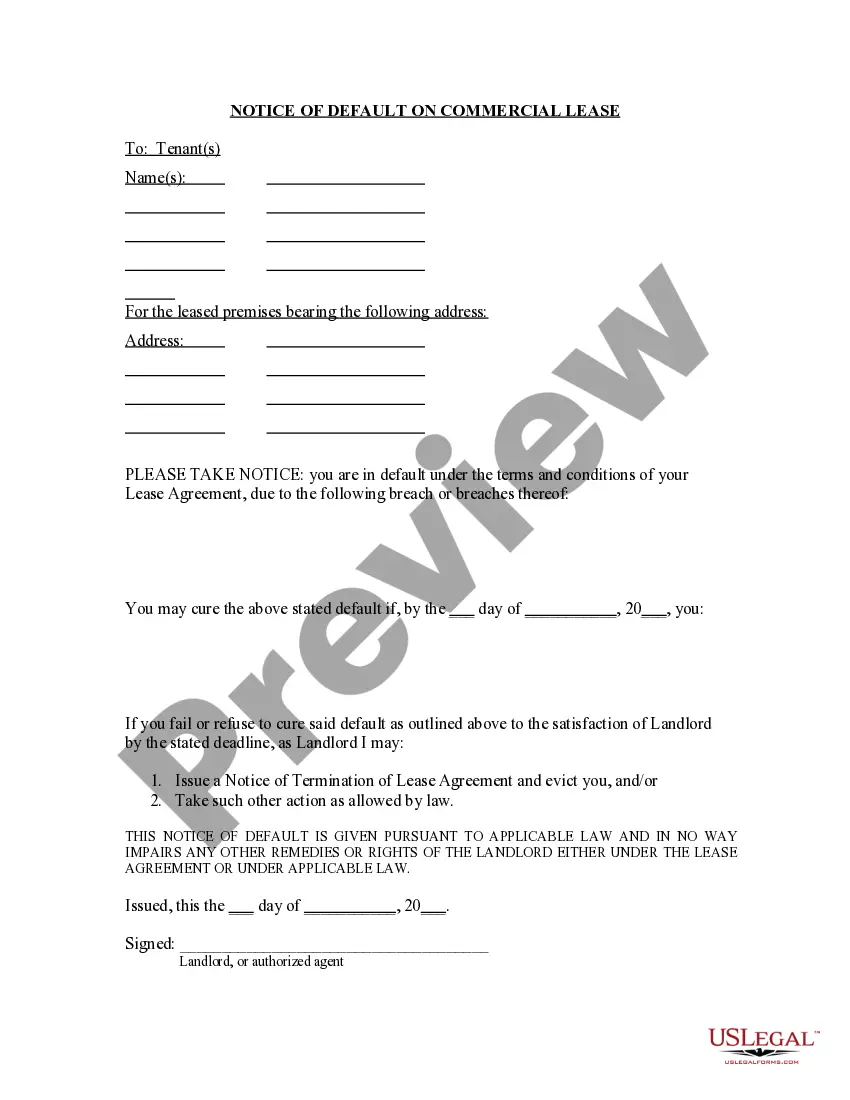
In landlord-tenant law, default refers to the failure of a tenant to timely pay rent due. In anticipation of such an occurence, landlords commonly require a new tenant to pay a security deposit, which may be used to remedy defaults in payment of rent and other monetary obligations under the rental agreement. In general, the landlord is required to give the tenant notice of the default before bringing eviction proceedings or applying security deposit proceeds to the payment in default. The fixing of a definite default date for payment of rent can be critical if it becomes necessary to evict a tenant for a default in the payment of rent. Landlords often require a background and/or reference check on prospective tenants in an attempt to minimize defaults in rent payments.
Landlord Tenant Letter
Description Tenant Letter
How to fill out Rhode Island Letter From Landlord To Tenant As Notice Of Default On Commercial Lease?
Creating documents isn't the most uncomplicated process, especially for those who rarely work with legal papers. That's why we recommend using accurate Rhode Island Letter from Landlord to Tenant as Notice of Default on Commercial Lease templates made by professional lawyers. It allows you to avoid troubles when in court or working with official institutions. Find the samples you need on our site for top-quality forms and accurate information.
If you’re a user with a US Legal Forms subscription, simply log in your account. Once you’re in, the Download button will immediately appear on the file web page. Right after getting the sample, it’ll be saved in the My Forms menu.
Customers without an activated subscription can quickly get an account. Look at this simple step-by-step guide to get your Rhode Island Letter from Landlord to Tenant as Notice of Default on Commercial Lease:
- Make sure that file you found is eligible for use in the state it is necessary in.
- Confirm the document. Make use of the Preview option or read its description (if readily available).
- Click Buy Now if this sample is what you need or utilize the Search field to find a different one.
- Select a convenient subscription and create your account.
- Make use of your PayPal or credit card to pay for the service.
- Download your document in a required format.
After finishing these simple actions, it is possible to complete the sample in your favorite editor. Recheck filled in info and consider asking a legal professional to review your Rhode Island Letter from Landlord to Tenant as Notice of Default on Commercial Lease for correctness. With US Legal Forms, everything gets much simpler. Try it now!