New York Federal Estate Tax Affidavit
About this form
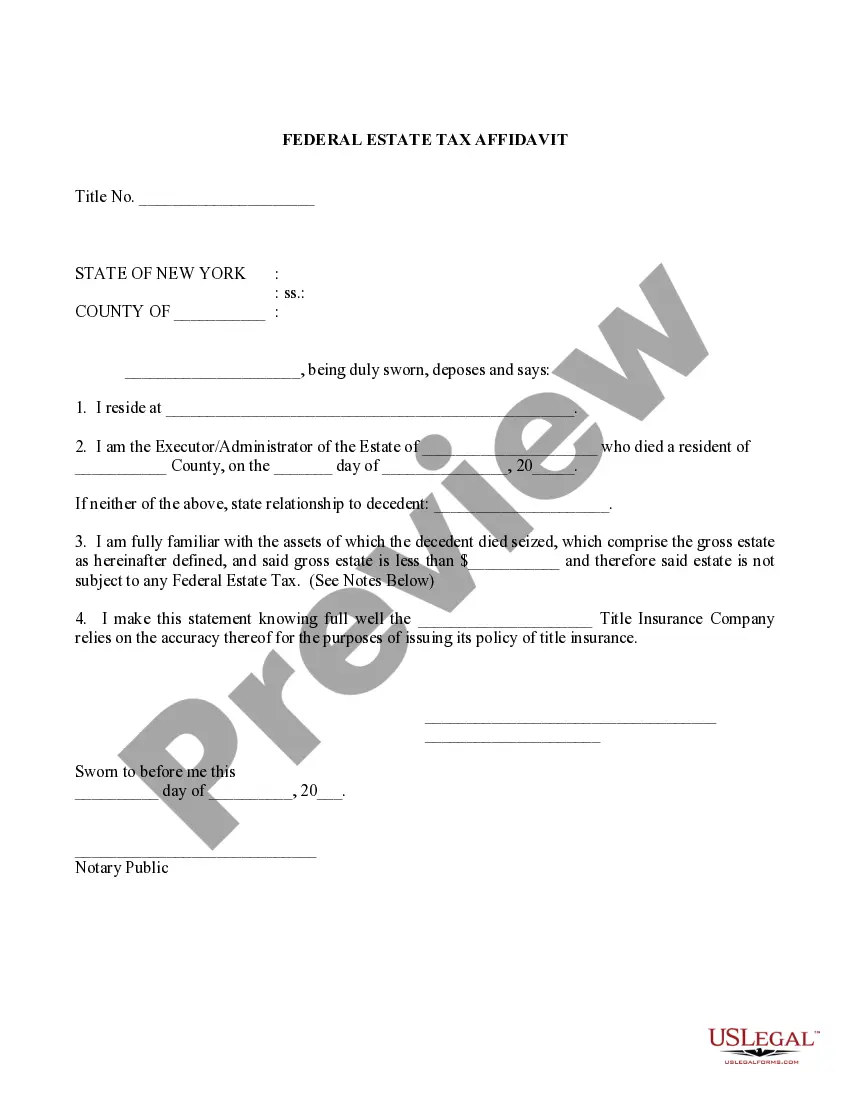
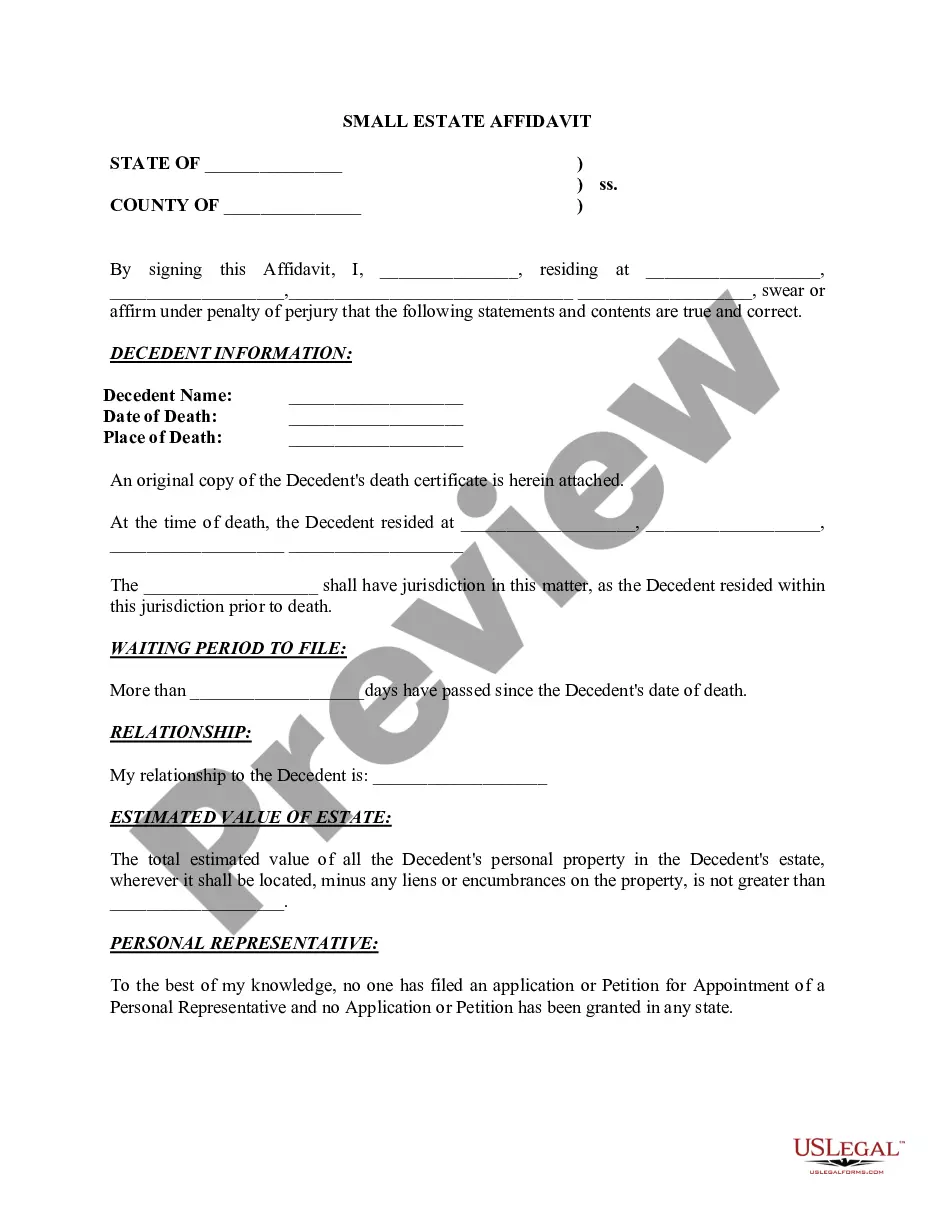
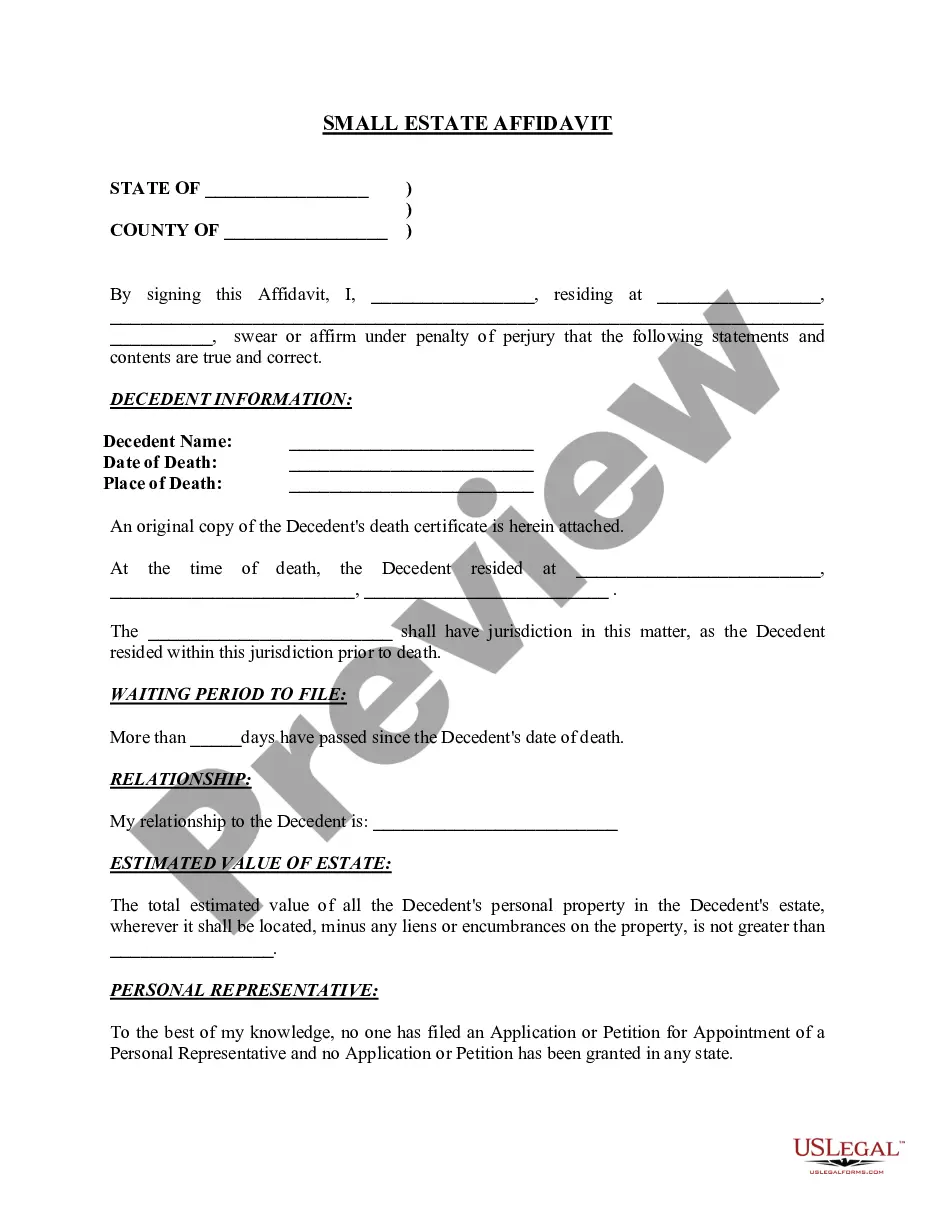
The Federal Estate Tax Affidavit is a legal document used by the executor or administrator of an estate. Its primary purpose is to affirm the gross value of the estate. This affidavit indicates that the total value is below the federal estate tax threshold, thus exempting it from taxation. Unlike other estate documents, this affidavit specifically addresses federal estate tax matters.
Key parts of this document
- Title number to identify the form.
- Details of the executor or administrator, including name and address.
- Information about the deceased, including name and date of death.
- Declaration of the gross estate value and confirmation of its insufficiency for federal estate tax applicability.
- Assurance of accuracy for title insurance purposes.

Situations where this form applies
This affidavit should be used when the estate of a deceased person is below the federal estate tax exemption amount. It is typically necessary when managing the estate's assets and ensuring that all legal requirements are met, especially when dealing with title insurance companies that require proof of the estate's value.
Who should use this form
- Executors or administrators of an estate.
- Individuals managing the affairs of a deceased person whose estate is below the federal estate tax threshold.
- Heirs or beneficiaries needing documentation for property transfer or title insurance claims.
Steps to complete this form
- Fill in the title number at the top of the form.
- Enter your name and address as the executor or administrator.
- Provide the name of the deceased and the date of their passing.
- State the relationship to the decedent if applicable.
- Specify the total gross value of the estate.
- Sign the affidavit in the presence of a notary public.
Does this document require notarization?
Yes, this form must be notarized to be legally valid. US Legal Forms offers integrated online notarization services, allowing you to complete this process via secure video calls, available 24/7, with no need for physical travel.
Get your form ready online
Our built-in tools help you complete, sign, share, and store your documents in one place.
Make edits, fill in missing information, and update formatting in US Legal Forms—just like you would in MS Word.
Download a copy, print it, send it by email, or mail it via USPS—whatever works best for your next step.
Sign and collect signatures with our SignNow integration. Send to multiple recipients, set reminders, and more. Go Premium to unlock E-Sign.
If this form requires notarization, complete it online through a secure video call—no need to meet a notary in person or wait for an appointment.
We protect your documents and personal data by following strict security and privacy standards.

Make edits, fill in missing information, and update formatting in US Legal Forms—just like you would in MS Word.

Download a copy, print it, send it by email, or mail it via USPS—whatever works best for your next step.

Sign and collect signatures with our SignNow integration. Send to multiple recipients, set reminders, and more. Go Premium to unlock E-Sign.

If this form requires notarization, complete it online through a secure video call—no need to meet a notary in person or wait for an appointment.

We protect your documents and personal data by following strict security and privacy standards.
Common mistakes to avoid
- Failing to accurately assess the total gross estate value.
- Not completing all required fields on the affidavit.
- Overlooking the necessity of notarization.
- Providing inaccurate personal or estate details.
Why use this form online
- Convenience of downloading and completing the form at your own pace.
- Editability allows for easy adjustments before finalizing the document.
- Access to reliable, attorney-drafted templates ensures legal compliance.
Summary of main points
- The Federal Estate Tax Affidavit confirms the estate's value is below the federal tax threshold.
- Accurate completion is essential for legal validity and acceptance by title insurers.
- Notarization is required for the affidavit to be effective.
Looking for another form?
Form popularity
FAQ
When authorization is required for the release of personal property, it is usually referred to as an estate tax waiver or a consent to transfer. New York State does not require waivers for estates of anyone who died on or after February 1, 2000. For details, See Publication 603, Estate Tax Waivers.
As of January 1, 2023, the New York exemption amount is $6.58 million per individual (up from $6.11 million in 2022).
What is the New York estate tax rate? The top New York estate tax rate is 16%. The top rate only applies when the New York taxable estate is over $10,100,000 million. Dollars below that amount are subject to tax at graduated rates, starting at 3.06% for the first $500,000.
How to avoid New York's Fiscal Cliff There are many ways our estate tax attorneys can help you avoid this cliff and safeguard your wealth.Credit Shelter Trusts. Non-Grantor Trusts. Changing Your Domicile. Strategic Gifting. Charitable Formula Gifts. Discounted Valuation of Closely-Held Businesses.
Residents. The estate of a New York State resident must file a New York State estate tax return if the following exceeds the basic exclusion amount: the amount of the resident's federal gross estate, plus. the amount of any includible gifts.
Residents: The estate of a New York resident must file a New York State estate tax return if the amount of the resident's federal gross estate, plus the amount of any includible gifts, exceeds the basic exclusion amount applicable at the date of death.
The estate tax rate in New York ranges from 3.06% to 16%. Estates over $6.11 million are subject to this tax in 2022, going up to $6.58 million in 2023.
How to avoid New York's Fiscal Cliff There are many ways our estate tax attorneys can help you avoid this cliff and safeguard your wealth.Credit Shelter Trusts. Non-Grantor Trusts. Changing Your Domicile. Strategic Gifting. Charitable Formula Gifts. Discounted Valuation of Closely-Held Businesses.