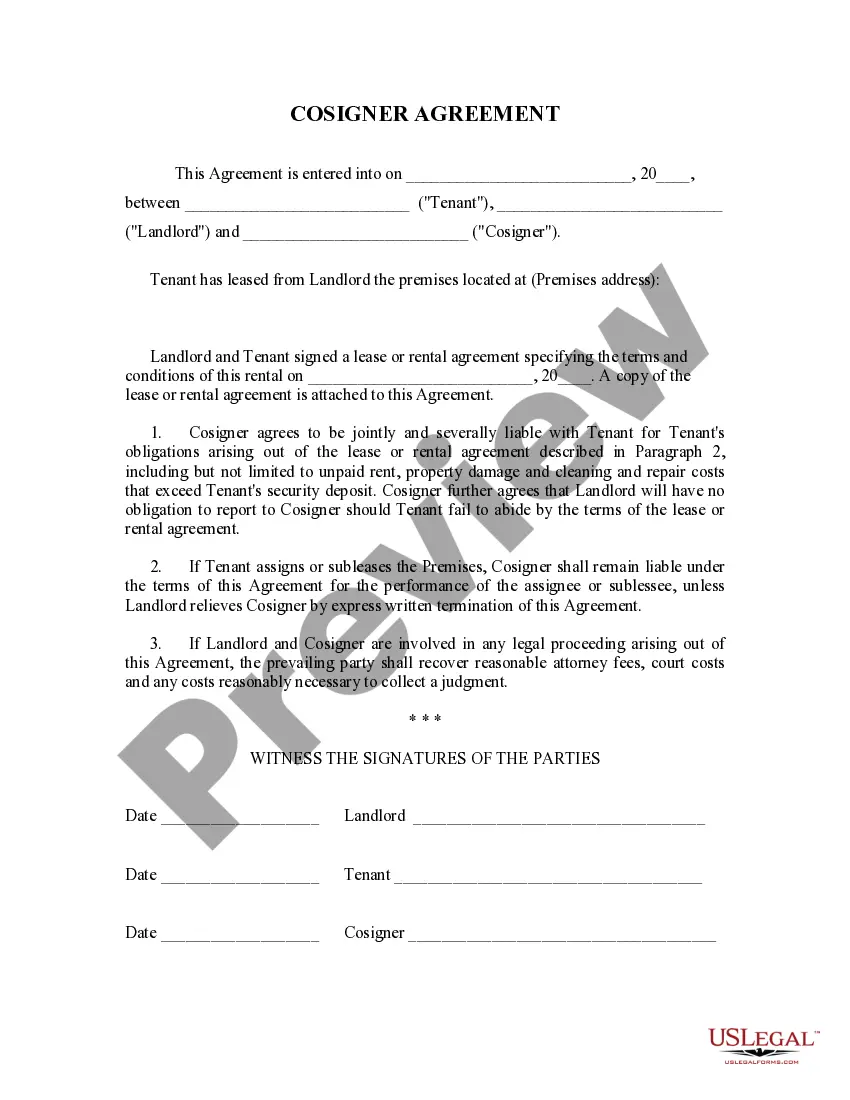
The Landlord Tenant Lease Co-Signer Agreement is a legal document that establishes a co-signer's responsibility for rent and damages if the primary tenant fails to meet their obligations under the lease. This agreement ensures the landlord has an additional layer of security when renting a property, as it makes the co-signer (sometimes referred to as a guarantor) legally liable. Unlike a standard lease agreement, this form specifically outlines the co-signer's role and responsibilities, distinguishing it from similar agreements that do not include a co-signer clause.
This form is typically used when a tenant is unable to meet the financial requirements set by a landlord, such as insufficient income or credit issues. By having a co-signer, landlords can mitigate the risk of non-payment. It is also beneficial in situations where a tenant is renting for the first time and may lack a rental history. Furthermore, this agreement may be necessary when the tenant's financial circumstances change, making co-signing a prudent option to secure the lease.
Notarization is not commonly needed for this form. However, certain documents or local rules may make it necessary. Our notarization service, powered by Notarize, allows you to finalize it securely online anytime, day or night.
Our built-in tools help you complete, sign, share, and store your documents in one place.
Make edits, fill in missing information, and update formatting in US Legal Forms—just like you would in MS Word.
Download a copy, print it, send it by email, or mail it via USPS—whatever works best for your next step.
Sign and collect signatures with our SignNow integration. Send to multiple recipients, set reminders, and more. Go Premium to unlock E-Sign.
If this form requires notarization, complete it online through a secure video call—no need to meet a notary in person or wait for an appointment.
We protect your documents and personal data by following strict security and privacy standards.

Make edits, fill in missing information, and update formatting in US Legal Forms—just like you would in MS Word.

Download a copy, print it, send it by email, or mail it via USPS—whatever works best for your next step.

Sign and collect signatures with our SignNow integration. Send to multiple recipients, set reminders, and more. Go Premium to unlock E-Sign.

If this form requires notarization, complete it online through a secure video call—no need to meet a notary in person or wait for an appointment.

We protect your documents and personal data by following strict security and privacy standards.
signer works on a lease by legally committing to cover the lease obligations if the tenant fails to do so. In a Minnesota Landlord Tenant Lease CoSigner Agreement, the cosigner signs the lease alongside the tenant, ensuring that they are responsible for rent payments and any damages. This arrangement benefits both parties; tenants gain access to rental options while cosigners provide additional financial security to landlords. Utilizing platforms like uslegalforms can simplify the process of drafting a cosigner agreement, ensuring it meets all legal requirements.
Filling out a lease agreement requires careful attention to detail. Begin by entering the names of the landlord, tenant, and any cosigner in the Minnesota Landlord Tenant Lease Co-Signer Agreement. Ensure that all terms, including rent amount, duration, and rules, are clearly stated. It’s beneficial to review the agreement with all parties to confirm understanding and agreement before signing.
Writing a lease with a cosigner involves including specific terms that detail the responsibilities of each party. Start by clearly identifying the tenant and the cosigner in the Minnesota Landlord Tenant Lease Co-Signer Agreement. Include provisions about payment responsibilities, liability for damages, and any conditions regarding the termination of the agreement. This clarity helps prevent misunderstandings and protects all parties involved.
Landlords may hesitate to accept cosigners for various reasons. Some landlords worry that the cosigner might not be financially reliable or may lack a good credit history. Additionally, they might prefer tenants who can meet their rental criteria independently, which minimizes risk. Using a Minnesota Landlord Tenant Lease Co-Signer Agreement can clarify the responsibilities of both the tenant and cosigner, making it a beneficial option.
To secure a co-signer for your lease, start by identifying a trustworthy individual who understands the responsibilities involved. This person should have a stable income and good credit history, as landlords often require these qualifications. Once you have a potential co-signer, both parties should review the Minnesota Landlord Tenant Lease Co-Signer Agreement to understand their obligations. Utilizing a platform like US Legal Forms can simplify this process by providing a clear and legally compliant agreement.
To include a co-signer on a lease, first discuss the arrangement with all parties to ensure mutual understanding and agreement. Next, add the co-signer’s information directly to the lease agreement, and ensure they sign the Minnesota Landlord Tenant Lease Co-Signer Agreement. This formalizes their commitment to the terms of the lease, providing clarity and security for the landlord. Utilizing resources from USLegalForms can streamline this process by offering customizable templates tailored for Minnesota laws.
To draft a lease agreement for tenants, start by outlining the terms of the rental arrangement, including the duration of the lease, rent amount, and payment methods. Incorporate details about security deposits, maintenance responsibilities, and rules regarding pets or guests. It’s important to include a Minnesota Landlord Tenant Lease Co-Signer Agreement if a co-signer is involved, ensuring all parties understand their obligations. Consider using platforms like USLegalForms to access templates that simplify the drafting process.