• US Legal Forms

Kentucky Letter from Landlord to Tenant as Notice of Default on Commercial Lease

State:
Kentucky
Control #:
KY-824LT
Format:
Word; 
Rich Text
Instant download

Overview of this form

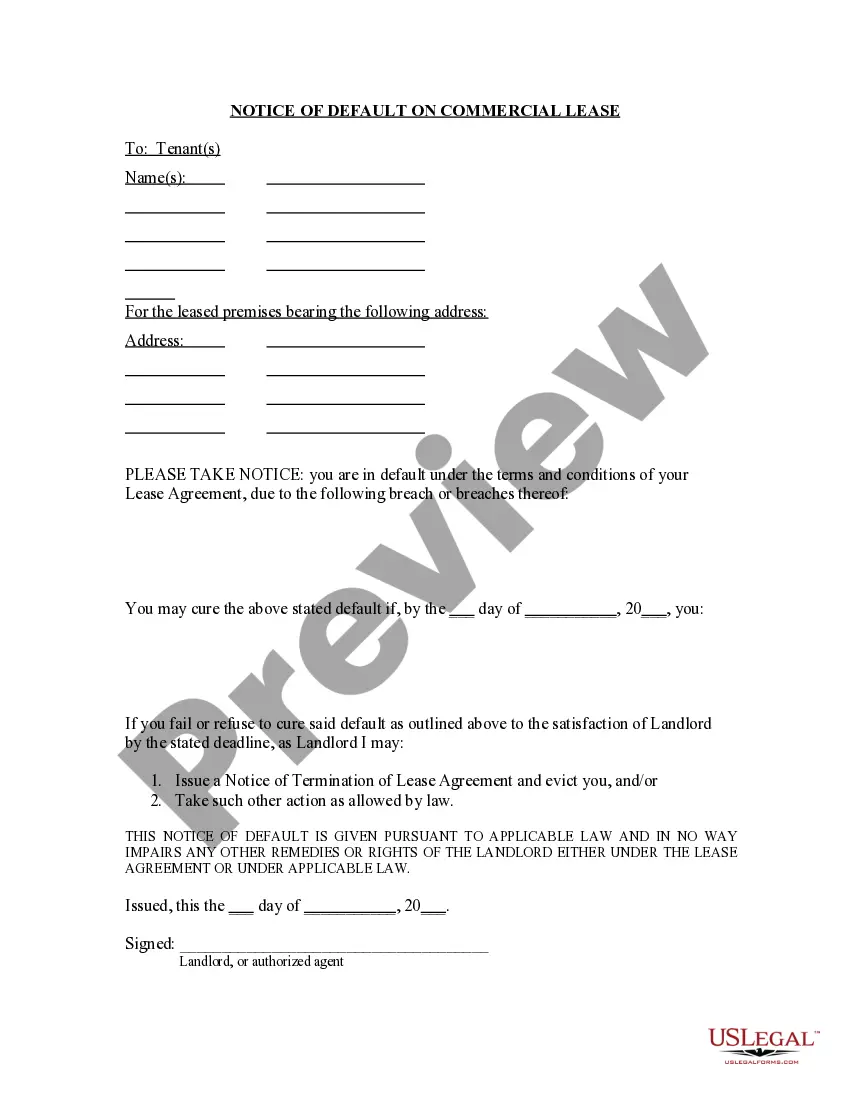
This form is a Letter from Landlord to Tenant as Notice of Default on a Commercial Lease. It serves as an official notification to the tenant regarding specific breaches of the lease agreement, including a deadline to rectify these breaches. Unlike other lease forms, this notice is critical before a landlord can pursue eviction or apply security deposits to cover unpaid obligations. It outlines the landlord's rights, providing clarity and legal standing in the event of tenant default.

Main sections of this form

  • Identification of the landlord and tenant involved in the lease agreement.
  • Detailed description of the specific breaches or defaults by the tenant.
  • A clear deadline for the tenant to cure the specified breaches.
  • A statement of the landlord's rights if the tenant fails to respond appropriately.
  • Signature section for the landlord or authorized agent.

Situations where this form applies

Who this form is for

  • Landlords of commercial properties looking to address tenant defaults.
  • Property management companies managing commercial leases.
  • Attorneys representing landlords in lease disputes.
  • Business owners renting commercial space needing to understand their rights and responsibilities.

Instructions for completing this form

  • Identify the parties: Clearly enter the names and contact information of both the landlord and tenant.
  • Specify the breaches: Detail the specific defaulting actions by the tenant, such as unpaid rent or lease violations.
  • Set a cure deadline: Indicate the date by which the tenant must remedy the breaches.
  • Include a statement of rights: State the landlord's rights if the breaches are not addressed.
  • Sign the form: The landlord or their authorized agent should sign and date the notice.

Does this document require notarization?

Notarization is not commonly needed for this form. However, certain documents or local rules may make it necessary. Our notarization service, powered by Notarize, allows you to finalize it securely online anytime, day or night.

Get your form ready online

Our built-in tools help you complete, sign, share, and store your documents in one place.

Built-in online Word editor

Make edits, fill in missing information, and update formatting in US Legal Forms—just like you would in MS Word.

Export easily

Download a copy, print it, send it by email, or mail it via USPS—whatever works best for your next step.

E-sign your document

Sign and collect signatures with our SignNow integration. Send to multiple recipients, set reminders, and more. Go Premium to unlock E-Sign.

Notarize online 24/7

If this form requires notarization, complete it online through a secure video call—no need to meet a notary in person or wait for an appointment.

Store your document securely

We protect your documents and personal data by following strict security and privacy standards.

Form selector

Make edits, fill in missing information, and update formatting in US Legal Forms—just like you would in MS Word.

Form selector

Download a copy, print it, send it by email, or mail it via USPS—whatever works best for your next step.

Form selector

Sign and collect signatures with our SignNow integration. Send to multiple recipients, set reminders, and more. Go Premium to unlock E-Sign.

Form selector

If this form requires notarization, complete it online through a secure video call—no need to meet a notary in person or wait for an appointment.

Form selector

We protect your documents and personal data by following strict security and privacy standards.

Common mistakes

  • Failing to specify the exact breaches, leading to ambiguity.
  • Not providing a reasonable cure deadline for the tenant.
  • Neglecting to sign the notice before delivering it to the tenant.
  • Using unclear language that complicates the tenant's understanding of their obligations.

Benefits of completing this form online

  • Convenience: Download the form anytime without a visit to a lawyer.
  • Editability: Customize the notice to your specific situation easily.
  • Reliability: Access a professionally drafted form to ensure compliance with legal standards.

Looking for another form?

This field is required
Virginia
Select state

Form popularity

FAQ

Default by landlord The most common form of landlord default is failure to provide services and maintain the property condition. When a landlord defaults on the terms of the lease, tenants may sue for damages.

To evict a tenant in California, a landlord must put his eviction notice in writing.If a landlord is evicting a tenant for a lease violation or to take control of the property, he must give the tenant 30-60 days notice.

In landlord-tenant law, default refers to the failure of a tenant to timely pay rent due.In general, the landlord is required to give the tenant notice of the default before bringing eviction proceedings or applying security deposit proceeds to the payment in default.

A break-early fee is a lump sum payment. The amount of the break-early fee will vary greatly depending upon the commercial tenant's specific circumstances. In exchange for the break-early fee, the landlord will agree to release the commercial tenant from all of its obligations under the commercial lease.

Protect your rental income. Even the most reliable tenants sometimes struggle to pay their rent.Tenant default insurance from Simply Business provides vital back-up for landlords it can cover your rental income if your tenant fails to pay rent.

For example, the lease may provide that in case of default, the landlord can recover late fees and interest. If the lease is a net lease, it may provide for the landlord to recover such things as property taxes, insurance, utilities, maintenance and repairs.

Tenant default occurs when a Tenant breaches one of the tenant's covenants in its lease. Tenant default can arise in a number of different ways but will typically be for one of the following: Non-payment of rent or other sums reserved under the lease.

Eviction. Action: Effective August 25, 2020 Governor Beshear replaced the state's eviction moratorium with a 30-day notice to vacate requirement. Housing providers will be allowed to initiate the eviction process but must serve a tenant with a 30-day notice to vacate.

Paying the remainder of the rent still owed on the lease in full; Paying a specified amount of liquidated damages as outlined in the contract terms; Paying an additional amount of punitive damages, dependent on local state laws; and/or.

Trusted and secure by over 3 million people of the world’s leading companies

Kentucky Letter from Landlord to Tenant as Notice of Default on Commercial Lease