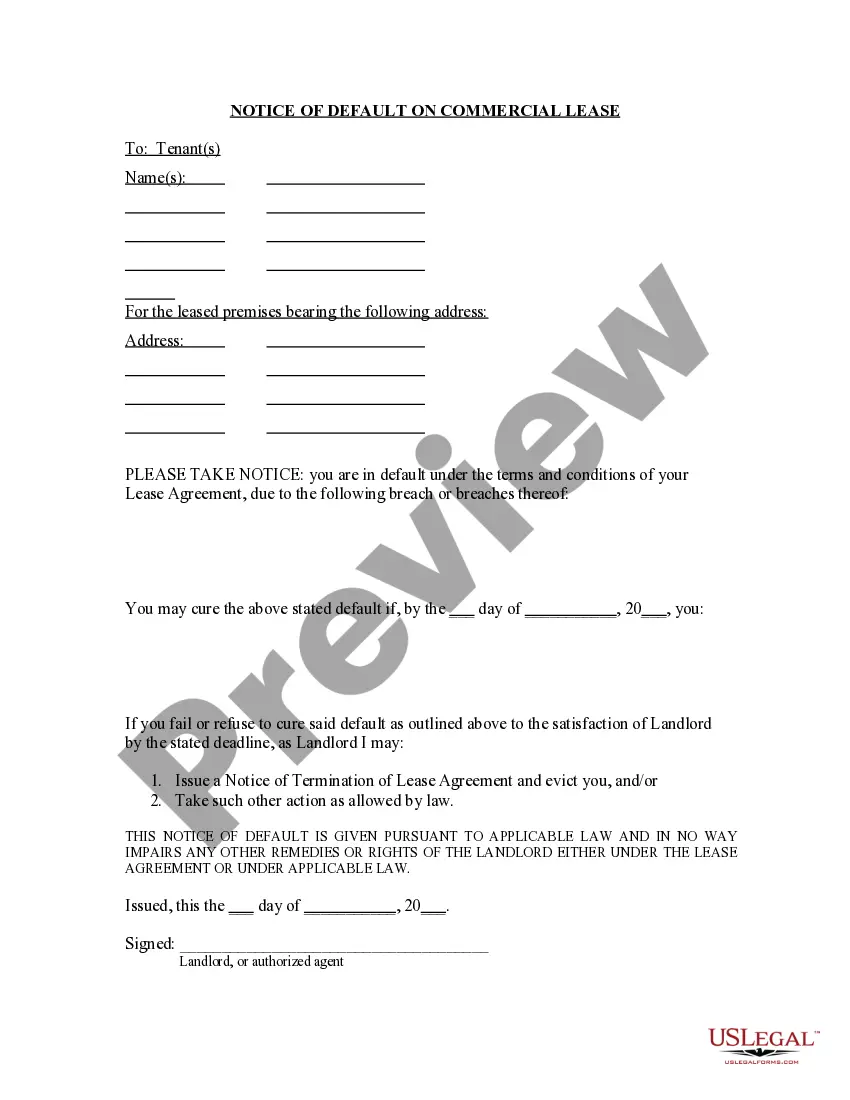
In landlord-tenant law, default refers to the failure of a tenant to timely pay rent due. In anticipation of such an occurence, landlords commonly require a new tenant to pay a security deposit, which may be used to remedy defaults in payment of rent and other monetary obligations under the rental agreement. In general, the landlord is required to give the tenant notice of the default before bringing eviction proceedings or applying security deposit proceeds to the payment in default. The fixing of a definite default date for payment of rent can be critical if it becomes necessary to evict a tenant for a default in the payment of rent. Landlords often require a background and/or reference check on prospective tenants in an attempt to minimize defaults in rent payments.
Kansas Landlord Tenant Lease Agreement
Description
How to fill out Kansas Letter From Landlord To Tenant As Notice Of Default On Commercial Lease?
Trying to find Kansas Letter from Landlord to Tenant as Notice of Default on Commercial Lease forms and completing them might be a problem. In order to save time, costs and energy, use US Legal Forms and choose the right template specifically for your state in just a few clicks. Our legal professionals draft all documents, so you just need to fill them out. It is really so easy.
Log in to your account and come back to the form's web page and save the document. Your downloaded examples are kept in My Forms and they are available always for further use later. If you haven’t subscribed yet, you have to register.
Look at our thorough guidelines regarding how to get the Kansas Letter from Landlord to Tenant as Notice of Default on Commercial Lease form in a few minutes:
- To get an entitled example, check its validity for your state.
- Check out the sample using the Preview option (if it’s accessible).
- If there's a description, go through it to learn the specifics.
- Click Buy Now if you identified what you're trying to find.
- Select your plan on the pricing page and create your account.
- Choose you wish to pay by way of a credit card or by PayPal.
- Download the sample in the favored format.
Now you can print out the Kansas Letter from Landlord to Tenant as Notice of Default on Commercial Lease template or fill it out utilizing any web-based editor. Don’t worry about making typos because your form can be employed and sent, and published as often as you wish. Check out US Legal Forms and get access to above 85,000 state-specific legal and tax documents.