Arkansas Transfer on Death Deed or TOD - Beneficiary Deed for Husband and Wife to Individual
Overview of this form
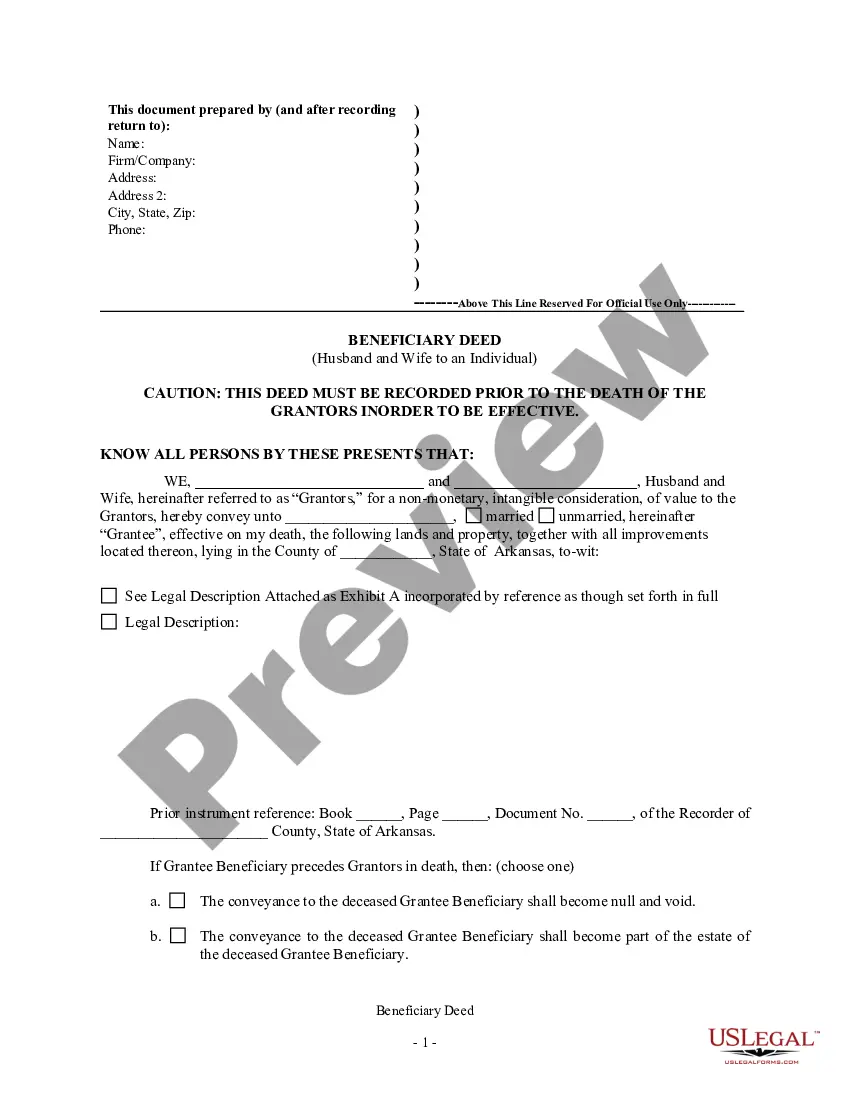
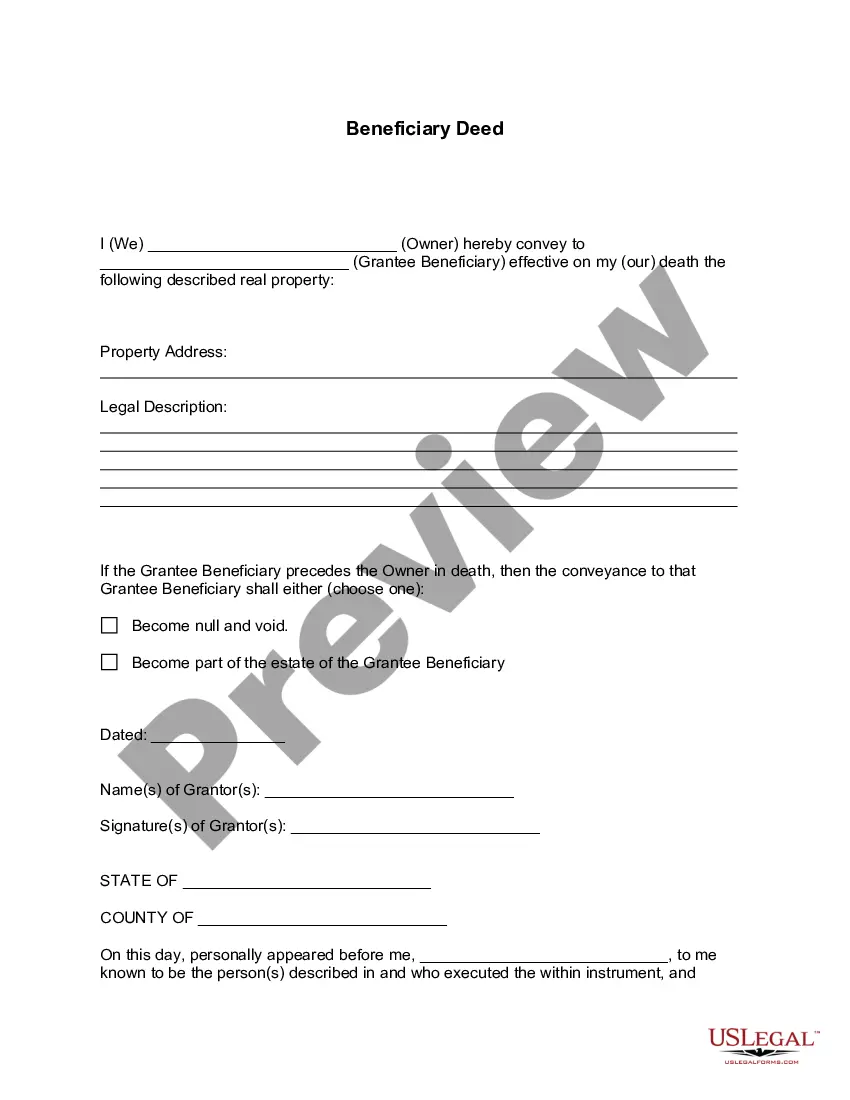
This Transfer on Death Deed, also known as a Beneficiary Deed, allows a married couple (husband and wife) to transfer their property to an individual beneficiary upon their death. Unlike other deeds, this form enables property ownership to pass to the grantee without going through probate, streamlining the estate settlement process. The transfer is revocable by the grantors during their lifetime and becomes effective only if filed before their deaths.
Form components explained
- Names of the grantors (husband and wife) and the grantee (beneficiary).
- Description of the property to be transferred including legal description.
- Conditions that nullify the transfer if the grantee does not survive the grantors.
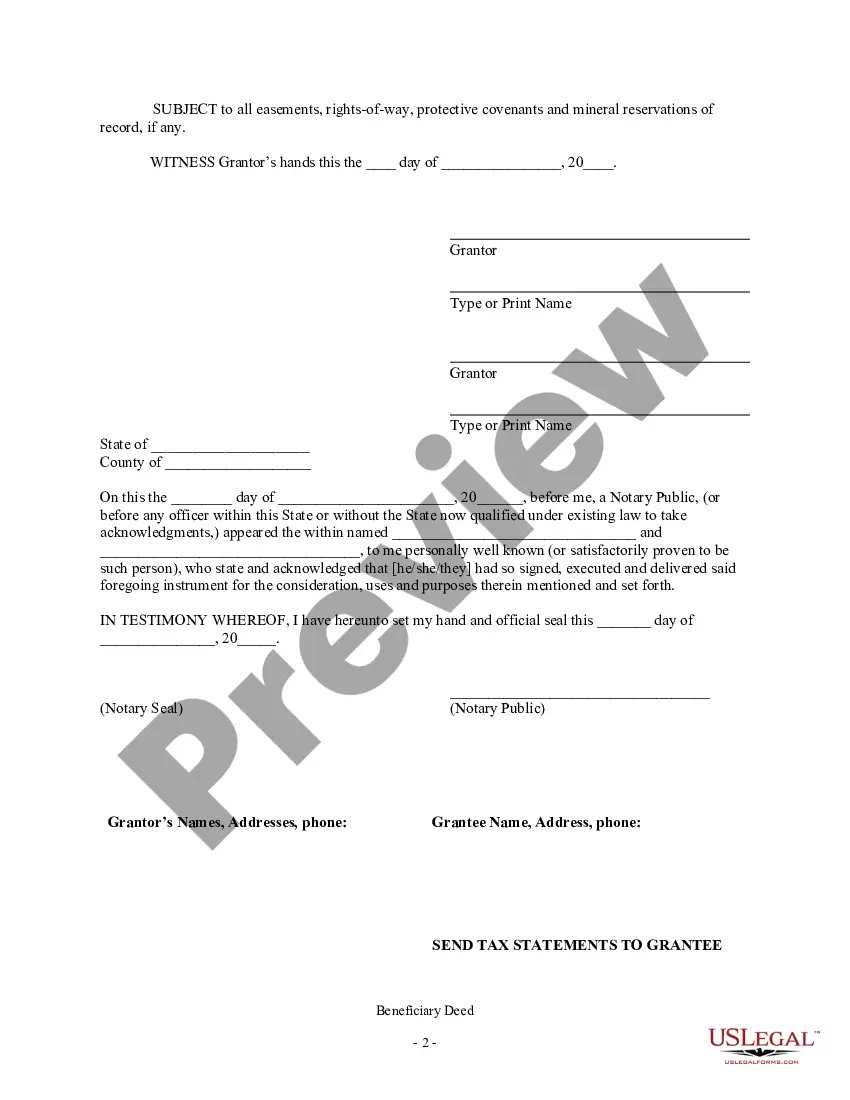
- Signature lines for the grantors and acknowledgment by a notary public.
- Revocation clause allowing grantors to change their minds before death.



When to use this document
This form is applicable when a married couple wishes to ensure that their real property passes directly to a designated beneficiary without being subjected to probate. It can be particularly relevant in scenarios such as estate planning, where minimizing delays and costs associated with the probate process is a priority. Additionally, it's useful for couples looking to provide for their loved ones efficiently.
Who can use this document
This form is intended for:
- Married couples wanting to transfer property to a specific individual upon their death.
- Individuals looking to simplify the estate settlement process for their heirs.
- Homeowners in states that recognize Transfer on Death Deeds.
Steps to complete this form
- Identify the full names of the husband and wife as grantors.
- Specify the name of the individual receiving the property (grantee).
- Provide a detailed legal description of the property being transferred.
- Enter the date and sign the form in the presence of a notary public.
- File the completed deed with the appropriate local government office before the death of the grantors.
Does this document require notarization?
To make this form legally binding, it must be notarized. Our online notarization service, powered by Notarize, lets you verify and sign documents remotely through an encrypted video session.
Get your form ready online
Our built-in tools help you complete, sign, share, and store your documents in one place.
Make edits, fill in missing information, and update formatting in US Legal Forms—just like you would in MS Word.
Download a copy, print it, send it by email, or mail it via USPS—whatever works best for your next step.
Sign and collect signatures with our SignNow integration. Send to multiple recipients, set reminders, and more. Go Premium to unlock E-Sign.
If this form requires notarization, complete it online through a secure video call—no need to meet a notary in person or wait for an appointment.
We protect your documents and personal data by following strict security and privacy standards.

Make edits, fill in missing information, and update formatting in US Legal Forms—just like you would in MS Word.

Download a copy, print it, send it by email, or mail it via USPS—whatever works best for your next step.

Sign and collect signatures with our SignNow integration. Send to multiple recipients, set reminders, and more. Go Premium to unlock E-Sign.

If this form requires notarization, complete it online through a secure video call—no need to meet a notary in person or wait for an appointment.

We protect your documents and personal data by following strict security and privacy standards.
Avoid these common issues
- Failing to complete the legal property description accurately.
- Not having the form notarized, which is essential for validity.
- Neglecting to file the deed before the death of the grantors.
- Forgetting to specify alternative beneficiaries in case the primary grantee does not survive.
Advantages of online completion
- Convenient access to legal forms from anywhere, at any time.
- Easy to complete and edit fields digitally.
- Forms are prepared in compliance with state-specific laws.
- Secure and reliable for personal legal documentation.
Legal use & context
- This form facilitates the transfer of property, bypassing probate proceedings, which can save time and resources.
- Deeds must be filed with the appropriate local authorities to be effective.
- To ensure enforceability, the form must meet state-specific legal requirements.
What to keep in mind
- The Transfer on Death Deed is a practical tool for married couples in estate planning.
- This document ensures designated beneficiaries receive property without undergoing probate.
- Proper completion and notarization are critical for the deed's validity.
Looking for another form?


Form popularity
FAQ
Yes, Arkansas does allow a transfer-on-death deed. This legal option enables property owners to transfer their property directly to designated beneficiaries upon their death without the need for probate. It simplifies the inheritance process for beneficiaries, making it an attractive choice for many individuals.
A beneficiary deed, such as the Arkansas Transfer on Death Deed or TOD - Beneficiary Deed for Husband and Wife to Individual, may help defer capital gains tax until the property is sold. When the beneficiary inherits the property, they receive a 'step-up' in basis, which can significantly reduce taxable gains when selling. However, it's advisable to consult a tax professional to understand the implications fully.
Yes, an Arkansas Transfer on Death Deed or TOD is often referred to as a beneficiary deed. This legal instrument allows property owners to designate beneficiaries who will inherit their property upon their death, avoiding probate. Both terms describe the same concept and serve the same purpose in estate planning.
While an Arkansas Transfer on Death Deed or TOD - Beneficiary Deed for Husband and Wife to Individual offers a simple transfer of property upon death, it may not provide the same level of protection as a trust. Trusts can manage complex assets and offer more comprehensive control over inheritance. Ultimately, the best choice depends on your specific needs and circumstances.
Being a beneficiary has advantages, but there are potential downsides. For instance, a beneficiary may inherit the property but also assume certain responsibilities, such as maintenance and taxes. Moreover, if the original owner incurs debt before passing, a creditor may pursue the inherited property. Therefore, understanding the implications is essential.
You do not necessarily need a lawyer to create an Arkansas Transfer on Death Deed or TOD - Beneficiary Deed for Husband and Wife to Individual. However, consulting with a lawyer can help ensure that your deed meets all legal requirements and is properly executed. Having professional guidance can also help you navigate potential complexities, especially if your estate has unique circumstances.
An Arkansas Transfer on Death Deed or TOD - Beneficiary Deed for Husband and Wife to Individual is not proof of ownership until it is recorded with the county clerk's office. This recording serves as legal evidence of the beneficiaries’ rights upon the owner’s death. Therefore, it is vital to properly file the deed to secure these rights.
To write an effective Arkansas Transfer on Death Deed or TOD - Beneficiary Deed for Husband and Wife to Individual, start with the proper legal form, which must include the property description and beneficiaries' names. Ensure that both spouses sign the deed in front of a notary public. After signing, you must file the deed with the county clerk’s office to finalize the process.
You do not necessarily need a lawyer to create an Arkansas Transfer on Death Deed or TOD - Beneficiary Deed for Husband and Wife to Individual, but working with one can simplify the process. An attorney can help ensure the deed is correctly filled out and meet all Arkansas laws. They also provide helpful advice, especially for unique situations.
An Arkansas Transfer on Death Deed or TOD - Beneficiary Deed for Husband and Wife to Individual generally overrides a will when it comes to the specific property covered by the deed. This means that if there is a conflict between the will and the deed, the beneficiary deed takes precedence. Understanding this hierarchy is crucial for effective estate planning.