Loading
Form preview
  • US Legal Forms
  • Other Templates
  • Miscellaneous Forms
  • Multi-State Miscellaneous Forms
  • Regent Biology Review 4: Reproduction

Get Regent Biology Review 4: Reproduction

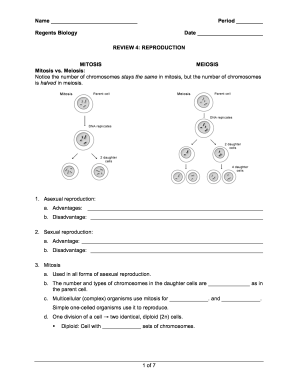
Here the baby will leave the body. 2 of 7 Name _____________________________ Regents Biology 7. Development a. Fertilization occurs in the __________________________________________________ .  A fertilized egg is called a ____________________  Fertilization restores the complete set of chromosomes, so the zygote is diploid (23 from the egg + 23 from the sperm = 46). Fertilization restores the correct number of chromosomes. b. A zygote develops in the following order:  Cleavage.

How it works

  1. Open form

    Open form follow the instructions

  2. Easily sign form

    Easily sign the form with your finger

  3. Share form

    Send filled & signed form or save

How to fill out the Regent Biology Review 4: Reproduction online

This guide provides a detailed and user-friendly approach for completing the Regent Biology Review 4: Reproduction online. Whether you are new to biology or looking to refine your knowledge, these instructions will help ensure your success in filling out the form accurately and effectively.

Follow the steps to complete the form accurately.

  1. Press the 'Get Form' button to access the document. This will allow you to open the Regent Biology Review 4: Reproduction in an online editor for completion.
  2. Begin by entering your name in the designated field at the top of the form. This personalizes your review and helps in identifying your submission.
  3. Next, indicate your class period in the appropriate box. Accurate class identification is essential for organizational purposes.
  4. On the 'Date' line, write the current date. This helps keep track of when the review was completed.
  5. Proceed to the sections on asexual and sexual reproduction. For each advantage and disadvantage, provide thoughtful and thorough responses in the blank spaces allocated.
  6. In the section on mitosis and meiosis, fill in the answers based on your understanding. Be clear and precise in stating facts about each process.
  7. Complete the questions pertaining to the male and female reproductive systems by filling in the processes and definitions where prompted.
  8. For the development section, answer each question thoughtfully, ensuring to cover all parts, especially the explanations of fertilization and related processes.
  9. Label the diagrams provided with the correct terms based on your knowledge of human reproductive systems.
  10. Review your completed form for clarity and accuracy before finalizing.
  11. Finally, save your changes, download, print, or share the filled document as needed to complete the submission process.

Complete your Regent Biology Review 4: Reproduction online today!

Get form

Experience a faster way to fill out and sign forms on the web. Access the most extensive library of templates available.
Get form

Related content

topic-4-reproduction-and-development-review-questions...
Sexual reproduction involves the combination of genetic material from two parents...
Learn more
Life Science: Biology Regents Exam Review Sessions...
Attention all faculty and students! Yearbook Portrait Photos are in the Auditorium from...
Learn more
The State of the Colorado River Ecosystem in Grand...
by S Links — Scientists are responsible for developing relevant information, and river...
Learn more

Related links form

Ub106a Lillytruassist Application Epilepsy Risk Assessment Template OPM 71 Technician Leave Form - Fire Ak Blm

Questions & Answers

Get answers to your most pressing questions about US Legal Forms API.

Contact support

Cell reproduction involves four critical stages: prophase, metaphase, anaphase, and telophase. These stages describe the process of mitosis, where a single cell divides to produce two identical cells. Prophase initiates the process, while metaphase ensures proper alignment of chromosomes. Anaphase helps separate these chromosomes, and finally, telophase completes the division, a concept key to understanding cell multiplication in the Regent Biology Review 4: Reproduction.

The four steps of reproduction encompass gamete formation, fertilization, embryonic development, and delivery of the offspring. First, organisms produce gametes, which then meet during fertilization. Afterward, the embryo develops within the mother or in the environment, depending on the species. This cycle is thoroughly discussed in the Regent Biology Review 4: Reproduction, emphasizing the importance of each step.

In the context of the Regent Biology Review 4: Reproduction, reproduction refers to the biological process through which new individual organisms are produced. This essential process ensures the continuation of a species, either through sexual or asexual means. Additionally, understanding reproduction can provide insights into broader biological systems and life cycles.

Plant reproduction typically involves four key steps: pollination, fertilization, seed formation, and seed dispersal. First, pollination allows pollen to transfer to the stigma of a flower. Then, fertilization occurs when the sperm from the pollen merges with the ovule. Subsequently, seeds form, and lastly, they disperse to new locations, continuing the cycle highlighted in the Regent Biology Review 4: Reproduction.

In the context of the Regent Biology Review 4: Reproduction, the four methods of reproduction are sexual reproduction, asexual reproduction, binary fission, and budding. Sexual reproduction involves the combination of genetic material from two parents, whereas asexual reproduction occurs without such merging. Binary fission is a simple division process seen in single-celled organisms. Budding occurs when a new individual develops from an outgrowth of the parent.

The four stages of reproduction involve sexual reproduction, asexual reproduction, embryo development, and maturation. In sexual reproduction, gametes combine to create genetic diversity. Asexual reproduction produces clones of the parent organism, while embryo development leads to the formation of new organisms. Finally, maturation is the stage where the organism grows to reproductive age, which is a key focus in the Regent Biology Review 4: Reproduction.

Reproduction in biology refers to the biological processes that result in the production of new organisms. This concept encompasses both sexual and asexual methods, detailing how organisms perpetuate their species. Taking notes on reproduction can help solidify your understanding, especially when you study the Regent Biology Review 4: Reproduction and explore various reproductive strategies.

Reproduction requires several key components, including viable gametes, suitable environmental conditions, and a mechanism for fertilization. Viable gametes are necessary for sexual reproduction to occur, while a suitable environment provides the necessary nutrients and conditions for the development of offspring. Knowing these requirements can be crucial for students engaging with the Regent Biology Review 4: Reproduction.

Humans reproduce through a process called sexual reproduction, which typically involves the fusion of male and female gametes. The Regent Biology Review 4: Reproduction provides a comprehensive overview of human reproductive anatomy and the stages of development from conception to birth. This knowledge is crucial for understanding human biology, health, and growth.

To reproduce in biology means to initiate the process of producing new individuals from existing ones. In the context of Regent Biology Review 4: Reproduction, this can include different strategies such as viviparity, oviparity, or budding. Understanding how diverse species reproduce helps illustrate the complexity of life.

Get This Form Now!

Use professional pre-built templates to fill in and sign documents online faster. Get access to thousands of forms.
Get form
If you believe that this page should be taken down, please follow our DMCA take down processhere.
Get Regent Biology Review 4: Reproduction
Get form
  • Adoption
  • Bankruptcy
  • Contractors
  • Divorce
  • Home Sales
  • Employment
  • Identity Theft
  • Incorporation
  • Landlord Tenant
  • Living Trust
  • Name Change
  • Personal Planning
  • Small Business
  • Wills & Estates
  • Packages A-Z
  • Affidavits
  • Bankruptcy
  • Bill of Sale
  • Corporate - LLC
  • Divorce
  • Employment
  • Identity Theft
  • Internet Technology
  • Landlord Tenant
  • Living Wills
  • Name Change
  • Power of Attorney
  • Real Estate
  • Small Estates
  • Wills
  • All Forms
  • Forms A-Z
  • Other Templates
  • Legal Hub
  • About Us
  • Help Portal
  • Legal Resources
  • Blog
  • Affiliates
  • Contact Us
  • Delete My Account
  • Site Map
  • Industries
  • Forms in Spanish
  • Localized Forms
  • State-specific Forms
  • Forms Kit
  • Real Estate Handbook
  • All Guides
  • Notarize
  • Incorporation services
  • For Consumers
  • For Small Business
  • For Attorneys
  • USLegal
  • FormsPass
  • pdfFiller
  • signNow
  • altaFlow
  • DocHub
  • Instapage
Form Packages
  • Adoption
  • Bankruptcy
  • Contractors
  • Divorce
  • Home Sales
  • Employment
  • Identity Theft
  • Incorporation
  • Landlord Tenant
  • Living Trust
  • Name Change
  • Personal Planning
  • Small Business
  • Wills & Estates
  • Packages A-Z
Form Categories
  • Affidavits
  • Bankruptcy
  • Bill of Sale
  • Corporate - LLC
  • Divorce
  • Employment
  • Identity Theft
  • Internet Technology
  • Landlord Tenant
  • Living Wills
  • Name Change
  • Power of Attorney
  • Real Estate
  • Small Estates
  • Wills
  • All Forms
  • Forms A-Z
  • Other Templates
Customer Service
  • Legal Hub
  • About Us
  • Help Portal
  • Legal Resources
  • Blog
  • Affiliates
  • Contact Us
  • Delete My Account
  • Site Map
  • Industries
  • Forms in Spanish
  • Localized Forms
  • State-specific Forms
  • Forms Kit
Legal Guides
  • Real Estate Handbook
  • All Guides
Prepared for you
  • Notarize
  • Incorporation services
Our Customers
  • For Consumers
  • For Small Business
  • For Attorneys
Our Sites
  • USLegal
  • FormsPass
  • pdfFiller
  • signNow
  • altaFlow
  • DocHub
  • Instapage
Social Media
Call us now toll free:
+1 833 426 79 33
As seen in:
© Copyright 1999-2026 airSlate Legal Forms, Inc. 17 Station Street, Ste. 203, Brookline, MA 02445
  • Your Privacy Choices
  • Terms of Service
  • Privacy Notice
  • Content Takedown Policy
  • Bug Bounty Program